Welcome to the world of model railroading, where turnouts are as busy as politicians. They decide if your train is a hero or a victim of derailment.
Turnouts are like traffic cops, guiding trains between tracks. They work with signals to keep things running smoothly. It’s all about precision, showing who’s a pro and who’s not.
Understanding turnouts is key, whether you’re building tracks or just learning. They’re not just pieces of metal; they decide your train’s path at every turn.
Forum talks show the complexity of turnout wiring and LED indicators. The right build can make your railroad reliable. It’s where engineering meets art.
Let’s see how these mechanical wonders work. We’ll learn why proper operation is vital for avoiding track problems.
Safety: soldering or no‑solder alternatives, low‑voltage only
Ever tried to rewire a lamp after watching a YouTube video? Let’s avoid that mess on your model railroad. This is your safety briefing, like TSA for your model railroad, but less annoying.
Low-voltage is key to avoiding melted plastic and regret. Most model railroads run at 12-16 volts. This might seem safe, but it can cause problems if not handled right.
The soldering debate is like arguing over Mac vs PC. Soldering is better for its conductivity and durability but needs skill. No-solder options like terminal blocks are easier for beginners, but might not last as long.
Resistors are not just extras. They’re essential for keeping LEDs working. Guessing resistor values is risky, like playing Russian roulette.
Forum discussions highlight three key safety points:
- Always use Ohm’s law to calculate resistor values – don’t guess
- Choose stranded wire for its flexibility and resistance to vibration
- Use fuses to protect your power supply lines
Good wiring is critical. Loose connections can cause heat, which is bad. Whether you solder or use other methods, connections must be secure.
For those new to soldering, our guide on proper techniques can help. The goal is to use the right temperature, enough flux, and just the right amount of solder for a solid connection.
Your low-voltage system needs respect. Short circuits can damage even at 12 volts. Always check your wiring before turning on power and keep a fire extinguisher ready.
Good safety practices don’t limit your creativity. They help your layout last longer. Now, wire safely – your future self and insurance will appreciate it.
Materials & Templates
Choosing materials for a turnout project is like picking a presidential cabinet. Each part must fit perfectly or the whole thing fails. It’s not just shopping; it’s about making strategic choices with big consequences.
Your list looks like a big bill for building something. You need rails that fit together just right, ties that hold everything together, and a switch stand that decides where your project goes. Forget about finding common ground; here, loyalty is key.
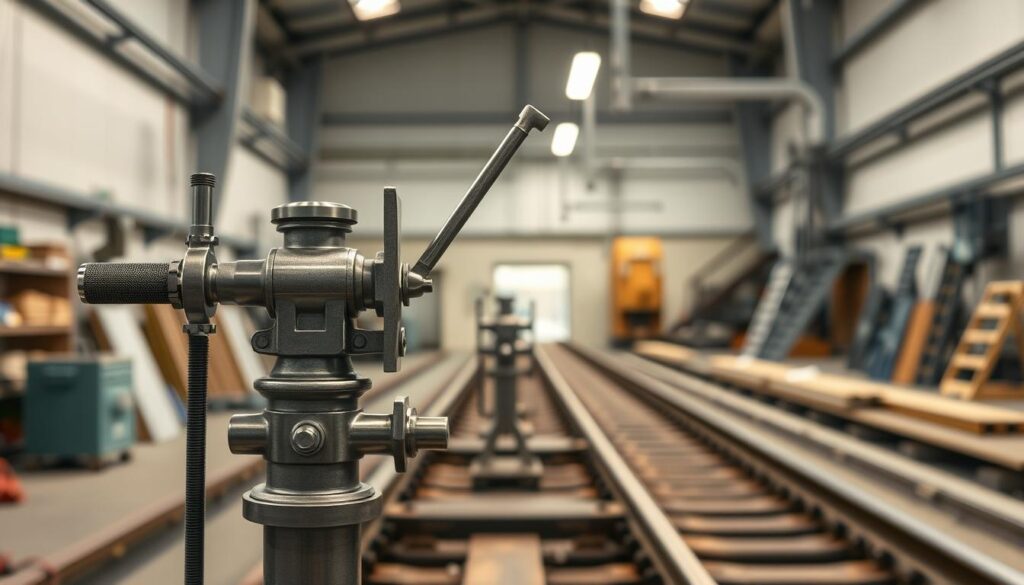
Choosing a brand is as important as picking a political party. Tortoise motors are slow but reliable, like a steady hand. Caboose Industries makes parts that are as dependable as a seasoned politician.
| Brand | Key Components | Specialty | Political Equivalent |
|---|---|---|---|
| Tortoise | Slow-motion motors, switch machines | Precision movement | Seasoned bureaucrat |
| Caboose Industries | Ground throws, switch stands | Manual control systems | Grassroots organizer |
| Peco | Complete turnout systems, frogs | Ready-to-go solutions | Political machine |
| Micro Engineering | Track components, detail parts | Scale authenticity | Policy wonk |
The switch stand is like your turnout’s campaign manager. It controls everything with authority. Without the right parts, your turnout is like a failed government.
Peco offers complete systems that work right away. They’re great for those who like established plans over starting from scratch.
Templates are like the rules for building your turnout. They help you avoid mistakes and make sure everything works well together. A good template keeps your turnout from looking like a mess.
In turnout building and politics, the quality of your materials matters a lot. They can make your project work well or fail. Choose carefully, because these parts will last a long time.
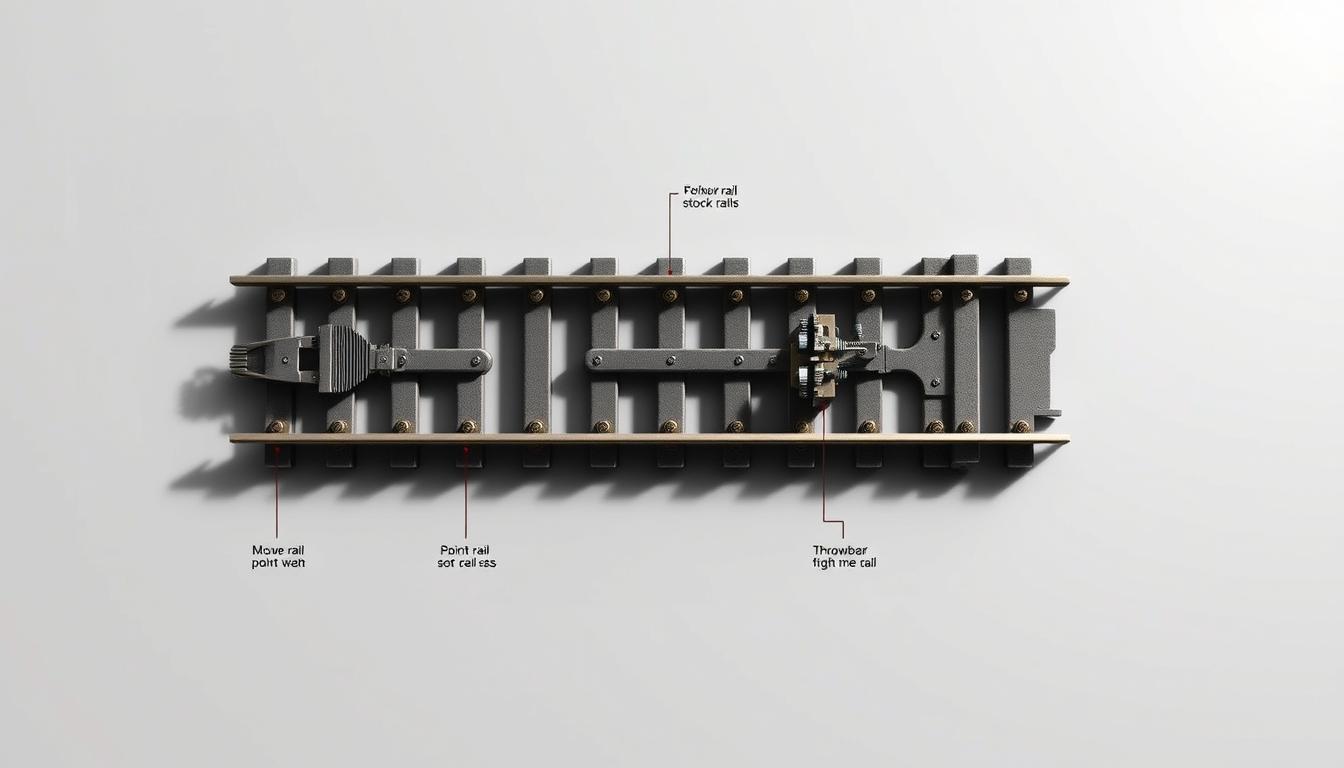
Build Steps: base • stock rails • points • frog • guard rails • lever/servo
Building a manual turnout is like starting a political campaign from scratch. Each part must work together like a well-oiled machine. But it also needs to be flexible for unexpected challenges. We’re using low-voltage solutions and mechanical genius, not high-voltage drama.
Imagine putting together your dream cabinet. The base is the foundation. Stock rails are the establishment politicians. Points are the flip-flopping representatives. The frog is the bipartisan compromise that can either work beautifully or fail spectacularly.
Building Your Political Foundation
The base is your administration’s foundation. Start with a solid template. Use quality materials that won’t bend under pressure. Forum experts recommend precision-cut wood or durable plastics.
Stock Rails: The Establishment
Your stock rails are the party elders. They provide stability and direction. Install them with confidence, ensuring perfect alignment. Even a small deviation can cause problems.
Points: The Flip-Floppers
The points are where things get interesting. These movable rails change direction like politicians during election season. Piano wire mechanisms offer reliable movement without electrical issues. Micro switches provide feedback, knowing the points’ direction at all times.
Frog: The Bipartisan Compromise
The frog is where opposing tracks meet. It requires precise work. Get it wrong, and you’ll face many derailments. File carefully, test often, and aim for perfection to avoid future headaches.
Guard Rails: The Security Detail
Guard rails prevent major mistakes. They keep wheels on track through the frog area. Position them to guide without causing friction.
Lever/Servo: The Puppet Master
The control mechanism is your campaign manager. Choose a manual lever or servo motor. Manual levers offer tactile satisfaction, while servos provide precise digital control.
Forum discussions show debates on both approaches. Piano wire mechanisms with micro switches create mechanical solutions. The key is reliability—your control system must work every time.
Assembly needs patience, like a Supreme Court justice deliberating. Test each part as you build. Check alignments and clearances. This is careful craftsmanship that will make your political machine run smoothly or crash.
Signal Circuit: simple logic with microcontroller or switch + LEDs
Welcome to the electronics department, where we turn simple parts into systems that impress. It’s not just about lights; it’s about clear communication in rail traffic.
Model railroading debates often focus on whether to use a microprocessor or a simple switch. Both methods can make LED signals that guide trains well.
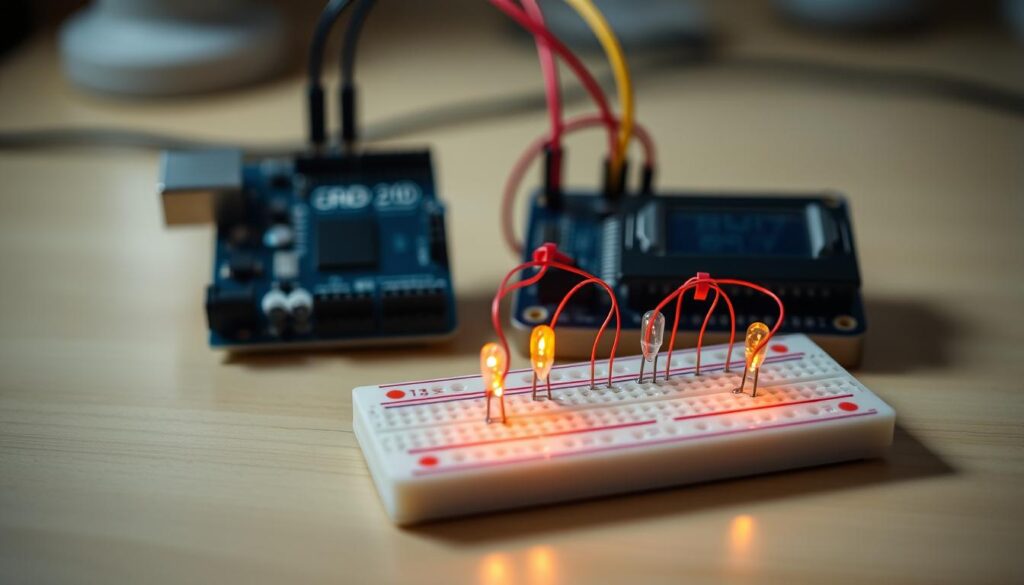
Switch-controlled signals start with basic switches or buttons. It’s like a town hall meeting—clear and straightforward.
Switch systems are simple. You can use bi-color LEDs with a double-pole double-throw switch. No need for complex programming.
Microcontrollers, like the Arduino, offer more. They can handle many signals and even respond to train detection systems.
The 555 timer is like a seasoned politician. It creates blinking signals and patterns with just a few parts. It’s reliable and never needs updates.
| Approach | Complexity | Flexibility | Cost | Best For |
|---|---|---|---|---|
| Switch + LEDs | Low | Basic | $10-20 | Simple layouts |
| 555 Timer | Medium | Moderate | $15-30 | Blinking signals |
| Arduino | High | Maximum | $25-50 | Complex systems |
When wiring bi-color LEDs, pay attention to polarity and current. Use resistors to protect your LEDs.
Microcontrollers let you create complex signaling logic. You can program signals to change only when tracks are clear. It’s like teaching signals to think before acting.
Switches offer immediate feedback and satisfaction. There’s joy in flipping a switch and seeing a signal change.
Test your circuits well before installing them. Check voltage, LED brightness, and switching reliability. Your signals must work every time.
Your choice between microcontrollers and switches depends on your preference and layout complexity. Both can improve your model railroad’s operation and look.
Testing: wheel flange clearance, electrical continuity, sightlines
Welcome to the fact-checking department of your model railroad operation. This is where optimism meets reality. Here, your turnout will either prove reliable or show its true colors.
This phase is like debate prep for your layout. We’re not admiring our work here. We’re looking for weaknesses until we find them or until everything checks out.
First, we test wheel flange clearance. It’s not about giving trains space. It’s about avoiding track jams.
Run your most finicky train through slowly. Watch how the flanges interact with everything. Any hesitation or scraping means your turnout is trying to tell you something.
Next, we check electrical continuity. This is where we see if your turnout really works. If electrical connections are bad, you’ve got issues.
Use a multimeter to test connections. Make sure power flows well through each route. Your turnout should make contact without any trouble.
Lastly, we look at sightlines. Can you see what’s happening? If your turnout is hidden, you’re trusting promises without checking.
Test from your usual spot. Can you see which route is chosen? Does the indicator work from there? If not, you’re in for surprises.
Remember, thorough testing now prevents big problems later. It’s the difference between a smooth operation and a mess.
User Guide: operations and maintenance
Running your turnout is like running a political campaign. It needs constant attention and strategic adjustments. You must accept that failures will happen at the worst times.
Daily operations are like giving speeches. They must be smooth, consistent, and convincing. In this case, your audience is your model trains.
When operating your turnout, act like a seasoned politician. Move the points smoothly and deliberately. Avoid jerky motions that could derail your plans.
Regular maintenance beats emergency repairs every time. Your weekly routine should include essential tasks. These include:
- Visual inspection for debris (the political equivalent of checking for scandals)
- Electrical contact cleaning (keeping your campaign finances transparent)
- Mechanical movement verification (ensuring your ground game is solid)
- Frog and guard rail alignment check (maintaining party unity)
If your turnout acts like a rookie congressman, you need a plan. First, check for physical obstructions. Then, verify electrical continuity. Lastly, assess mechanical wear points.
The most overlooked aspect of turnout maintenance? Seasonal adjustments. Temperature and humidity changes affect your layout more than polling numbers affect a campaign. Expand and contract your clearance checks with the seasons.
Forum discussions show that different turnout types need different care. Manual turnouts need more mechanical attention, while powered ones demand electrical vigilance. It’s like managing a grassroots campaign versus a super-PAC operation.
Remember: a well-maintained turnout operates smoother than a political operative spinning favorable polling data. Your reward isn’t electoral victory but something better – flawless operation and the satisfaction of a system that works exactly as intended.
Extensions: interlocking, block detection, sound cues
Your turnout and signal system is like a well-oiled machine. It’s time to take it to the next level. Think of these extensions as stepping up from local to national politics.
Interlocking systems are like political alliances. They prevent big failures. Signals and turnouts work together smoothly, like a party platform.
Setting up interlocking needs diplomacy skills. It’s like making treaties between track sections. This ensures they communicate well, like a bipartisan committee.
Block detection is like your intelligence network. It shows where trains are, like polling data shows where to focus. It’s about knowing where to be strategic.
Modern block detection uses advanced sensors. They track movement and provide real-time data. You’ll know your trains’ locations better than a campaign manager knows voters.
Sound cues add to the experience like political ads. They provide auditory feedback that makes everything more real and functional. Crossing bells and station announcements are the soundtrack to your operation.
These sounds do more than entertain. They share status information and warn of movements. They create atmosphere, like a rally with fireworks and music.
You can add these extensions gradually. Start with basic interlocking, then add block detection and sound cues. It’s like building a political movement, one step at a time.
Each addition makes your layout more advanced without causing problems. You’re creating elegant solutions that impress any systems engineer.
Reflection: systems engineering mindset
Building turnout systems is more than just rails and electricity. It’s about having a systems engineering mindset. This approach would impress even the most educated at MIT. Every part, from resistors to rails, is part of a complex system.
Your miniature railroad is like the real world’s systems. It’s not just about trains moving. It’s about understanding why they do.
This mindset turns a hobby into a deep intellectual journey. You start seeing patterns everywhere. The same logic that works on your layout applies to global systems. That’s the power of systems engineering.
Now, apply this thinking to more than just your layout. See how systems shape our world. You might solve big problems with the same elegant logic.
