
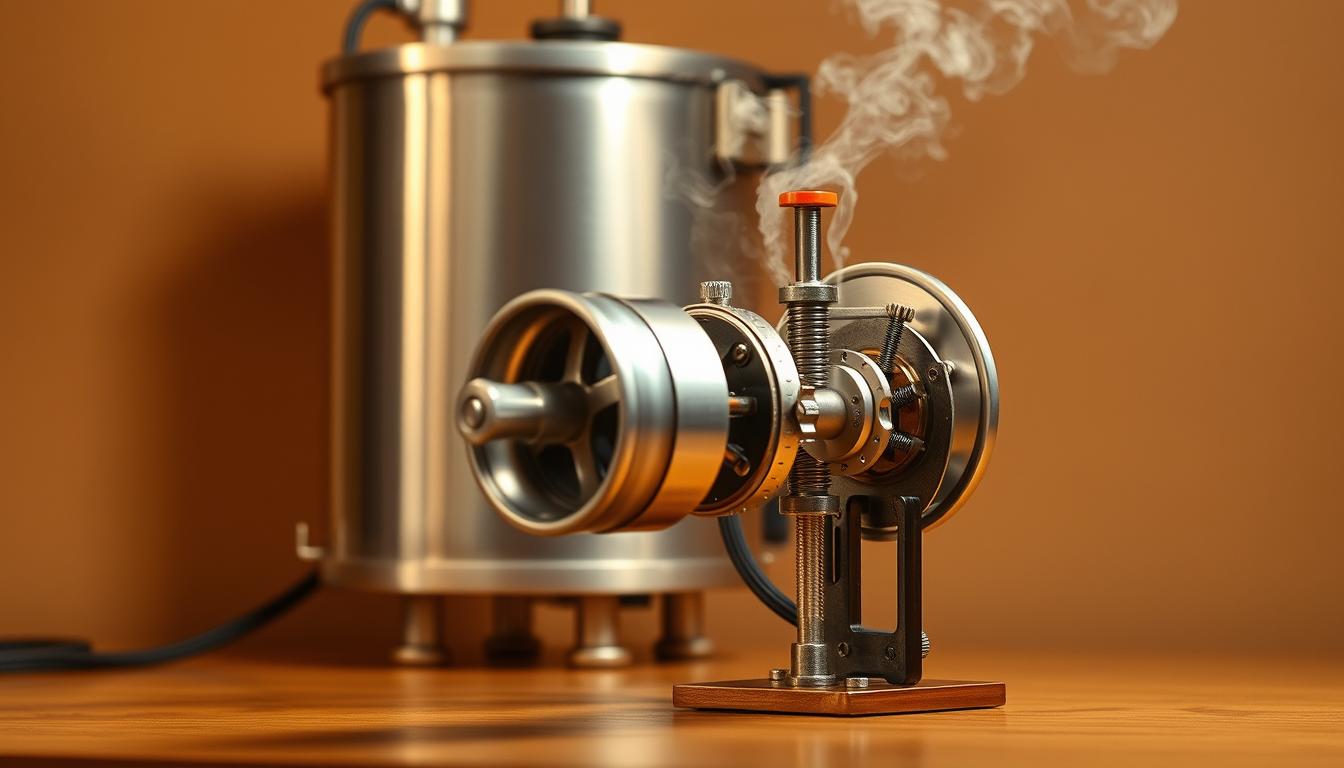
In ancient times, while the Romans expanded their empire, a Greek mathematician named Hero worked on something new. His aeolipile project from 62 AD was the first steam-powered device. It marked the start of our journey with reaction turbines.
Hero’s invention was both simple and inefficient. It had a spinning sphere on a kettle, with steam escaping through L-shaped tubes. This created a rotational force. It was a clever idea, but not very useful back then.
Imagine if ancient civilizations had focused more on engineering. We might have had steam-powered chariots long ago. But Hero’s work stayed a curiosity for nearly two thousand years.
The industrial revolution came much later, thanks to Britain’s need for coal and Newcomen’s engine. Yet, Hero’s idea was right on track in the first century.
Risk Assessment & Safety Setup: splash guard, goggles, hot plate not open flame, water only, clear perimeter
Safety is key, not just a hassle. It keeps us safe from boiling water and moving metal. Our hot plate demo turns water into energy, not a trip to the hospital.
Goggles are not just for looks. They protect us from steam and splashes. They make sure we watch science, not become part of it.
The splash guard keeps things exciting but safe. It lets us see the physics without getting wet. It’s like the bouncer at our steam party.
Choosing the right heat source is important. We use a hot plate, not open flames. This avoids the drama of aluminum cans and straws near flames. The hot plate’s even heat makes our demo educational, not sensational.
Water is the only liquid used here. This isn’t a mixology class or a chemistry experiment gone wrong. Other liquids add risks we can’t handle.
Keep a safe distance from the demo. Physics doesn’t care about your phone or coffee mug. When the can spins, it follows Newton’s laws, not your personal space.
Proper physical hazard assessment is key for any demo. What seems simple, like a hot plate demo, has many risks that need careful handling.
Every safety measure has a purpose in our demo. It’s not too much. It lets us learn about reaction turbines safely.
Materials & Tools: Your Junk Drawer Engineering Kit
Forget fancy lab equipment – our soda can turbine experiment shows genius in everyday objects. You’ll turn simple items into a powerful display of ancient engineering.
Let’s search the kitchen and garage for these parts:
- Aluminum soda can – Your combustion chamber awaits
- Straight pin – The minimalist pivot point
- Wire stand – Safety first, hot fingers last
- Bendable straws – Adjustable jet nozzles for precision
- Hot plate – Controlled heat, civilized science
The aluminum can is not just recyclable. It’s also conductive and light. That pin? It’s our low-friction bearing system, centuries of engineering in one sharp point.
Our bendable straws are special. Unlike Hero’s fixed tubes, we can adjust the jet angles. This is progress in a drinking straw.
The hot plate gives us consistent, measurable heat. No open flames needed. This makes collecting data easier and safer.
This mix of everyday items becomes magical when put together. Each part shows how physics has powered us for thousands of years.
Build Steps: create angled jets • suspend can • add water • position heat source
Turning everyday items into a steam turbine is a precise task. It’s like building something that would impress Hero of Alexandria. Let’s aim for perfection.
Crafting those critical straw jets is key to success. It’s not about making holes randomly. Place two holes opposite each other at the can’s base. The angle should be 15-20 degrees from horizontal.
Too steep and it’s a rocket. Too shallow and it’s a weak sputter. Get it just right.
Suspension science is all about balance. Hang the can from the top center with a wire. Make sure it’s perfectly level. Any tilt ruins the whole thing.
Water measurement is important. Fill the can with about a quarter of water. This amount creates steam without too much pressure.
Thermal positioning is like cooking a steak. Put the hot plate 2 inches below the can’s base. This spot is perfect for steam without any damage.
With everything done right, your turbine will spin smoothly. The straw jets will shoot out steam beautifully. It’s a true marvel of turning heat into motion.
Operation & Data: measure RPM with phone tachometer, time‑to‑spin, cooling curve
Welcome to the digital age of Hero’s engine. Your smartphone is now the ultimate scientific tool. No more guessing like the ancients. We’re turning this rotating steam can into a data treasure trove.
First, download a tachometer app. Your phone, once a social media tracker, now measures steam RPMs. It’s like giving Hero of Alexandria an iPhone – a mind-blowing mix of past and present.
When steam jets start, hit record. Watch as your rotating steam can turns into a whirling dervish. The app captures RPM data with precision Hero could only dream of.
But RPM is just the start. Time-to-spin shows thermal efficiency – how fast heat turns into motion. It’s like a drag race for steam engines. Start your timer when heat is applied, stop at first rotation.
Then, there’s the cooling curve – a reality check for thermodynamics. As your can spins, track temperature drop versus rotation decay. This data shows energy loss patterns that would impress Newton.
You’ll see interesting patterns:
- Optimal water volume for maximum spin duration
- Heat settings that balance safety and performance
- The sweet spot where jet angle meets rotational velocity
This isn’t just about making metal spin. It’s proving action-reaction principles that wouldn’t be stated for centuries after Hero’s design.
| Measurement Type | Tool Required | Data Insight | Historical Context |
|---|---|---|---|
| RPM | Phone Tachometer | Rotational velocity | Hero’s visual estimation |
| Time-to-Spin | Stopwatch | Thermal efficiency | 17th century Newtonian principles |
| Cooling Curve | Thermometer + Timer | Heat transfer rates | Modern thermodynamic analysis |
| Water Volume Effect | Graduated Cylinder | Energy capacity | Ancient trial and error |
Each experiment with your rotating steam can connects past and present. You’re not just collecting data – you’re carrying on a conversation that started in ancient Alexandria and continues today.
The numbers tell a story of energy transformation, efficiency limits, and mechanical optimization. Your rotating steam can is both a teaching tool and a historical bridge, linking past ingenuity with present analysis.
Science Deep Dive: torque, angular momentum, jet angle optimization
Watching a tin can spin wildly is fun, but understanding why it spins is even more magical. We’re about to explore the physics behind our aeolipile. It’s more exciting than your last Netflix show.
The can spins thanks to Newton’s third law. When steam shoots out, it pushes the can in the opposite direction. It’s a physics miracle.
Torque is the force that makes things spin, like Ferraris and fidget spinners. The angled jets create a force that makes the can rotate. It’s like the universe telling it to spin.
The jet angle optimization is key. If the jets are too straight, you get lots of thrust but not much spin. If they’re too angled, you get lots of spin but less thrust. Hero of Alexandria found the perfect balance.
Once the can starts spinning, angular momentum takes over. Objects in motion stay in motion, thanks to Newton’s first law. It keeps spinning until friction and steam pressure drop.
This problem is elegant:
- Steam velocity determines thrust magnitude
- Jet angle determines torque efficiency
- Can mass affects rotational inertia
- Heat input controls steam production rate
Hero solved this puzzle over 2,000 years ago without modern tools. He found the perfect balance of thrust, angle, and rotational force. It’s like finding the perfect Instagram filter, but with steam and physics.
So, the next time you see a spinning can, remember Newton’s laws at work. It’s thanks to ancient engineering genius. Not bad for some bent straws and a tin can, right?
Classroom Management: roles, timers, safety monitor
Managing a classroom steam experiment is like leading an orchestra. But, half the musicians are new to their instruments. The key is to prepare your students like a well-oiled machine before they start.

Assign roles with the precision of a NASA mission control. You’ll need:
- Materials Managers – The gatekeepers who prevent straws from becoming projectiles
- Assembly Specialists – Your precision engineers who actually read the instructions
- Data Recorders – The human spreadsheets documenting every glorious failure and success
- Safety Monitor – The designated worrier with permission to shout “STOP!” like a theatrical understudy
Timers are essential – they’re your lifeline. Without them, some groups might achieve nuclear fusion while others struggle. Set incremental checkpoints: “By 2:15, your can should be suspended. By 2:25, water should be added.”
The safety monitor role is critical. Rotate this position like a coveted parking spot. Everyone needs to develop that paranoid spidey-sense for disasters. It’s not just about preventing burns; it’s about situational awareness.
What’s the real payoff? You’re not just building miniature steam engines. You’re creating a collaborative science environment where success relies on teamwork. Plus, you’ll avoid “I did all the work” complaints.
The chaos of classroom steam experiments becomes manageable with defined roles. It turns chaos into a symphony of learning – with less screaming than a middle school band practice.
Variations: multi‑jet can, insulated vs uninsulated, airflow effects
Why settle for just two jets when you can make your aeolipile a waterworks? Adding more jets turns your can into a mechanical octopus. You can have four, six, or eight jets, depending on your drilling skills and the can’s strength.
But, more jets don’t always mean more spin. There’s a point where extra holes just leak more without adding thrust. It’s like too many chefs in the kitchen – they just get in the way.
The debate between insulated and uninsulated cans is for the true efficiency experts. Insulating your can with foil or fiberglass makes it more energy-efficient. This can make the spin last longer, sometimes even triple.
Uninsulated cans, on the other hand, burn hot but fast. They’re great for showing how heat escapes, but not for saving energy.
Airflow around the spinning can shows cool fluid dynamics. The vortex it creates is not just pretty; it’s a lesson in science. Try different straw sizes and angles to see how it affects the can’s spin.
This is when students start to think like real scientists. They’re not just following a recipe; they’re testing ideas. They might ask if a 45-degree angle is better than 30 degrees, or if insulation thickness is more important than the material.
Remember Schmidlap’s “step rocket” from the 16th century? It was more than just fireworks. It was about trying different things to find something new. Your classroom can have that same spirit of discovery.
The beauty of these variations is how simple they are. With the same materials, you can get very different results. It shows that sometimes, the best discoveries come from asking “what if we tried it this way?”
Assessment/Worksheet & Exit Ticket
Assessment shows who truly understands physics. It’s not about how well you built something. It’s about if you grasped Newton’s third law.
Our worksheet goes beyond just following steps. It asks why angled jets are important. It also asks what happens when steam meets resistance.
Good answers show they understand action-reaction pairs. They don’t just memorize steps.
Questions about energy transformation show who gets the big picture. They see how thermal energy turns into mechanical work. But they also know it’s not very efficient.
The exit ticket is very honest. My favorite question is: “Would this work better, worse, or the same in a vacuum chamber? Explain.” Answers vary from great to sad. Some think steam needs air to work. Others explain that reaction forces work without a medium.
Real-world application questions tell us who will be engineers. They ask where else reaction turbines are used. They also ask what makes them different from impulse turbines.
| Assessment Type | Measures | Common Misconceptions | Probing Questions |
|---|---|---|---|
| Worksheet | Conceptual understanding | Steam pushes against air | Why do angled jets increase torque? |
| Exit Ticket | Immediate comprehension | Vacuum would stop rotation | Where does the reaction force originate? |
| Group Discussion | Application ability | More heat equals faster spin | How is this like spacecraft thrusters? |
| Design Challenge | Innovation capacity | Bigger cans work better | What design changes improve efficiency? |
These assessments are not about right answers. They show how we think. The student who understands why insulation is key? They’ll remember this in twenty years.
This method is simple. No need for complicated grading. Either they get it or they don’t. The proof is in the spinning.
Cleanup & Storage
Ever watch the credits after a blockbuster? That’s cleanup—the unsung hero of science. It shows we respect the equipment and the next curious mind.
Let’s start with the hot plate. Fire safety isn’t a suggestion; cool it completely before storage. No one wants a surprise encore.
Inspect those straws. Bent or battered? Replace them. A damaged jet means a flawed experiment down the line.
Straighten the wire stand. Store it where it won’t become an entanglement hazard—because tripping over physics is ironic, not educational.
This isn’t just tidying; it’s the scientific method’s final, critical step. Restore order. Keep the cycle of inquiry spinning smoothly.
Leave a messy lab? That says more about your commitment to science than any hypothesis ever could.
