
Let’s be honest. We’re surrounded by endless talk about the next big thing. But what if I told you the first blueprint for change wasn’t in code? It was made in fire, water, and lots of pressure.
Steam is the raw, physical magic that changed the world. It’s not just old history. It’s the study of how steam built our modern world. From James Watt’s work to today’s turbines, the same principles drive innovation.
This field is all about using science to solve real problems. It’s about making math and physics work for us. This mission hasn’t changed, even from the first piston.
So, why should you care about steam in today’s fast-paced world? Learning about it is a smart career choice. It’s the foundation of many industries, like energy and aerospace. By mastering these principles, you’re not just following trends. You’re creating the machinery that makes them happen.
Career Paths in Steam Technology
The modern steam technologist’s business card might show a CAD model, not a wrench. It’s time to break the old stereotype. We’re not talking about dirty overalls and coal chutes anymore. Instead, we’re exploring a wide range of careers, from practical to creative.
At the practical end, we have heroes like Power Generation Engineers. They keep our lights on and the grid stable. Their work is vital but often overlooked. On the other side, Marine Engineers handle steam for ships and huge systems. They control massive power.
In the middle, mechanical engineering careers really shine. This area includes advanced manufacturing, robotics, and aerospace. Here, engineers apply thermodynamics and fluid mechanics to create precise systems. They design the heart of robots or satellite systems.
Then, there’s the creative side. This is where STEAM careers come alive. Think of a Drone Choreographer at Verity Studios. They mix mechanical engineering with art to create stunning drone shows. It shows how understanding motion and energy can lead to beauty.
Knowing steam and mechanical principles opens many doors. You could become an Aerospace Engineer, a Civil Engineer, or a Product Designer. Even an Architect uses these skills for building and design.
The common thread in these mechanical engineering careers? You’re not just fixing things. You’re directing energy to achieve specific tasks. Whether it’s powering a city or making a drone dance, your skills are always in demand.
Modern Applications & Industries
Steam tech is not just old news; it’s the backbone of today’s world. It’s a field full of steam technology jobs. This isn’t your great-grandfather’s steam room. Today, it’s a mix of old engineering and new tech, powering things you use every day but don’t see.
Let’s talk about big players like combined-cycle power plants. Here, making the most energy is a big deal. They use gas and steam turbines together, getting every bit of energy from their fuel. This makes sure your lights stay on and helps the planet a bit.
There are also new areas like geothermal energy. It uses the earth’s steam for clean power. And then there’s carbon capture and storage, using steam to clean the air. It’s tech that cares about the planet.
In the industrial world, chemical plants and refineries need steam for many tasks. This is where steam meets renewable energy and battery making. Making biofuels or battery materials needs precise steam control. Getting it wrong can be very costly.
Pharmaceuticals and food processing also rely on steam. They need it for sterilizing and drying. A mistake here can be very serious. This creates special steam technology jobs that need great attention to detail.
Steam keeps our power grid stable and our medicines safe. It’s the hidden force behind our economy. Here’s where it plays a big role.
| Industry | Key Steam Application | Why It’s Critical |
|---|---|---|
| Power Generation | Driving turbines in combined-cycle & nuclear plants | Baseload electricity reliability and grid stability |
| Chemical & Renewable Fuels | Process heating, distillation, and reaction control | Determines product purity, yield, and safety in volatile processes |
| Pharmaceuticals | Equipment sterilization and product drying | Mandatory for regulatory compliance and patient safety |
| Food & Beverage | Pasteurization, cooking, and cleaning-in-place (CIP) | Ensures product safety, shelf life, and consistent quality |
| Infrastructure & District Energy | Heating for large buildings and water treatment | Civil engineering’s answer to efficient, large-scale urban utility management |
So, next time you flip a switch or take a pill, think about the steam tech behind it. The world of steam technology jobs is huge, hidden in many important areas. It’s a field where you help keep our modern life running smoothly.
Educational Requirements
To start a career in steam power, you need a special kind of mind. This process is detailed and demanding. It can’t be rushed with online videos or weekend workshops.
The first step is a Bachelor of Science in Mechanical Engineering. It must be from an ABET-accredited program. ABET ensures the curriculum meets industry standards. It’s your engineering pathways quality seal.
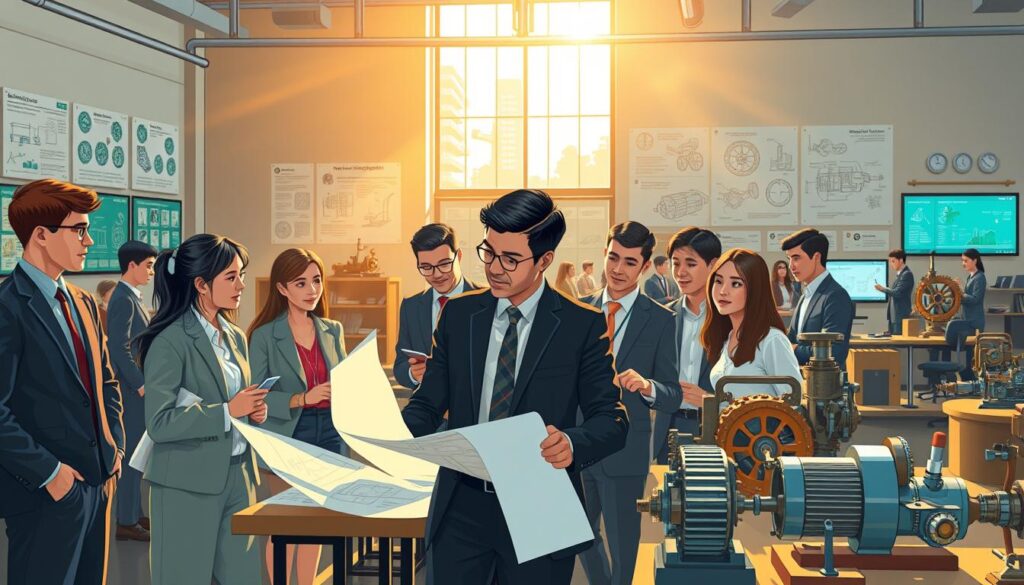
The curriculum is like a mental workout. Each course adds to your knowledge base.
Thermodynamics is like a law book for energy. Fluid mechanics teaches how steam and water react under pressure. Heat transfer explains how thermal energy moves. Materials science helps you choose the right materials for extreme conditions.
| Core Course | Intellectual Focus | Direct Steam Application |
|---|---|---|
| Thermodynamics | Laws of energy, work, and heat | Efficiency of steam cycles, boiler design |
| Fluid Mechanics | Behavior of liquids and gases under pressure | Steam flow through pipes, turbine blade design |
| Heat Transfer | Conduction, convection, and radiation | Boiler and condenser design, insulation |
| Materials Science | Properties and limits of engineering materials | Selecting alloys for high-temperature/pressure components |
This table is more than a syllabus. It’s a blueprint for learning. After the core, you can specialize in areas like power plants or renewable energy.
The goal is to think like an engineer. You’ll see pressure drops and energy flows in your sleep. This education prepares you to design and troubleshoot complex systems.
The best programs mix theory with hands-on learning. You’ll work on projects like modeling turbines or diagnosing boiler faults. This sharpens your communication skills.
This educational journey is your map to success. It builds a resilient, analytical mind for steam power. Choosing the right program is your first step on the engineering pathways.
Day in the Life Profiles
A day in mechanical engineering careers is all about the details. It’s not just about finding solutions. It’s about keeping technology running smoothly. You mix creativity with science, making sure everything works together.
Profile A: The Plant Engineer at a Cogeneration Facility. Your day starts with reports on how well things are running. You look for any problems, like a drop in output or a temperature issue. It’s like being a detective, but with numbers.
Then, a call comes in about a pressure problem. You rush out to check it. Is it a faulty valve or sensor? It’s a quick switch from sitting at a desk to being hands-on.
This job is all about solving puzzles fast. It’s like being part of a team in a high-stakes mission. You make sure everything runs smoothly and safely.
Profile B: The R&D Engineer Developing Next-Gen Steam Traps. Your job is to dream up new ideas. You use computer models to test them. It’s a battle against losing energy, fought with software.
In the afternoon, you test your ideas in real life. You use a special rig to see if they work. It’s not just about the science; it’s about making it work in the real world.
You have to convince others that your ideas are worth it. It’s about finding a balance between new ideas and what it costs to make them. It’s a challenge, but it’s worth it.
Steve Maasen talked about the excitement of combining creativity and technical skills. That’s what these jobs are all about. The plant engineer keeps things running smoothly, while the R&D engineer comes up with new ideas.
This job is a mix of everything. It’s about numbers and tools, blueprints and coffee. You don’t just design systems; you live with them. The best part is making sure they keep working.
| Role Dimension | The Plant Engineer | The R&D Engineer |
|---|---|---|
| Primary Focus | Optimization & Uptime | Innovation & Efficiency |
| Tools of the Trade | SCADA systems, diagnostic tools, team radios | CAD software, simulation programs, prototype rigs |
| Daily Adrenaline | Reactive: System failures, pressure drops | Progressive: Test results, design breakthroughs |
| Key Skill | Crisis management under operational constraints | Translating theoretical gains into business value |
| Output | Reliable megawatt-hours | Patents and performance margins |
So, what’s it like? It’s like being the heart of a big machine. Some days, you fine-tune things. Other days, you create something new. The key is making things work better.
Salary Expectations
Forget the Silicon Valley hype for a moment. The real question is, can you make a comfortable living keeping the lights on? Let’s talk numbers.
First, the baseline. The Bureau of Labor Statistics says mechanical engineers make about $95,300 a year. That’s a good starting point.
In the power generation sector, things get more exciting. New mechanical engineers here make between $65,000 and $75,000. It’s a good start, but there’s more to come.
As you gain experience, your salary grows. With five to ten years of experience and a Professional Engineer (PE) license, you could make $100,000 to $130,000. Specializing is key to earning more.
Let’s break it down with a bit of analytical flair, shall we?
The Numbers: From Entry-Level to Principal
ASME and industry surveys show a clear path.
- Entry-Level Engineer (0-3 years): $65,000 – $80,000. You’re learning, you’re valuable, but you’re not calling the shots on a boiler retrofit.
- Project Engineer (4-7 years, PE license): $90,000 – $120,000. Now you have responsibility. And liability.
- Senior/Staff Engineer (8-12 years): $115,000 – $150,000. You’re the go-to person for failure analysis. Your weekends are your own, mostly.
- Principal Engineer/Engineering Manager (12+ years): $140,000 – $200,000+. You own the department budget. Your hair might be grey.
The key differentiator? Specialization. Knowing steam systems well is one thing. Being the only person in the state certified for a new boiler design is another. That’s a different league.
Think about it. While your friends in software worry about new frameworks, your skills in steam technology jobs keep hospitals running, data centers cool, and cities safe. The market values that kind of expertise.
Let’s compare. Software developers make about $110,000 on average. But how many of them deal with emergencies at 3 AM? Or have their licenses affect thousands of lives daily? The value of steam technology jobs goes beyond money. It’s about stability, respect, and necessity.
In a world chasing the next big thing, mastering the basics is valuable. Your 401(k) will thank you. So will your future self when the tech bubble bursts and the steam keeps going.
Getting Started Guide
Building a career in steam technology isn’t about following a map. It’s about drawing your own path. I learned this the hard way. My own engineering pathways started with a simple question in a thermo class: “Why does this condenser look so… inefficient?”

That question led to a heat exchanger model, which became a portfolio piece. It led to an internship at a municipal utility that smelled faintly of sulfur. The point is, you don’t need to have it all figured out. You just need a system. This is your playbook, forged in the real world, not just theory.
The Four Pillars of Strategic Entry
Success here is a game of leverage. You’re competing against folks who love clean rooms and sleek software. Your edge? You understand the beauty of a humming, greasy, 150-year-old machine. The strategy is to build your credentials around that edge.
-
Academic Targeting: The Power of the Elective
Your degree is the canvas, but the electives are the paint. This is where most people go on autopilot. Don’t. Scour your course catalog like it’s the Matrix red pill/blue pill scene. You’re looking for courses with names like “Applied Thermodynamics,” “Power Plant Systems,” or “Fluid Systems Design.” These are your power-ups. This isn’t about getting a grade; it’s about building a narrative. That project where you modeled a more efficient steam trap? That’s a story for your resume.
Source 2’s suggestion to assign roles in group projects? Brilliant. Volunteer to be the “Systems Efficiency Analyst.” It sounds made up, but it’s the exact kind of specific, technical language that makes hiring managers’ ears perk up. This is how you start to build a tangible identity.
-
The Internship Hunt: Go Where the Metal Groans
The flashy tech startups will promise you ping-pong tables and kombucha on tap. They will also likely be bankrupt in 18 months. For a foundation in real steam technology, you go where the infrastructure is old, heavy, and essential. Municipal utilities. Naval shipyards. Heavy industrial manufacturers. Yes, the dress code is probably khaki and steel-toed boots. Yes, the coffee might be terrible. But here, you will get your hands on a literal 50-ton steam turbine.
Source 1’s promotion of hands-on challenges through programs like Camp Invention is the perfect feeder league for these opportunities. These are the proving grounds. Treat them as such.
-
Professional Society Membership: The Early Bird Gets the Network
Join the American Society of Mechanical Engineers (ASME) yesterday. Not tomorrow. Yesterday. The student membership fee is a rounding error compared to the value. You’re not paying for the subscription; you’re paying for access to the secret society.
This is where you’ll hear about the internship at the utility that no one else knows about. This is where you’ll meet the engineer who will later write you a recommendation letter because you helped him solve a pressure drop issue at a conference. This is the hidden curriculum of your career.
-
The Portfolio: Your Tangible Proof of Concept
In the digital age, your portfolio is your digital handshake. It’s no longer a nice-to-have; it’s your sine qua non. That heat exchanger model you built in a simulation software? That’s not just a class project; it’s a case study in applied thermodynamics. Document the process. What was the problem? What was your proposed solution? What were the results? Frame it like a detective novel.
This portfolio becomes your greatest leverage. It’s the physical proof that you can translate theory into practice. It’s what turns you from just another graduate into a sought-after asset.
This guide isn’t about finding a path. It’s about engineering pathways that are uniquely yours. It requires seeing your education not as a checklist to complete, but as a strategic toolkit to assemble. It demands viewing that internship not as a line on your resume, but as a masterclass in applied physics. It’s a long game in a world obsessed with the short term. And trust me, there is nothing more satisfying than hearing that deep, resonant hum of a turbine you helped keep online.
Industry Certifications
Industry certifications are not just nice to have. In the world of steam systems, they are essential. They prove you are a professional and follow the law. If you want steam technology jobs, you need these certifications.
The PE license is the top certification. It shows you are a true engineer. Getting it means the state trusts you with public safety. The process is tough to weed out the unqualified.
The journey starts with the FE exam. It’s like your final exam in school. It tests your knowledge in many areas, including ethics. Passing it makes you an Engineer in Training (EIT).
Then, you need to work under a licensed PE for about four years. This is not just about doing your job. It’s about showing you can apply what you learned. Your mentor’s approval is a big deal.
The final step is the PE Mechanical: Thermal and Fluids Systems exam. It’s a long test that proves you can solve problems under pressure. The pass rate is high, showing it’s not easy.
After getting your PE, you can get specialized certifications. For example, the Boiler Operator certification is needed for some jobs. It’s the law. Being an Authorized Pressure Vessel Inspector (API 510) means you have a big responsibility.
So, why go through all this? It’s for career advancement and to be credible. Having a PE license is required for many jobs. It also shows you are responsible and respected in your field.
| Certification | Governing Body | Key Requirements | Typical Career Impact |
|---|---|---|---|
| PE Mechanical (Thermal & Fluids) | NCEES (State Boards) | FE Exam, 4 yrs experience, PE Exam | Licensure for design authority & senior roles |
| Fundamentals of Engineering (FE) | NCEES | Accredited engineering degree or equivalent | EIT status, first step to PE license |
| Boiler Operator (High Pressure) | State Licensing Boards | Training hours, practical exam, state exam | Mandatory for operating plant boilers |
| Pressure Vessel Inspector (API 510) | American Petroleum Institute | Experience, training course, written exam | Qualifies for inspection roles in refineries & plants |
Getting these certifications shows you are serious. It tells employers you’ve passed the test. For top steam technology jobs, it’s a must.
Future Outlook
Let’s dive into the future of this career path. Is it destined for the museum or the cutting-edge control room? The answer is clear: it’s heading to the control room. But, it won’t be like your grandfather’s. The need for experts in thermal energy systems is growing fast, driven by urgent climate issues.
The future is all about coming together. We see three big trends changing these engineering pathways:
- The Renewable Handshake: Old steam cycles are teaming up with new sources like solar and geothermal. It’s not about replacing them, but combining them for better efficiency.
- The Nuclear Nuance: We’re moving away from big nuclear plants. Small Modular Reactors (SMRs) are in the spotlight, using advanced steam cycles for efficient power. This is all about precision and politics.
- The Efficiency Obsession: We need to get every bit of work out of every bit of heat to meet carbon goals. The focus is on making industrial processes super efficient, from cooling data centers to capturing carbon. Waste heat is the main enemy now.
This isn’t just about the Rankine cycle anymore. It’s about combining old principles with new tech like AI and battery storage. Engineers today design more than just turbines; they also train algorithms to predict and manage performance.
STEAM’s power is more important than ever. It’s about combining technical skills with systems thinking and creativity. This approach helps solve complex problems, from drone control to new heat exchanger designs. As machines get smarter, humans become the leaders, innovators, and interpreters.
The future is all about combining old and new. The laws of thermodynamics stay the same, but our ways of applying them are just starting to get exciting. For those who are quick to adapt, this offers some of the most exciting and critical engineering pathways out there.
Student Action Steps
So you’ve read the map. Now it’s time to lay the track. Your journey into mechanical engineering is a project, not a mystery. Every great project starts with a clear step.
First, find something that really interests you. This week, explore beyond your textbooks. Read an ASME article on turbine blade cooling or watch a documentary on geothermal plants. Your goal is to find one detail that makes you curious.
Next, change how you see your classroom. In physics, don’t just solve for force. Think about what real-world system—a piston, a bridge, a valve—that equation models. Start seeing things in systems, not just answers. This is the heart of engineering.
Then, create something. It doesn’t matter what. Build a model steam engine, a better solar oven, or a Rube Goldberg machine. The process of design, failure, and trying again is key. It turns theory into something you can touch.
Lastly, find someone to guide you. Email a mechanical engineer or a professor. Most are excited to talk to curious students. This isn’t just networking; it’s about getting real advice.
I’ve seen many smart ideas never take off. The difference between a dream and a career is taking action. Your future in energy doesn’t start with a five-year plan. It begins with the spark of action you take today. Go ahead and lay that first brick.
