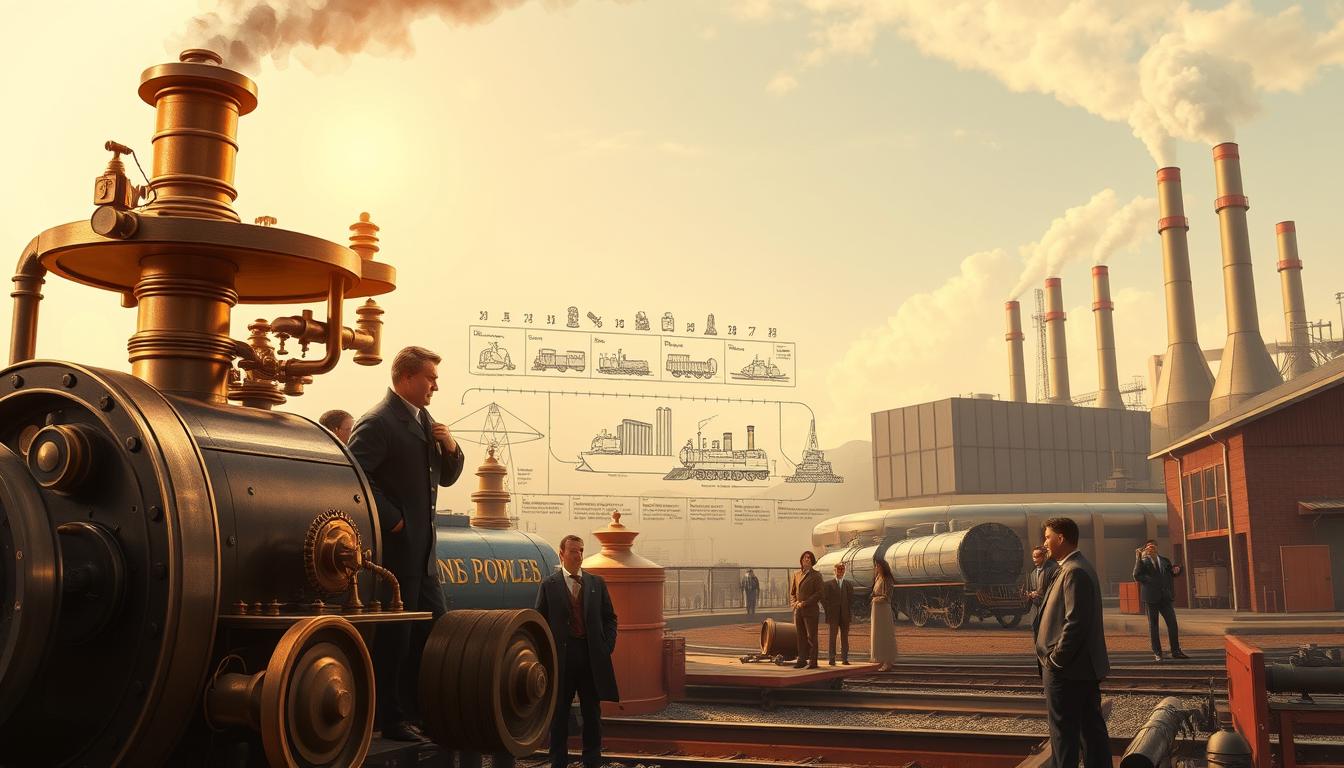
Imagine a world where factories were tied to riversides, relying on wind and water. The story of breaking free is a tale of human ingenuity. It’s the history of steam power, from simple pumps to the turbines lighting our cities.
James Watt was at the core of this change. He didn’t create the first steam engine. Instead, he fixed a major flaw in the Newcomen engine with his separate condenser. This greatly reduced waste and increased efficiency.
This improvement, along with rotary motion, sparked the Industrial Revolution. It freed industry from location limits and led to rapid growth. Watt’s work shows the maker’s spirit: find a problem, observe deeply, and create a simple yet effective solution.
This drive for better efficiency and innovation is seen today in business and tech. Learning from these pioneers helps us understand our modern world.
Timeline from Newcomen to Modern Turbines
The journey of steam power is a tale of human ingenuity. It’s not just a list of dates. It’s a story of how each mind built on the work of others.
Thomas Savery started it all in 1698 with a steam-powered pump. His invention was the first to use steam for work. But it was not very efficient and often dangerous.
Then, in 1712, Thomas Newcomen created the “atmospheric engine.” He used a vacuum to push the piston down. This was a big step, even if it used a lot of fuel.
James Watt saw how wasteful Newcomen’s engine was. In 1769, he made the separate condenser. This made the engine much more efficient. Later, in 1781, he made it turn rotary, changing factories forever.
Richard Trevithick made the first high-pressure steam locomotive in 1801. These engines were smaller, more powerful, and could move. This led to the creation of railroads. Peter Cooper’s “Tom Thumb” locomotive even beat a horse in a race in 1829.
Eventually, steam engines gave way to internal combustion and electricity. But the principles of steam are used in modern power plants and naval systems.
The table below shows the key moments in steam technology:
| Inventor | Year | Key Invention | Technical Leap |
|---|---|---|---|
| Thomas Savery | 1698 | Steam Pump | First practical steam-powered device for drainage |
| Thomas Newcomen | 1712 | Atmospheric Engine | Utilized vacuum via condensed steam for reliable power |
| James Watt | 1769 | Separate Condenser | Greatly improved fuel efficiency by keeping cylinder hot |
| James Watt | 1781 | Rotary Motion Engine | Enabled steam power to drive factory wheels directly |
| Richard Trevithick | 1801 | High-Pressure Locomotive | Made steam engines smaller, more powerful, and mobile |
| Peter Cooper | 1829 | “Tom Thumb” Locomotive | Demonstrated the viability of steam-powered rail transport |
Knowing this timeline is key. It shows how innovation builds on itself. For more on the people behind these machines, check out our steam engine superstars feature. This sets the stage for hands-on activities and discussions about the history of steam power.
Primary Sources and Museum/Archive Activities
Working with primary sources and museum collections makes studying steam power hands-on. It turns theory into real history. For teachers and curious people, these materials connect us directly to the past.
Primary sources are the raw materials of history. They include original documents and objects from the time you’re studying. For example, James Watt’s 1769 patent shows his claims and legal protections. Ads from that time show how steam engines were marketed.
Personal letters, like Watt’s to scientist Joseph Black, reveal the challenges and teamwork behind the inventions.
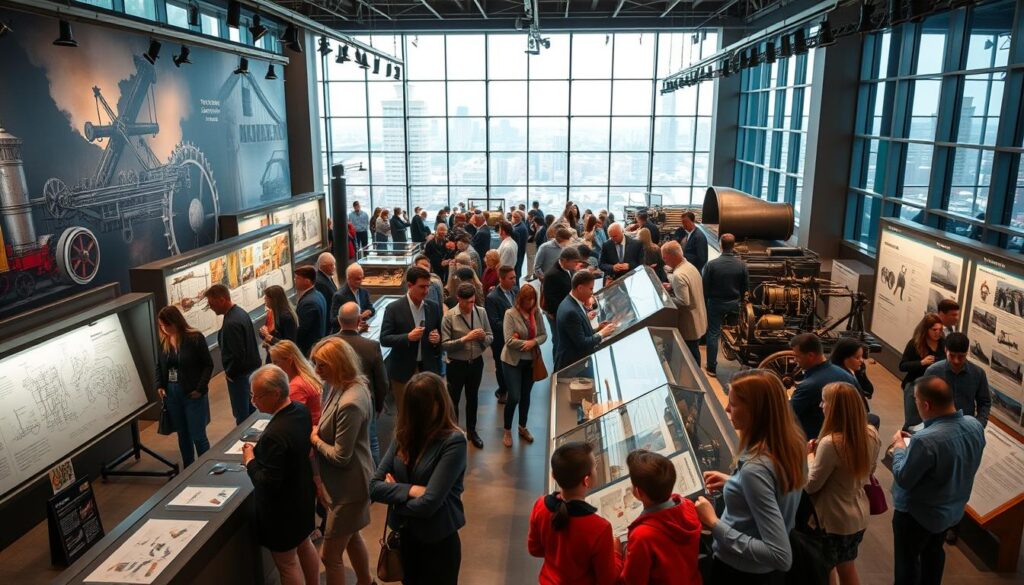
Museum activities with preserved engines give a three-dimensional view. Seeing a massive cylinder or complex valve gear makes abstract ideas real. This hands-on experience is very valuable.
The table below helps analyze different types of primary sources. It turns simple looking into deep analysis.
| Type of Source | Location/Example | Key Question for Analysis |
|---|---|---|
| Historical Artifact (Engine) | Science Museum, London (“Old Bess,” 1777) | How does the material (cast iron) and size limit or enable its function? |
| Patent Document | National Archives or online repositories | What specific problem does the inventor claim to solve, and how is the solution uniquely described? |
| Technical Drawing | Museum archives, like Watt’s engineering drawings | What details are emphasized that might not be visible on the finished physical engine? |
| Personal Correspondence | University library collections | What frustrations, partnerships, or external influences are revealed in the inventor’s own words? |
Visiting a museum becomes a mission with the right questions. Instead of just looking, challenge yourself or your students with specific tasks.
- At the Science Museum in London, compare the size of a Newcomen engine cylinder to a Watt separate condenser model. What does the reduction in cylinder size, for the same power output, tell you about thermal efficiency?
- At Thinktank Birmingham, observe the working Smethwick Engine (1779). How does the motion of the beam translate into practical pumping work?
- At the Henry Ford Museum, study the replica of Watt’s 1788 rotative engine. How did this design adapt steam power for rotary motion to drive factory machinery?
- At Crofton Pumping Station, witness the 1812 Boulton & Watt engine in steam. What sensory details—sound, smell, rhythm—define the experience of early industrial power?
Not everyone can visit these sites. Many places offer online virtual museum archives with digitized collections. You can find high-quality images of patent documents, engine models, and more for the classroom.
These primary sources and museum activities build critical thinking. They teach students to question evidence, connect design to function, and appreciate innovation in its original context. It’s history you can see, touch, and question.
Build a Simple Newcomen Pump Model
Maker education is all about hands-on projects. Building a Newcomen engine from 1712 is a great way to learn about physics and history. It makes complex ideas real and functional. It’s a perfect example of industrial revolution projects for schools and makerspaces.
The Newcomen engine was a big step forward in 1712. It used steam and cold water to create a vacuum. This vacuum was pushed by the outside air, moving a piston down. This motion lifted water from mines.
But, it was not very efficient. The engine wasted a lot of energy because it was always being heated and cooled. This made it hard to use.
To make this engine, you need just a few things. This shows how maker education can be simple yet powerful.
- Two large plastic syringes (one acts as the cylinder/piston)
- Flexible plastic tubing
- A small candle or tea light (as a heat source)
- A shallow dish of water
- Cardboard, wood, or LEGO bricks to build a stable frame and rocking beam
- Modeling clay or hot glue for seals
- Build a stable frame. Mount one syringe horizontally as the steam cylinder. Attach its piston rod to a simple rocking beam.
- Connect the second syringe vertically to the beam. This is the pump that lifts water.
- Use tubing to connect the nozzle of the horizontal syringe to your heat source and a water reservoir. Make sure connections are tight with clay.
- Place the dish of water near the vertical “pump” syringe. Make sure its intake is submerged.
When you heat water to make steam, it pushes the piston out. Adding cold water simulates condensation. Atmospheric pressure then pushes the piston back in. This rocks the beam and lifts water in the vertical pump.
This model shows two important scientific ideas. It uses the change of water to steam and back to create force. It also shows how atmospheric pressure works. Making and improving this model is where real learning happens.
Looking at the model’s flaws helps us understand history. It was slow and wasted a lot of energy. James Watt later fixed this with a separate condenser. Building this model shows how Watt’s improvements were a big step forward.
Create a Gallery Walk with Student Posters
The gallery walk format uses maker education to tell the story of steam power progress. It turns learners into curators and teachers. They research, design, and present their findings in a formal exhibit.
Divide your class or team into small groups. Assign each group one key inventor or technological concept. The goal is to create an informative, visually engaging poster. This poster will become a station in a classroom or workshop gallery.
Focus on four key inventors and their partners. Their work defined the steam era.
- Thomas Newcomen: Creator of the first practical atmospheric engine for pumping water.
- James Watt (with Matthew Boulton): Perfecter of the steam engine through his separate condenser and partnership that enabled manufacturing.
- Richard Trevithick: Pioneer of high-pressure steam and early locomotives.
- Peter Cooper: Builder of the first American steam locomotive, the “Tom Thumb.”
Each inventor connects to specific engineering concepts. Groups must explain these in their posters.
Key ideas include Watt’s separate condenser and rotary motion. Also important are his sun and planet gear and parallel motion linkage. Trevithick’s work involves high-pressure, double-acting engines. The term horsepower itself is a Watt concept for marketing engine power.
Every poster should contain four core elements. This structure ensures depth and consistency across the gallery.

The table below provides a blueprint for group research. It links inventors to their innovations, source materials, and historical impact.
| Inventor/Technology | Key Innovation (Concept) | Primary Source Quote Idea | Impact Analysis Focus |
|---|---|---|---|
| Thomas Newcomen | Atmospheric Beam Pump | Description from a mining company record praising the “fire engine” for draining a flooded pit. | How it revolutionized deep mining and saved the tin/coal industries. |
| James Watt & Matthew Boulton | Separate Condenser; Rotary Motion | Watt’s own writing on the “eureka” moment walking on Glasgow Green, or Boulton’s famous quote: “I sell here, sir, what all the world desires to have—power.” | The shift from water pumping to factory power, enabling the Industrial Revolution’s centralized workshops. |
| Richard Trevithick | High-Pressure, Double-Acting Engine | Newspaper account of the “Catch Me Who Can” steam locomotive demonstration in London. | Made engines smaller and more powerful, leading directly to railways and mobile steam power. |
| Peter Cooper | American Steam Locomotive (“Tom Thumb”) | Report from the 1830 race against a horse-drawn car on the B&O Railroad. | Proved steam traction’s viability in the US, catalyzing transcontinental railroad expansion and westward settlement. |
| Supporting Concepts | Horsepower, Sun & Planet Gear, Parallel Motion | Watt’s patent specifications or engineering drawings explaining the mechanisms. | How these improvements increased efficiency, reliability, and the practical applications of steam power. |
Once posters are complete, arrange them around the room. The gallery walk begins. Groups stand by their stations to present summaries. Other learners rotate through, taking notes and asking questions.
This format is a powerful museum activity. It encourages peer-to-peer teaching and active learning. Visitors synthesize individual stories into a cohesive historical timeline. They see how one innovation built upon another.
The final discussion should connect all the dots. Ask the group to trace the evolution from Newcomen’s pump to Cooper’s locomotive. This collaborative curation makes the history of technology tangible and memorable. It turns individual research into a shared, interactive discovery.
Role-Play: Inventor Pitches and Patent Debates
Step into the world of steam power through a role-play of inventor pitches and debates. This activity turns historical facts into a gripping story about risk, marketing, and legal protection. It brings the commercial battles of the Industrial Revolution to life for today’s professionals.
Key conflicts set the stage. James Watt and Matthew Boulton got a patent extension in 1775. They wanted to cover their huge development costs. Watt was hesitant to use high-pressure steam due to safety concerns. This led to Richard Trevithick’s innovation.
Watt also came up with the term “horsepower” to market his engine. It compared his engine’s power to a horse’s, a clever marketing move.
To start this industrial revolution project, assign roles to participants:
- James Watt: The perfectionist inventor. Pitch your engine’s efficiency and fuel savings. Argue for your patent extension to fund more research.
- Matthew Boulton: The savvy industrialist. Focus on the business side. Negotiate license fees with mine owners based on fuel savings. Highlight the investment’s long-term benefits.
- Richard Trevithick: The daring disruptor. Promote the power and new uses of high-pressure steam. Challenge the old patent as a barrier to progress and safety.
- Skeptical Mine Owner: The pragmatic customer. Ask about costs, safety, and reliability. Look for the best financial deal.
The debate begins as each character presents their case. Use arguments and data from the time, like horsepower comparisons or fuel cost estimates. The goal is to secure a patent, a license, or choose an engine supplier.
This role-play shows how innovation and business are closely linked. It goes beyond dates and diagrams to the human negotiations that drove change. For today’s professionals, it reflects the challenges of pitching ideas, protecting IP, and convincing others.
Such industrial revolution projects are more than history lessons. They offer a way to understand the entrepreneurial spirit. The debate makes complex ideas like patent law and market adoption personal and unforgettable.
Compare Past vs. Present Efficiency
Business leaders know that being efficient is key to making money. This idea has driven three centuries of steam technology progress. This section will show how far we’ve come, from the first engines to today’s power plants.
Thomas Newcomen’s engine was a big step forward, but it only turned 1% of coal’s energy into work. Most of the energy was lost, making these early engines very expensive to use.
James Watt changed the game with his new engine parts. His separate condenser and steam jacketing almost doubled the engine’s efficiency. This huge improvement made factories more affordable and helped start the modern factory era.
Now, modern gas turbines can reach over 60% efficiency. This is thanks to many improvements in materials and design. The history of steam power is a story of constant improvement in efficiency.
| Era | Key Innovation | Approx. Efficiency | Business Parallel |
|---|---|---|---|
| Early 1700s (Newcomen) | Atmospheric Pressure & Condensation | ~1% | High operational cost, low ROI on capital. |
| Late 1700s (Watt) | Separate Condenser & Steam Jacketing | ~2-3% | Process optimization that doubles output, justifying investment. |
| Modern (21st Century) | Combined-Cycle Gas Turbines | >60% | Maximizing resource utilization for superior competitive advantage. |
Improving efficiency was also about safety. Early boiler explosions were deadly, stopping progress and wasting money. The 1803 invention of the lead fusible plug was a smart fix. It melted at a safe temperature to prevent explosions.
This early safety measure is like today’s safety rules. Safety has always pushed innovation forward. Learning about these lessons is important for anyone. Building a model steam engine shows the balance between power, efficiency, and safety.
Looking at the history of steam power through efficiency and safety shows us a lot. It teaches us how small improvements can lead to big changes. It also shows the importance of managing risks for growth. These lessons are not just history; they are essential for today’s success.
Equity and Social Impact Discussions
Primary sources from the 19th century show us the people behind the steam engine’s rise. They give us a raw look at its social impact. The machinery was amazing, but its true legacy is in the lives of those who lived through the change.
The move from farm to factory was huge. People moved to cities, creating a new industrial working class. Life in these factories was tough, with long hours, bad air, and danger.
To understand this, we look at primary sources. We analyze worker stories, factory reports, and early union pamphlets. This lets us see the human cost of the technological change. It helps us think about the balance between short-term disruption and long-term progress.
Use these documents for a deep discussion. Ask questions that make people think about fairness and management:
- Who got the most benefits from steam technology, and who suffered the most?
- How did the treatment of women and child laborers, as seen in primary sources, challenge fairness?
- What does the rise of labor unions tell us about worker power and fighting exploitation?
- Is the creation of a large, literate middle class worth the hardships of the first industrial workers?
These questions aren’t just about history. They make us think about the broader impact of new technologies today. The steam era changed social contracts and led to reform movements.
By learning from this history, we see that innovation isn’t neutral. It has big social effects. Understanding this through real human stories is key to shaping our technological future responsibly.
Field Trip/Virtual Tour Planning
Learning by visiting museums or taking virtual tours connects students to engineering history. It’s more than just reading about it. Students can see massive steam engines or explore digital exhibits up close. Planning these trips is key to making learning impactful.
Many top museums are great places to visit. The Crofton Pumping Station in the UK shows steam power in action. London’s Science Museum has famous engines like Watt’s separate condenser. Birmingham’s Thinktank dives into the Industrial Revolution.
In the U.S., The Henry Ford Museum in Dearborn, Michigan, has a vast collection of American innovation. Sydney’s Powerhouse Museum offers a global view. The good news is that virtual tours and online archives from these places make history accessible to all classrooms.
A successful trip, whether in person or online, has three stages: before, during, and after. Use this checklist to plan your trip.
Pre-Visit Preparation
Start by building knowledge and curiosity before you go.
- Research Questions: Have students research the site’s main artifacts. For example, “What was the primary fuel for early Newcomen engines?”
- Technical Vocabulary: Teach key terms like “sun and planet gear” or “condenser” so students know them.
- Logistics Briefing: Make sure everyone knows the schedule, how to get there, or how to access the virtual tour.
On-Site Engagement Goals
Keep students observing and analyzing during the visit.
- Scavenger Hunt: Create a list of items to find. Tasks might include: “Find an example of a parallel motion linkage,” or “Identify a 19th-century boiler.”
- Sketch or Photograph: Encourage students to document their favorite machine, noting its main parts.
- Talk to Experts: Prepare questions for docents or curators about restoration and operation.
Post-Visit Reflection
Make sure learning sticks and connects to bigger ideas.
- Discussion Prompts: “How did seeing a beam engine change your understanding of its power?” or “What surprised you about turbine design?”
- Connection Project: Have students link one artifact they saw to a modern technology, making a short presentation or diagram.
- Feedback Loop: Collect student thoughts on what worked well for future museum activities.
Mastering the Virtual Tour
Exploring online is just as good as in person. Many museums offer great online experiences.
Focus your virtual tour by guiding students to specific online collections. The Science Museum’s website has deep dives into their steam gallery. The Henry Ford’s digital assets include detailed engine models. Schedule a class where you explore together, stopping to highlight important features.
Use screen sharing and breakout rooms for a guided discussion. Ask questions in real-time about what students see. This keeps everyone engaged and makes history come alive, no matter where you are.
Planning these experiential learning trips, whether in person or online, makes history real. It turns facts into stories with real objects and places. This approach to museum activities helps every student appreciate the engineering marvels that shaped our world.
Assessment: Project Portfolio and Reflection
Learning in a maker education unit is more than just a final test. A complete assessment strategy looks at the whole experience. It includes hands-on work and critical thinking.
We suggest creating a “maker portfolio.” This collection shows the learner’s journey. It focuses on skills shown, not just memorization.
A good portfolio for this unit should have several important items. These items show the process and the final results of the activities.
- Photographs or sketches of the constructed Newcomen pump model.
- The completed research poster from the gallery walk activity.
- Notes and position statements from the inventor role-play and patent debates.
- Data sheets from the efficiency comparison exercise.
Each item in the portfolio shows how learners engaged with primary sources and historical ideas. It’s a detailed display of learning.
The heart of this assessment is a written reflection. This part tests higher-order thinking. The prompts should make learners think deeply about their work.
How does the iterative failure and success of early steam pioneers mirror the modern engineering design process? Learners see how historical innovation relates to today’s problem-solving.
Another great prompt asks learners to connect the unit’s themes to their own field or community. This makes history relevant and useful to them.
This portfolio and reflection method looks at more than just remembering facts. It checks if learners can analyze, connect, and apply what they’ve learned. It truly captures the essence of maker education by valuing the journey as much as the outcome.
Extension: Local Industry Guest Speakers
The story of the steam engine doesn’t stop in history books. It lives on in today’s power plants and naval ship designs. A guest speaker from a local industry can bring this story to life for your students. They show how Watt’s work leads to today’s engineering wonders.
Steam turbines are key in many areas today. They power coal, nuclear, and geothermal plants. They also drive big ships across the seas. Watt’s drive for efficiency has led to today’s advanced manufacturing and energy sectors.
A guest speaker connects history to today. They share real-world challenges and answer important questions. They make students see why this history matters.
Finding the right speaker is key. Look for people in your area who work on themes related to your industrial revolution projects. Good candidates include:
- A power plant engineer or operations manager.
- A naval architect or marine engineer.
- A manufacturing efficiency or process improvement expert.
- A historian of technology from a local museum or university.
Once you find someone, send them a clear invitation. Explain your unit’s focus and how their expertise adds a modern view. Most professionals love to inspire the next generation.
Getting ready for the visit is important. Have students research the speaker’s company and industry. Help them come up with questions that link past and present. The table below shows possible speaker profiles and discussion topics.
| Industry | Professional Role | Key Legacy Topics | Sample Student Question |
|---|---|---|---|
| Energy Production | Power Plant Engineer | Thermal efficiency, boiler design, safety systems, renewable integration. | “How do the basic principles of converting heat to motion, established in the 1700s, |
| Maritime & Defense | Naval Propulsion Engineer | High-pressure steam, turbine design, fuel-to-power optimization. | “What are the biggest differences between early marine steam engines and the propulsion systems on modern ships?” |
| Advanced Manufacturing | Lean Manufacturing Specialist | Systematic process improvement, waste reduction, precision measurement. | “James Watt was obsessed with precise measurement to improve efficiency. How does that same mindset show up in your factory today?” |
| Education & Heritage | Technology Historian | Societal impact, ethical considerations, evolution of engineering standards. | “What do you think is the most overlooked social consequence of the steam engine’s adoption?” |
Give the speaker a quick overview of what your students have learned. This helps them tailor their talk. Ask them to share stories, photos, or props from their work.
Good questions lead to deep learning. Encourage students to ask about problem-solving, safety, and the human side of engineering. Here are some examples:
- “What is one major safety protocol in your job that has its roots in lessons learned from early industrial accidents?”
- “Can you describe a time when you had to optimize a system for efficiency, similar to how inventors improved early engines?”
- “How does working with massive, powerful machinery today compare to the challenges faced by engineers in Watt’s time?”
This activity makes history come alive. It shows students that the Industrial Revolution’s ingenuity is ongoing. By connecting your industrial revolution projects to a real expert, you give students a memorable, authentic learning experience. It helps them understand and inspires them for the future.
Standards Connections (History, ELA, Engineering)
This project on steam power is a powerful way to learn across subjects. It meets key standards in History, English, and Engineering. This makes it easy to use in the classroom or for training.
For History, the project explores the Industrial Revolution’s causes and tech impact. Students create timelines and analyze primary sources. They also discuss how technology changed society.
In English Language Arts, students dive into complex texts. They practice writing and speaking through role-plays and debates. They also make posters for a gallery walk to improve their communication skills.
Engineering and design standards are covered through hands-on model building. Students build a Newcomen pump model to learn about engineering. They compare old and new systems to understand efficiency.
This project aligns with many learning goals in History, ELA, and Engineering. It’s a flexible tool for teachers. It saves time and gives students a rich, engaging learning experience.
