Most history workshops feel like being stuck in a dusty museum. Not this one. We’re starting our journey with the events that changed everything.
Imagine 1712, when Thomas Newcomen showed off his atmospheric steam engine. It was a big, clumsy machine that pumped water from mines. Then, in the 1760s, James Watt, a Scottish engineer, worked on Newcomen’s design.
Watt’s separate water condenser was a game-changer. It was like the iPhone of the 18th century. Why does it matter today? Because it’s the root of every power plant, turbine, and energy debate.
This section follows the steam engine’s journey from its early days to its global impact. It’s a workshop full of “aha” moments, like a marathon of TED Talks.
Biography Studies: James Watt, Robert Fulton, and Other Steam Pioneers
The story of steam technology is not just about machines. It’s about the people who dared to dream big. James Watt is a prime example. He was a hypochondriac and overthinker who turned a simple device into a game-changer. His partnership with Matthew Boulton was like a tech startup from the 18th century, filled with excitement and disputes.
Robert Fulton changed America by making rivers into highways with his steamboats. His work impacted American commerce deeply. On the other hand, Richard Trevithick was a Cornish daredevil who put wheels on a steam engine. This led to the invention of the locomotive, a major transportation breakthrough.
These pioneers didn’t just make machines; they left lasting legacies. Their stories are full of genius and ambition. What drove them? Was it money, fame, or the thrill of the challenge? Their journeys teach us more about innovation than any TED Talk.
In our steam technology history workshop, we explore these biographies. We learn about their motivations and quirks. This gives us a deeper understanding of the technological advancements that shaped our world. For more on these steam empires, check out this link.
Hands-On History: Building Historical Steam Engine Replicas
Building a steam engine replica takes you back to the 18th century. It’s more than a craft; it’s a journey into steam technology’s heart. Assembling a miniature Newcomen engine shows the power of innovations like the separate condenser.
The hiss of steam and the creak of metal become your friends. You might even feel a thrill of danger. This is because you’re working with a piece of history that could have exploded back then!
This historical STEM learning experience connects you deeply with the past. Reading about Watt’s genius is one thing. But until you work with a piston mechanism, it’s just words. This hands-on approach makes history real.
Here’s what you can expect when diving into this fascinating project:
- Understanding Mechanics: Learn how each component works together to create motion.
- Historical Context: Discover the innovations that changed the world during the Industrial Revolution.
- Problem-Solving Skills: Overcome challenges that arise during construction, improving your critical thinking.
- Team Collaboration: Work alongside others, sharing insights and techniques.
As you build your engine, the joy of seeing it work is unmatched. It’s a moment that makes adults feel like kids again. So, if you’re ready to get your hands dirty and learn about steam technology history, this workshop is your gateway to the past.
Industrial Revolution Impact: Understanding Societal Changes Through Steam Power
The Industrial Revolution was a major change in society. It’s hard to imagine a world without steam power. Before steam engines, the textile industry was small and labor-intensive.
Then came the spinning jenny, flying shuttle, and power loom. These inventions created the factory system. This led to cities growing and the rise of the working class.
Learning about the Industrial Revolution is more than just dates. It’s about how steam power changed society. In 1776, Adam Smith wrote “The Wealth of Nations,” supporting free enterprise as steam power grew.
Factories, banks, and stock exchanges started to appear. The iron industry also changed, using coke instead of charcoal. This was perfect for Napoleon’s wars.
Steam power brought big changes to society. It changed how people worked, cities grew, and a new class of workers emerged. The effects of steam technology are seen in our daily lives, from coffee to smartphones.
Transportation Revolution: Steamboats, Locomotives, and Early Automobiles
A big change was happening, not just in fancy tea parties. The way people moved around was changing with steam technology. Before steam, traveling far was hard because of horses. But then, Richard Trevithick came up with a steam locomotive in the early 1800s. This made long trips much safer.
By 1830, trains were moving goods between Manchester and Liverpool. This made these cities very busy. The idea of traveling by train was a big deal. Steamboats were also changing things, moving goods on rivers and canals, and even across the Atlantic.
By 1815, Britain had built over 2,000 miles of canals. This was like a liquid highway system. Seeing steamboats on these canals was exciting. They made traveling easier and faster.
This change wasn’t just about speed. It made the world smaller. Suddenly, the idea of a global world was real. Our engineering history activities will show you how these machines worked. It’s a journey you won’t want to miss!
Manufacturing Changes: How Steam Power Transformed Industry
Steam engines changed manufacturing forever when they started working. This wasn’t just a small change; it was a big shift from handwork to machine work. Watt and Boulton’s engine brought steam power to flour mills, paper factories, and cotton mills. It seemed like steam was determined to replace manual labor.
Coal use soared as steam engines needed more of it. This created a loop where engines needed coal, so miners used steam to dig deeper. It was a paradox where both answers to “which came first” were “profit.” This was the Industrial Revolution’s chicken-and-egg problem.
Steam technology spread fast, touching all kinds of businesses. If you turned raw materials into products, steam came knocking. This change brought big shifts in how things were made:
| Industry | Pre-Steam Production | Post-Steam Production |
|---|---|---|
| Flour Mills | Manual grinding by artisans | Mechanized grinding with steam power |
| Cotton Mills | Hand-spinning and weaving | Mass production using steam-driven looms |
| Iron Works | Labor-intensive forging | Steam-powered machinery for efficiency |
| Distilleries | Traditional distilling methods | Faster production with steam heat |
Was this progress? Factory owners made a lot of money, and machines worked fast. But workers faced tough conditions and long hours. From a technical view, steam made manufacturing a science. But what was the cost to people?
In this workshop, we dive into these issues. We see how steam power changed not just manufacturing but also the lives of workers. The story of steam is one of innovation, profit, and the human experience in the machine age.
Global Impact: Steam Technology’s Spread Across Different Countries
Steam technology didn’t just travel; it conquered nations with the same fervor as the British Empire. It wasn’t just about exporting engines and coal. It was about exporting a new way of life. Steamships carried cotton from colonies to Manchester, then returned with goods, creating a cycle of exploitation.
In America, steam was welcomed with open arms. The vast landscapes needed a railroad network, and steam engines fit perfectly. Samuel Morse was working on the telegraph, a response to the fast pace of steam trains. The need for better signaling was clear after two locomotives collided.
As steam technology spread, each nation adapted it to its needs. Japan quickly adopted steam, using it in its modernization during the Meiji Restoration. India, on the other hand, experienced colonial exploitation, where steam served British interests, not the locals.
Steam’s journey is not uniform. Japan’s rapid adoption showed its ambition, while India’s experience highlighted the dark side of progress. Yet, steam’s ability to reshape societies is a common thread. It left a lasting mark, changing economies and social structures.
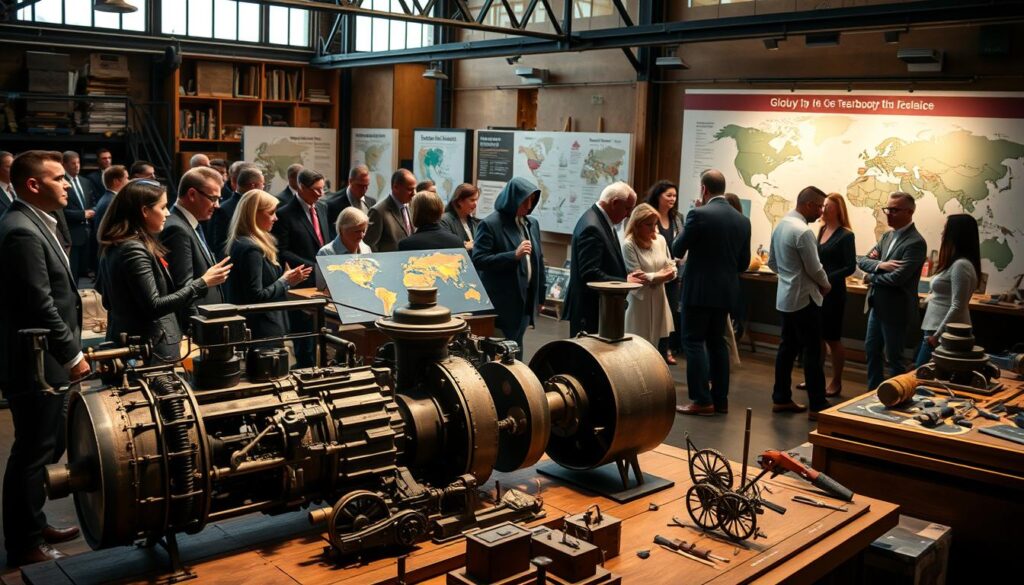
In conclusion, steam technology’s global impact tells a complex story of innovation, power, adaptation, and change. Exploring this history shows how steam technology has influenced nations, challenging us to think about its legacy today.
Scientific Breakthroughs: Thermodynamics and Engineering Principles Discovery
In the world of steam technology, something interesting happened. Pioneers found the principles of thermodynamics by accident. James Watt, for example, didn’t have a textbook. He had a workshop, a dream, and a drive to make things better.
These early engineers discovered key concepts through trial and error. They were not just inventors but also accidental scientists. They turned steam power into a tool for learning.
Some major discoveries include:
- Energy Conservation: The idea that energy can’t be made or lost but only changed.
- Entropy: The understanding that things tend to get more disordered over time, thanks to steam engines.
- Absolute Temperature Scale: A way to measure heat, important for studying heat engines.
Watt’s separate water condenser was a big leap. It made steam engines more efficient and sparked curiosity. This curiosity led to deeper questions and the start of modern thermodynamics.
Sadi Carnot’s work on heat engines came from watching steam engines. His simple question, “Could this be better?” led to important ideas. This shows how science can start with simple questions and observations.
This story shows that science isn’t always planned. It can start with a simple observation or question. The history of steam technology is a story of human creativity and curiosity.
Modern Applications: Contemporary Uses of Steam Technology
Steam technology is very much alive today. Many think it’s old news, but it’s key in our world. Steam turbines, from Watt’s idea, make most of our electricity.
These turbines work in many places. They’re powered by coal, gas, nuclear, or even sun power. Steam tech has grown a lot, used in plants, sterilizing systems, and even espresso machines. We all need our coffee, just like electricity!
To show how steam tech is used today, let’s look at a table:
| Application | Description | Energy Source |
|---|---|---|
| Power Generation | Steam turbines generate electricity in power plants. | Coal, Natural Gas, Nuclear, Solar |
| Industrial Sterilization | Steam is used to sterilize equipment in hospitals and labs. | Electricity or Natural Gas |
| Geothermal Energy | Steam extracted from the earth powers turbines for electricity. | Geothermal Heat |
| Espresso Machines | Steam heats water to brew coffee. | Electricity |
The same ideas Watt had are powering our world today. It’s amazing how something old can become essential in our lives. Steam, our first power source, is vital, even with new tech.
Comparative Analysis: Steam vs Other Power Sources Throughout History
Let’s dive into the battle between steam and its competitors. When steam technology came along, it was a game-changer. It faced off against water wheels, windmills, and the long-standing power of horses.
Water wheels needed a river, which was a big limitation. Windmills worked only when it was windy. Horses were reliable but couldn’t grow with the demand. Steam, on the other hand, was flexible and powerful. It only needed coal and water, making it easy to transport and use anywhere.
Steam wasn’t the only contender, though. The shift from manual labor to machines was key. It wasn’t just about which technology was superior. It was about which one fit the current setup and economic needs. For example, charcoal was used in smelting, but coke became the better choice due to its efficiency and availability. Steam technology could adapt to the fast-changing industrial scene.
So, why did steam become the favorite? It wasn’t just about power. It was about being in the right place at the right time. Technology adoption is often about fitting into the cultural and economic context.
To learn more about this interesting topic, check out this in-depth look at steam technology.
Primary Source Analysis: Reading Historical Documents and Patents
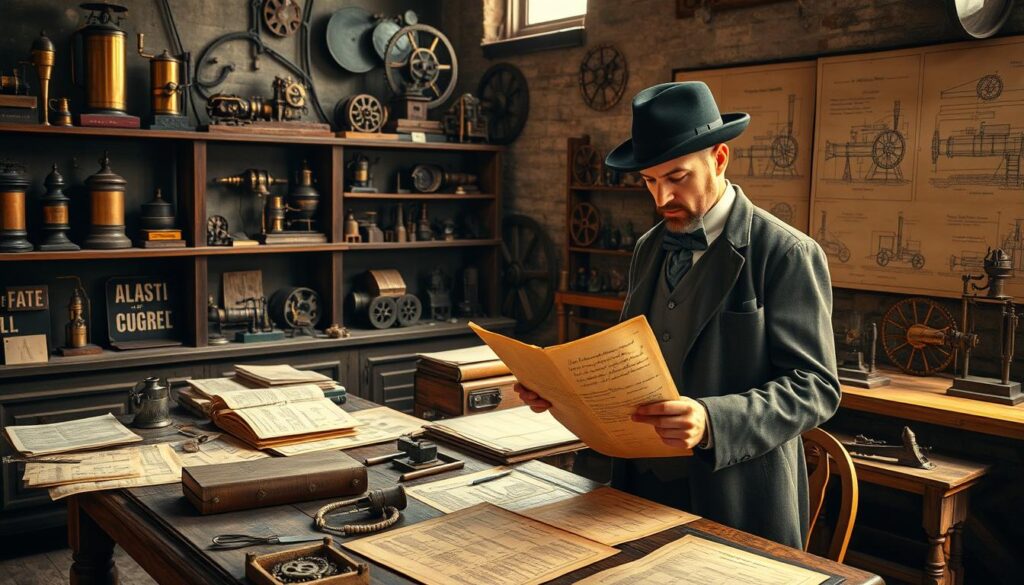
Reading patents from the steam era is like solving a complex puzzle. Innovators of the past left us these clues. James Watt’s original patent documents give us a peek into their minds.
Imagine trying to understand IKEA instructions written by a lawyer who’s had too much sherry. That’s what analyzing these documents can feel like.
In our steam technology history workshop, we’ll learn to find meaning in historical documents. We’ll look at patent applications, engineering notebooks, and letters between famous figures like Boulton and Watt. We’ll also explore newspaper accounts of steam demonstrations.
Each document is a part of a bigger story. They show us not just the innovations but also the thought behind them.
Primary source analysis is like detective work. For example, why did Watt write his condenser claim so broadly? What secrets did he hide to protect his trade?
These questions lead us on a journey of discovery. We’ll learn how these innovators saw their legacies. The insights we gain are priceless. They show us not just what happened but also how these pioneers thought about their inventions and the world.
Creative Projects: Historical Fiction Writing and Steam-Era Art Activities
Imagination is key to understanding the past. In our steam technology history workshop, we encourage creative exploration. Writing historical fiction brings the Industrial Revolution to life.
Imagine a mill worker’s first sight of a power loom or a captain navigating a steamship. These stories help us feel connected to the past. They show us what life was like back then.
Art is also vital in this journey. Artists like J.M.W. Turner showed the beauty of industrial scenes. Participants can draw steam engines or paint scenes from that time.
These projects don’t just end the workshop. They invite you to live in history. Through stories and art, we gain a deeper understanding of steam technology’s role. Let your creativity shine and make the steam era your own.
