Ever wondered why Victorian engineers were so obsessed with pistons and boilers? They were seeing something amazing—the dance of thermal energy that started the Industrial Revolution. This trio of heat transfer worked together, hotter than your morning espresso machine.
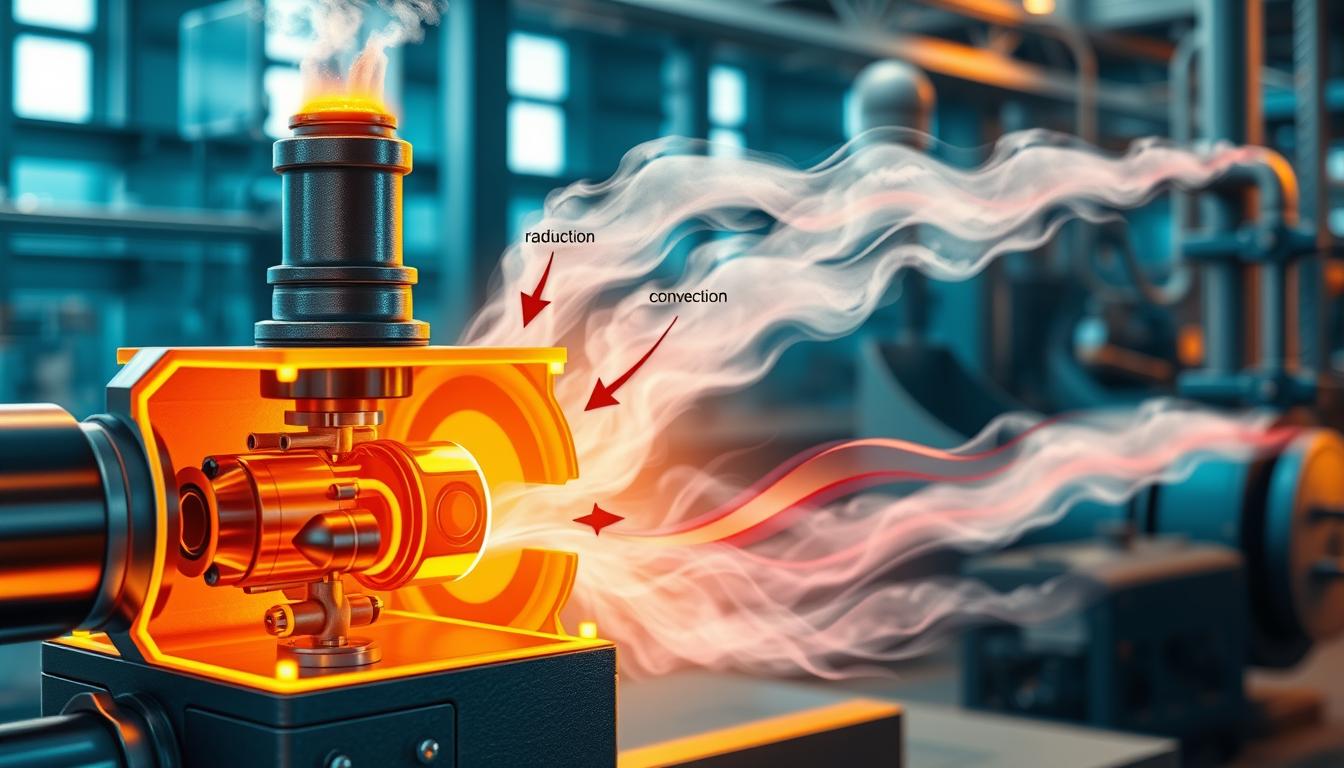
This isn’t just old museum stuff. It shows us fundamental physics principles that apply to everything from coffee makers to nuclear plants. We’re looking at three ways energy moves: conduction through metal walls, convection in boiling water, and radiation from fireboxes.
Nineteenth-century steam engines were true thermal wonders, not just mechanical feats. Scientists like Sadi Carnot studied these iron giants, laying the groundwork for thermodynamics. The molecular dance of conduction, the fluid movements of convection, and the electromagnetic waves of radiation turned water into a force for civilization.
Ready to see why these temperature-driven processes are important today? Let’s get the boiler going and explore some really cool physics.
Boiler anatomy firebox tubes water jacket steam drum
Ever wondered where thermal energy meets engineering? Meet the boiler, a mix of science and controlled explosion. It’s not your grandma’s tea kettle, but it works on similar principles. A steam boiler uses many parts to work together like an orchestra.
The firebox is where the magic starts. Fuel burns here, releasing energy that powers everything else. It’s like the engine’s furnace, turning chemical energy into heat efficiently.
Tubes carry heat through the system like veins. They’re not just for looks; they’re the paths for thermal energy. Copper or steel tubes are used, each with its own benefits.
The water jacket keeps things safe by absorbing heat. It’s the calm part of the system. It keeps the metal from getting too hot.
The steam drum separates water from steam. It uses physics to make sure only dry steam goes out. This is important for efficiency and safety.
This setup works because each part does many things. The firebox heats the tubes, which then warm the water. This creates a system that’s efficient and reliable.
| Component | Primary Function | Heat Transfer Mode | Efficiency Impact |
|---|---|---|---|
| Firebox | Combustion chamber | Radiation | Determines maximum thermal output |
| Tubes | Heat conductor | Conduction | Maximizes surface area contact |
| Water Jacket | Heat absorption | Convection | Maintains circulation and cooling |
| Steam Drum | Phase separation | All three modes | Controls steam quality and pressure |
Boiler efficiency comes from all three heat transfer methods working together. Radiation sends heat without touching anything. Conduction moves energy through metal. Convection circulates water to spread heat.
This isn’t just luck. It’s the result of many years of learning from successes and failures. Early designers learned that using just one method is not enough.
The water jacket shows how all three methods work together. It absorbs heat, conducts it, and creates currents. Without any of these, it’s not just inefficient—it’s dangerous.
Today, improving boiler efficiency means making each part better. Designers increase tube area for better conduction. They make fireboxes burn fuel completely. They shape water jackets for better convection.
The steam drum is key for quality control. Wet steam can hurt efficiency and damage equipment. Good design ensures only dry steam comes out.
Each part works together to make fuel into useful work. The firebox starts it, the tubes carry it, the water jacket spreads it, and the steam drum delivers it. It’s a dance of physics and engineering.
Conduction test copper vs steel vs ceramic rods temp vs time
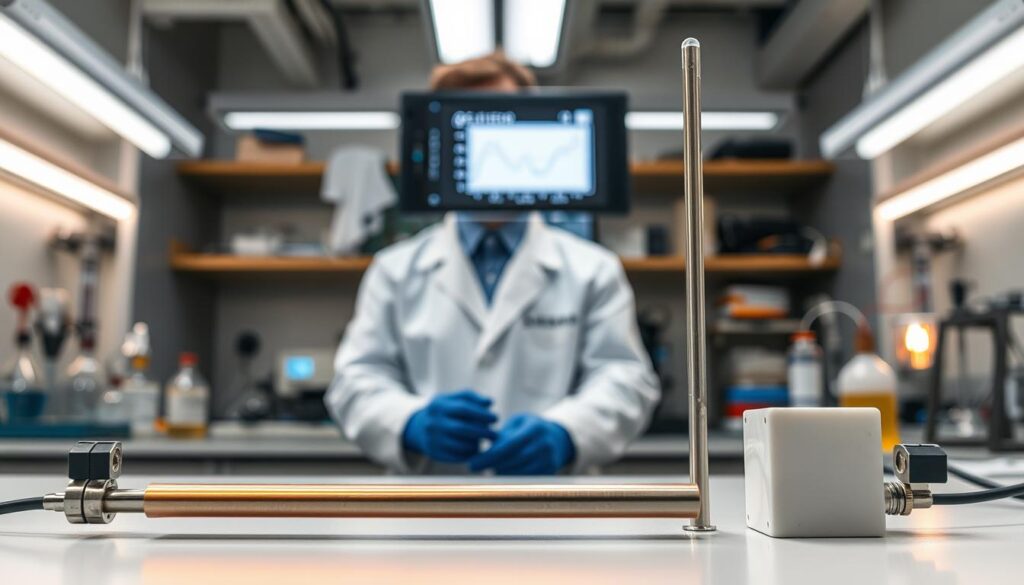
Ever wondered why engineers are so picky about materials? Watch three rods heat up and see the difference. This simple test shows how conduction works and why your steam engine needs the right materials.
Take three rods—copper, steel, and ceramic—each twelve inches long. Heat one end of each to the same temperature. Then, watch how they change over time. You’ll be amazed.
Copper is like a chatty friend, spreading heat fast. Steel moves heat steadily but slower. Ceramic is like slow-moving molasses, letting heat move very slowly.
This isn’t just random. Fourier’s Law explains why materials act differently. It says heat transfer rate depends on thermal conductivity, area, and temperature difference: q = λA(dT/dx).
Fourier’s Law shows physics’ beauty. A bigger temperature difference means heat moves faster. It’s like water flowing down a steep slope.
The thermal conductivity coefficient (λ) shows materials’ true nature. Copper is a champion with 400 W/m·K. Steel is good with 50 W/m·K. Ceramic is slow with 1-2 W/m·K.
Air is really bad at heat flow, much worse than steel. It’s 1,500 to 3,000 times more resistant. Compared to copper, it’s 8,000 to 16,000 times worse. These numbers are huge for insulation.
Plot temperature against time for each rod. You’ll see heat transfer in action. Copper’s curve rises fast, showing quick conduction. Steel’s curve goes up slower but steadily. Ceramic’s line barely moves, looking almost flat.
| Material | Thermal Conductivity (W/m·K) | Heat Transfer Rate | Steam Engine Application |
|---|---|---|---|
| Copper | ~400 | Excellent (8x faster than steel) | Premium boiler tubes, superheater elements |
| Steel | ~50 | Good (25x faster than ceramic) | Standard boiler construction, fireboxes |
| Ceramic | 1-2 | Poor (400x slower than copper) | Insulation, refractory linings only |
| Air | 0.026 | Terrible (15,000x slower than copper) | Insulation gaps, thermal barriers |
Why does this matter for steam engines? Material selection isn’t just about looks—it’s about thermodynamics. Boiler tubes need to be steel or copper to transfer heat well. Ceramic would be too slow, expensive, and fragile.
The temperature gradient is key in conduction systems. Keep a big difference between hot and cold, and efficiency goes up. Let the gradient get smaller, and performance drops fast.
Think about the molecular level. Heat transfer in solids happens through molecular collisions. Copper’s atoms are close and move fast, passing heat well. Ceramic’s atoms are far apart and move slowly, making heat transfer hard.
Choosing the wrong material means big losses. Copper pots are more expensive because they cook faster and use less energy. The same goes for industrial steam systems, where the stakes are higher.
This experiment shows why engineers care so much about materials. The right choice can save fuel, cut emissions, and boost performance. In today’s world, understanding conduction is not just a theory—it’s a way to make money.
Convection in boiling dye plume baffle plates and circulation
Drop a bit of food coloring into boiling water and suddenly you’re witnessing thermodynamics in technicolor. Those graceful plumes rising through the liquid aren’t just pretty—they’re convection doing what it does best. The dye traces invisible currents, revealing how heat transfer happens when fluids get moving.
Here’s what’s actually happening beneath the surface. Water molecules near the heat source absorb energy and start bouncing around like caffeinated teenagers. They spread out, taking up more space, which makes that warmed water less dense than the cooler stuff above it.
Buoyancy takes over from there. The lighter, hotter water rises in visible columns while cooler water from the top sinks down to replace it. This creates circulation patterns that turn your pot into a self-mixing system—no spoon required.
These circulation patterns aren’t random chaos. They follow predictable paths driven by temperature differences. The continuous cycle of heating, rising, cooling, and sinking establishes convection currents that distribute thermal energy throughout the entire volume of fluid.
Now let’s complicate things in the best possible way with baffle plates. These strategically positioned obstacles interrupt the natural flow, forcing water along longer, more winding routes. It’s engineered turbulence with a purpose—maximizing contact time between fluid and hot surfaces.
Think of baffles as speed bumps for heat transfer. They slow down those eager rising currents, extracting every available joule before the water completes its journey upward. In steam engine boilers, this design prevents hot spots and ensures uniform temperature distribution across the entire system.
The math behind this process comes from Newton’s Law of Cooling: q = hA(Ts – T∞). Translation? Heat transfer rate (q) depends on the convective heat transfer coefficient (h), surface area (A), and temperature difference between the surface and surrounding fluid. Bigger temperature gaps mean faster convection.
Natural convection operates purely on density differences—thermodynamic inevitability doing its perpetual thing without mechanical assistance. Forced convection adds pumps or fans to accelerate the process when nature’s pace doesn’t match industrial demands. Both have their place, depending on whether you’re prioritizing simplicity or speed.
| Characteristic | Natural Convection | Forced Convection |
|---|---|---|
| Driving Force | Buoyancy from density differences | Mechanical pumps or fans |
| Heat Transfer Rate | Moderate, self-regulating | High, adjustable speed |
| Energy Input | None beyond heat source | Requires electrical power |
| Application Example | Simple boiler systems | Industrial steam generators |
In practical steam engine applications, convection circulation prevents the engineering nightmare of localized overheating. Without it, you’d have scorching zones next to tepid pockets—like a casserole that’s burnt on top and frozen in the middle. The beauty lies in its self-sustaining nature.
Watch those dye plumes long enough and you’ll see physics teaching itself. The rising columns, the sinking currents, the endless cycle—it’s all natural convection making visible what’s usually invisible. And in steam engines, it’s what keeps everything running smoothly without melting down.
Radiation emissivity foil vs matte IR thermometer lab
Imagine the sun, 93 million miles away, yet you feel its warmth. This is radiation at work, transferring heat without touching anything. It’s like thermal radio waves moving through space.
Every warm object sends out thermal radiation. Your coffee mug and the steam engine’s firebox do this too. Even you are radiating heat, but not in a way we can see.
Molecules are always moving, creating waves that spread out. The hotter an object, the more energetic its waves.
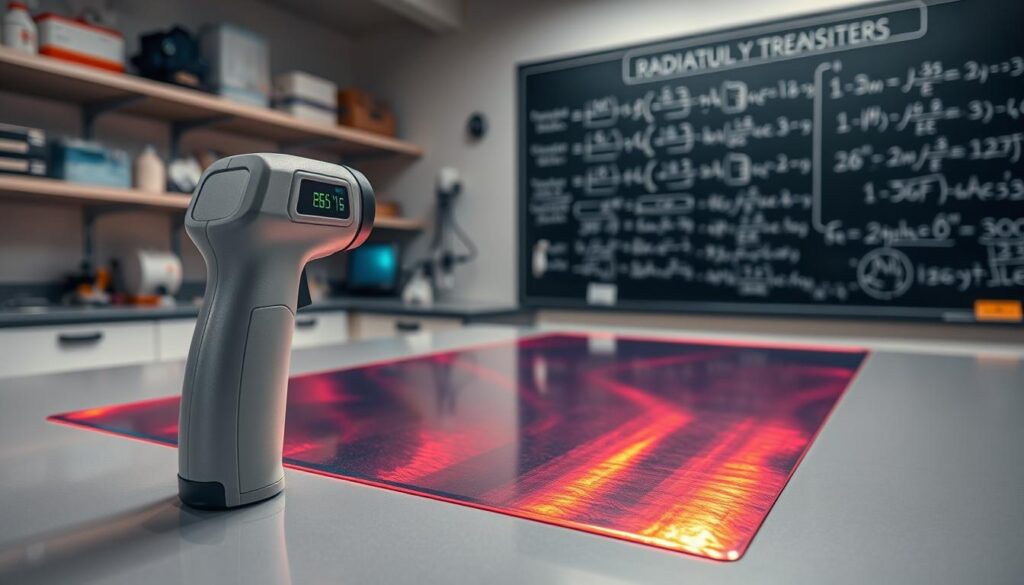
Emissivity shows how well a material radiates heat. It ranges from 0 to 1, with 1 being perfect at radiating. This is important for understanding how objects lose or gain heat.
Use an IR thermometer on aluminum foil and matte black paint at 200°F. The readings will show how different materials handle radiation.
Shiny foil reflects radiation well, but doesn’t emit much. Matte surfaces, on the other hand, absorb and emit heat efficiently. This is key for steam engines.
| Material Surface | Emissivity Value | Radiation Behavior | Steam Engine Application |
|---|---|---|---|
| Polished Aluminum Foil | 0.03 – 0.06 | Reflects 94-97% of thermal radiation | External cladding to minimize heat loss |
| Matte Black Paint | 0.95 – 0.98 | Absorbs and emits 95-98% efficiently | Firebox interior for maximum absorption |
| Oxidized Copper | 0.60 – 0.70 | Moderate emission and absorption | Boiler tubes balancing heat transfer modes |
| Polished Steel | 0.07 – 0.15 | Reflects most radiation, low emission | Steam piping exterior insulation barriers |
In steam engines, using the right materials and finishes is key. Paint the firebox dark to absorb heat. Use reflective materials outside to keep heat in.
Surface finish is as important as material for heat transfer. A polished copper pipe is different from an oxidized one. It’s not just about the material, but how it interacts with radiation.
Infrared radiation is part of the spectrum we can’t see. It affects how materials interact with heat. Water absorbs it well, while glass and metal reflect it.
Do a simple test. Heat three metal plates to 300°F. One is polished, one is matte black, and one is oxidized. Use an IR thermometer to measure the temperature as they cool.
The polished plate will show lower temperatures. This is because shiny surfaces reflect radiation well. The matte black plate will give accurate readings. The oxidized plate will be somewhere in between.
This isn’t just about science. When using IR sensors in steam engines, knowing emissivity is important. If you don’t adjust for emissivity, your readings will be wrong.
Some IR thermometers let you adjust for emissivity. Set it to 0.95 for matte surfaces and 0.1 for polished metal. This makes your measurements accurate.
The main point is that electromagnetic radiation doesn’t care about looks. It follows quantum rules that make surface properties as important as material. To reduce heat loss, make surfaces reflective. For maximum absorption, go dark and matte.
This is heat transfer at a different level. It travels at the speed of light, needing no medium. It’s why space is cold, despite being filled with radiation. And it’s why your steam engine’s efficiency depends on the right surfaces.
Insulation lagging thickness vs heat loss simple R value calc
Insulation is like the cheapest horsepower you’ll never buy. It keeps the energy you paid for from escaping. In steam engines, where every British thermal unit counts, understanding thermal resistance is key. It’s about keeping your money warm, wrapped in fiberglass.
The Victorians called it “lagging,” which sounds like a Monday morning feeling. But it’s actually about wrapping boilers and pipes in layers to keep heat in. The basic idea is simple: block the heat from escaping.
Insulation works by using materials that don’t let heat pass through easily. Air is the best at this, and we breathe it without even noticing.
Air is amazing at stopping heat transfer. Here are some comparisons that make engineers happy:
- Air is 1,500 to 3,000 times better at blocking heat than steel
- Air beats copper by a factor of 8,000 to 16,000
- A 0.025 mm film of air blocks as much heat as 400 mm of solid copper
- Trapped air is free and works better than expensive materials
That last point is key. The best insulator is free and everywhere. We just need to trap it with materials like fiberglass or foam.
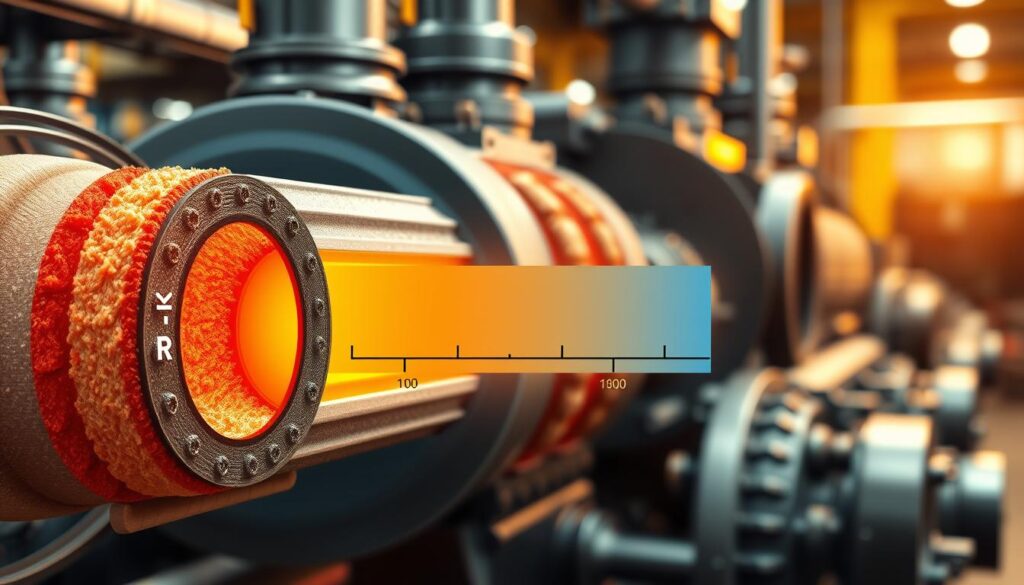
Engineers use R-value to measure how well insulation works. Think of it as keeping your expensive heat in. Higher R-values mean better performance and lower bills.
The math is simple:
R = thickness ÷ thermal conductivity
Thickness is measured in inches or meters. Thermal conductivity shows how well heat flows through a material. Divide one by the other, and you get your thermal resistance.
Here’s the cool part: R-values add up like frequent flyer miles. More insulation means more R-value. Two inches of material with R-10 per inch equals R-20 total. This math is too easy.
Thickness and heat loss aren’t directly related. Doubling insulation thickness more than doubles your resistance to energy loss. This is huge when fuel costs a lot.
| Material | Thermal Conductivity (W/m·K) | R-value per Inch | Typical Application |
|---|---|---|---|
| Fiberglass batts | 0.040 | 3.14 | General purpose lagging |
| Mineral wool | 0.038 | 3.30 | High-temperature pipes |
| Polyurethane foam | 0.023 | 6.25 | Space-constrained areas |
| Calcium silicate | 0.052 | 2.44 | Industrial boiler surfaces |
Notice how special insulation materials beat structural ones. Steel’s thermal conductivity is around 50 W/m·K, much worse than foam. Copper is even worse, near 400 W/m·K.
In steam engines, good lagging changes the game. Those wrapped pipes aren’t just pretty. They’re smart investments that save money every hour.
Calculate your heat loss with and without insulation. The difference is money lost to the air. A bare steam pipe at 300°F loses about 1,500 BTU per hour per square foot to air at 70°F.
Add two inches of mineral wool, and that drops to about 150 BTU per hour per square foot. That’s a 90% cut in wasted energy. Over a year, the savings can pay for insulation in months.
Insulation also helps the environment. Less fuel means fewer emissions. It’s a simple way to fight climate change.
Victorian engineers learned the hard way. Their well-lagged engines outperformed and made more money. Today, we know the same thing: letting heat escape is bad for business and the planet.
When picking insulation for your steam engine, think about a few things:
- How hot the surface will get
- The environment it will be in
- The R-value you need for savings
- How thick you can make it
- How long it needs to last
Do the math before you decide. Figure out heat loss, multiply by fuel costs, and see when you’ll break even. More insulation is usually better.
The biggest mistake is using too little insulation. An extra inch costs a bit upfront but saves a lot over time.
Watch your fuel bills go down. Trapping air around hot surfaces turns waste into efficiency and saves money.
Efficiency ideas feedwater heating economizer condensate return
Want to know where your fuel dollars are disappearing? Follow the heat that’s leaving your system unused. Every degree of temperature that escapes up the stack or radiates into the air represents wasted energy—and wasted money.
Improving boiler efficiency isn’t about exotic technology or expensive overhauls. It’s about capturing heat that’s already there and putting it to work. Three proven strategies dominate the efficiency landscape: feedwater heating, economizers, and condensate return systems.
Let’s start with feedwater heating, which is delightfully straightforward. Why start with cold water when you have waste heat lounging around? Preheating incoming water reduces the energy needed to reach boiling temperature. It’s thermal recycling at its finest.
The process works like this: exhaust gases or condensate heat exchange with cold makeup water before it enters the boiler. That simple swap can boost system performance by 5-10%. Not revolutionary, perhaps, but those percentages compound over time.
An economizer takes this concept further. This heat exchanger sits in the exhaust gas stream, capturing thermal energy before it vanishes up the stack. Those gases leaving at 400-600°F carry substantial heat—heat that represents burned fuel doing absolutely nothing useful.
Installing an economizer recovers that escaping energy and transfers it back into the feedwater. The efficiency gains are measurable and immediate, often improving heat transfer effectiveness by 10-15%. That’s the kind of number that makes plant managers very happy.
Then there’s condensate return, the circular economy of steam systems. When steam condenses after doing work, it becomes hot water containing significant residual energy. Dumping this condensate is thermodynamically criminal.
Returning condensate to the boiler saves energy, reduces water treatment costs, and minimizes thermal stress on equipment. The water is already hot (often 180-212°F) and already purified—distillation is an excellent side effect of condensation. Why waste that?
| Efficiency Method | Heat Recovery | Typical Savings | Payback Period |
|---|---|---|---|
| Feedwater Heating | Uses waste heat to preheat incoming water | 5-10% fuel reduction | 1-3 years |
| Economizer Installation | Captures exhaust gas heat before stack exit | 10-15% efficiency gain | 2-4 years |
| Condensate Return | Recycles hot condensed steam to boiler | 8-12% energy savings | 6 months-2 years |
| Combined Systems | Integrates all three recovery methods | 20-30% total improvement | 3-5 years |
Stack these improvements together, and thermal efficiency jumps dramatically. We’re talking 20-30% gains when all three systems work in harmony. Those aren’t incremental improvements—they’re transformative.
The sustainability angle matters too. Reduced fuel consumption means lower emissions, smaller carbon footprints, and less environmental impact. What starts as an economic decision becomes an environmental win. Capitalism and conservation aligned—it does happen occasionally.
In industrial settings, effective heat transfer management separates competitive operations from historical curiosities. The plants that thrive are those that treat waste heat not as inevitable but as recoverable opportunity. Every BTU counts, and every joule saved contributes to the bottom line.
Modern steam systems incorporate these efficiency strategies as standard practice, not optional upgrades. The question isn’t whether to implement them but how quickly you can justify the capital investment. With payback periods measured in months or a few years, the math generally works in your favor.
For heat transfer steam engines—whether powering locomotives, generating electricity, or driving industrial processes—boiler efficiency determines viability. The difference between profitable operation and expensive nostalgia often comes down to what you do with heat that’s trying to escape.
Mini project insulate a kettle measure time to boil savings
Science doesn’t always need big machines. Sometimes, a kettle, a towel, and a stopwatch are enough. This practical application turns your kitchen into a real science lab. You can learn about insulation without spending money on fancy tools.
Begin by measuring how long it takes for a liter of water to boil. Let’s say the water is 68°F. Note how long it takes and if your kettle shows energy use. If not, figure it out by multiplying the wattage by the time in hours.
Next, wrap your kettle like a surprise gift. Towels, bubble wrap, or even a scarf work well for insulation. Use duct tape to keep everything in place, leaving the spout and handle free.
Do the experiment again with your kettle wrapped up. Use the same water and starting temperature. You’ll see the kettle boil faster because less heat transfer happens.
The time saved might seem small at first. But, a 15% boost in thermal efficiency is big. An industrial boiler could save thousands of dollars a year with this improvement.
Keep track of your results. Make a table to compare the two trials. The numbers will show how heat transfer theory works in real life. It’s very satisfying.
| Condition | Time to Boil (minutes) | Energy Used (Wh) | Heat Lost (%) |
|---|---|---|---|
| Uninsulated Kettle | 5.2 | 156 | 22 |
| Towel Insulation (1 inch) | 4.5 | 135 | 11 |
| Bubble Wrap (2 layers) | 4.3 | 129 | 8 |
| Newspaper (3 inch layer) | 4.6 | 138 | 13 |
If you’re up for it, plot your findings. You’ll see curves that match what scientists predict. This shows which household items are best at keeping heat in. Your data is real proof.
For big steam engines, these ideas are key to making money. Saving heat means less fuel, less pollution, and lower costs. This simple kettle test shows how practical application proves theory right.
This mini-project is open to everyone. You don’t need rare materials or fancy tools. Just use what you have to show how thermal efficiency can improve. And you’ll have hot water for tea too.
Safety hot surfaces scald prevention checklist
Understanding heat transfer is interesting. But, experiencing it firsthand is not. It’s important to know how to avoid burns.
Hot surfaces in steam systems are dangerous. Conduction can transfer heat to skin quickly. Skin damage starts at 44°C (111°F), while steam system parts often get hotter.
Some boiler surfaces get very hot. The physics is simple: hot metal plus skin equals burns fast. Burns can happen in under three seconds at these temperatures.
Here’s your essential safety protocols checklist. It’s better to finish this article with your skin intact:
- Assume all surfaces are hot – Visual inspection is unreliable. Metal doesn’t glow red until it’s very hot. Never test with bare hands.
- Install proper insulation – Cover all accessible surfaces with lagging materials. If budget is tight, focus on areas where people are likely to touch.
- Use warning labels and barriers – Clear signage prevents accidents. Physical barriers add extra protection.
- Implement temperature monitoring – Install thermometers and alarms for abnormal conditions. Early detection prevents accidents.
- Maintain adequate ventilation – Prevent steam accumulation that can cause scalds. Steam dispersal is critical.
- Understand latent heat dangers – Steam at 100°C carries more energy than water at the same temperature. Steam burns are severe.
- Wear protective equipment – Heat-resistant gloves and long sleeves reduce conduction risk during maintenance.
- Train all personnel – Everyone working near steam equipment must understand thermal hazards and emergency procedures. Knowledge prevents accidents.
Schools and training facilities need to be extra careful. They must have safety protocols before any hands-on demonstrations. Young learners need to know about hot surfaces and burn prevention.
The table below shows how quickly thermal hazards can cause tissue damage at common steam system temperatures:
| Surface Temperature | Contact Duration | Injury Severity | Common Location |
|---|---|---|---|
| 44°C (111°F) | 6 hours | First-degree burn | Warm water jacket |
| 55°C (131°F) | 17 seconds | Second-degree burn | Steam pipe exterior |
| 60°C (140°F) | 5 seconds | Full-thickness burn | Boiler shell |
| 100°C (212°F) | Under 1 second | Severe tissue damage | Exposed firebox |
In steam engine operations, safety and efficiency go hand in hand. Proper insulation protects both humans and energy budgets. It also reduces heat transfer losses to the environment.
Temperature monitoring is key for safety and system optimization. Unexpectedly hot surfaces often show insulation failure or circulation problems. Fixing these issues improves safety and performance.
Follow these safety protocols consistently. You’ll learn about thermal physics without risking injury. Practical caution and knowledge create a safe learning environment for exploring conduction, convection, and radiation in steam systems.
Wrap up worksheet match parts to heat modes
Time for your thermal literacy test. Grab a pen and match each steam engine component to its dominant heat transfer mode. The firebox radiates infrared energy like a tiny sun. Copper tubes are all about conduction, passing heat molecule by molecule.
The water jacket circulates through convection currents. Hot water rises and cool water sinks in endless loops.
Here’s the twist that separates amateurs from experts: nothing operates in isolation. The water jacket experiences conduction from metal walls, convection within the fluid, and radiation from nearby flames. Steam engines are thermal orchestras, not solo performances.
Your worksheet should include these components: firebox (radiation dominant), boiler tubes (conduction), water circulation (convection), steam drum (mixed modes), and insulation (blocks all three). Can you identify which thermal processes matter most in each location? What happens when you swap materials or change configurations?
This isn’t academic busywork. Understanding heat transfer mechanisms in steam engines builds intuition that applies everywhere, from kitchen kettles to power plants. The physics doesn’t care about scale or century. Victorian locomotives and modern thermal systems follow identical laws.
Master these principles and you’re not just memorizing facts. You’re learning to see the invisible dance of energy that powers our world.
