

Forget the scantron. Today’s test isn’t in a quiet classroom. It’s in a roaring arena where the next generation builds, codes, and solves problems under pressure. Welcome to the high-stakes world of student contests, where innovation is the goal, not just a passing grade.
Think of it as the intellectual equivalent of a rock tour. Instead of guitar solos, you get the synchronized dance of robotics arms and the elegant logic of fresh code. This is the modern landscape of Youth Engineering Programs.
From the nationally televised drama of the Discovery Channel Young Scientist Challenge to the garage-born spirit of a local hackathon, these events form a sprawling ecosystem. Major leagues like FIRST Robotics and the Regeneron ISEF are household names. Even government-backed efforts, like ORISE challenges, dangle serious prizes—3D printers, telescope kits—to fuel young minds.
So why has this become the new crucible for talent? It’s simple. These engineering competitions demand more than a poster board. They require grit, creativity, and real-world application. It’s a far cry from the participation trophy. This is where future innovators are forged.
Ready to look behind the curtain? Let’s analyze what makes these STEM competitions tick, who they’re really for, and why your old science fair project suddenly feels so quaint.
Major Competition Overview
Not all STEM challenges are the same. Some can really kickstart a career. The world of engineering contests is vast, like a buffet with too many choices. Each contest promises glory, but only a few can boost your resume like a rocket.
So, how do you pick the right one? It’s like choosing the best TV show from a long list. We’re looking for contests that can make a real difference in your career.
The Regeneron Science Talent Search is like the Ivy League for pre-college research. It’s about solving real-world problems with advanced skills. The FIRST Robotics Competition is like a sport, combining engineering and strategy.
The Congressional App Challenge is unique. It shows that coding can impact politics. These contests are the big leagues.
But what’s best for your student? Are they coding or saving the environment? The best STEM challenges match their age and interests. The table below helps you choose the right one.
| Age Group | Competition Name | Primary Discipline | Notable Perk |
|---|---|---|---|
| Middle School | Future City | Civil Engineering, Urban Planning | Teaches scalable systems thinking early. |
| Middle School | Broadcom MASTERS | General Science & Engineering | National recognition for junior scientists. |
| Middle School | Science Olympiad | Multi-Disciplinary Science | Builds teamwork across scientific fields. |
| High School | Envirothon | Environmental Science | Hands-on, solutions-based environmental focus. |
| High School | Regeneron STS | Independent Research | Ultimate prestige and significant scholarship money. |
| High School | AIME (American Invitational Math Exam) | Advanced Mathematics | Pure meritocracy; a test of raw problem-solving. |
| High School | Moody’s M3 Challenge | Mathematical Modeling | Applies math to real-world business & policy issues. |
| All Ages | FIRST LEGO League | Robotics & Programming | Scaffolded learning from elementary to high school. |
| All Ages | CyberPatriot | Cybersecurity | Direct pipeline to national security careers. |
| All Ages | Purple Comet! Math Meet | Mathematics | International, team-based online format. |
The top youth programs do more than test your knowledge. They simulate real-world environments. The Moody’s M3 Challenge is like consulting, and CyberPatriot is like defending against cyber threats.
Choosing the right challenge is a big decision. Is your student a solo researcher or a team player? The table is your guide to finding the right fit. The right STEM challenge can boost your skills and tell a compelling story in college essays.
In the end, these contests are more than just competitions. They are youth programs that build skills and networks. They help you stand out in a crowded field by showing your commitment.
Steam-Specific Challenges
STEAM challenges are like an obstacle course through an art gallery. They’re not just about building a robot or a car. It’s about creating something elegant, telling a story, or showing what’s possible with simple materials.
The ‘A’ for Arts adds a special touch. It brings design thinking, storytelling, and beauty into the mix.
Logic and creativity meet in these challenges. Let’s look at some student contests that need this mix.
FIRST Tech Challenge is a robot competition. But it’s more than that. Teams build robots using Java and must have a strong team brand and a detailed engineering notebook. The robot should be not just functional but also elegant.
Autodesk’s F1 in Schools challenges students to design a miniature F1 car. The focus is on aerodynamics and CAD modeling. But the car’s design, the team’s uniform, and the pit display are also key. Students must be engineers, marketers, and designers.
The ArcGIS StoryMaps Competition is different. It’s about telling a story with geospatial data. Students analyze data to share a community issue. The engineering is in the data, and the art is in the storytelling.
The ORISE “Repurpose” Challenge is like MacGyver. Students turn household items into something new. It’s about creativity and seeing things in a new way.
The NSF Game Maker Awards ask students to design future tech through games. The ‘A’ is the game itself. It combines coding, character design, and storytelling.
These engineering competitions all share a common trait. They blend technical skills with creativity. Here’s a table showing their dual nature.
| Competition | Technical Core | Artistic/Design Element | Key Output |
|---|---|---|---|
| FIRST Tech Challenge | Robotics, Java Programming | Team Branding, Engineering Notebook Narrative | Functional Robot & Presentation |
| F1 in Schools | Aerodynamics, CAD Modeling | Car Livery & Graphic Design, Marketing Pitch | Scale Model Car & Portfolio |
| ArcGIS StoryMaps | Geospatial Data Analysis | Digital Storytelling, Visual Data Presentation | Interactive Online Story |
| ORISE “Repurpose” | Engineering Design Process | Creative Re-imagination, Aesthetic of Final Product | Prototype from Recycled Materials |
| NSF Game Maker | Game Development Coding | Game Art, Narrative, World-Building | Playable Game Concept |
These challenges show that the best solutions come from combining different ways of thinking. A programmer can think like a storyteller, and a designer can understand physics. These student contests help students develop this hybrid mindset.
Want to see more examples? Check out our list of engineering challenges for high school students that show innovation across disciplines.
STEAM competitions are not just adding a touch of art. They’re changing how we solve problems. And that’s a challenge worth taking on.
Team Formation Strategies
Forget the myth of a solo genius working alone. Winning in youth programs is all about teamwork. The idea of a lone wolf is charming but useless. Real success in STEM challenges comes from a team of experts, each with their own skills.
Think of it like planning a heist, not like assembling the Avengers. You need the right person for every task. So, how do you find this dream team from your school’s hallways?

The first rule is to look for people with different skills, not just copies of yourself. A good team usually has three main types:
- The Visionary: The dreamer who sees the final product before it’s built.
- The Pragmatist: The practical person who turns ideas into working prototypes.
- The Debugger: The patient one who finds and fixes problems late at night.
Competitions like FIRST Robotics or MATHCOUNTS don’t just reward individual talent. They test a team’s ability to work together, think creatively, and communicate under pressure. A team of dreamers alone might have great ideas but nothing that works.
Managing personalities is key when deadlines are tight and problems arise. Set clear roles and a way to communicate from the start. Who decides on design changes? How do you handle disagreements without conflict?
Use a simple, agile workflow. Break the project into weekly goals. Hold a 15-minute meeting each morning to stay on track. This isn’t just corporate jargon; it’s essential for success. It prevents wasting time on the same task over and over.
Let’s look at some major competitions and the team dynamics they require. This isn’t about finding friends; it’s about finding the right team members.
| Competition | Team Size | Key Archetype Needed | Why It Works |
|---|---|---|---|
| FIRST Robotics | 10-30 | The Pragmatist | Ideas are cheap. A robot that moves and doesn’t catch fire is priceless. |
| Future City | 3-5 | The Visionary | You need someone who can imagine a hyperloop station before it’s physically possible. |
| MATHCOUNTS (Team) | 4 | The Debugger | Calm under pressure, able to spot a subtle error in a complex calculation while the clock ticks. |
| HMMT (Team Rounds) | 8-15 | All Three | A pure math tournament needs dreamers to propose novel solutions, builders to execute, and detectives to find the flaw. |
Recruitment is an art. Post flyers in the computer lab and the art room. The best coder might be in the film club, and the most compelling presenter might be the debate team captain.
Once formed, the real work is building trust. This isn’t about being friends. It’s about respecting each other’s skills. Can you trust the pragmatist to tell the visionary that their design has physics problems?
Effective teamwork in these challenges is a skill that helps in the real world. For more guidance, check out a formal engineering mentorship program for communication and project management tips.
So, drop the fantasy of going it alone. Your success in these challenges depends on your team. Start recruiting like your grade depends on it. Because in these youth programs, it just might.
Project Development Process
The project development process in student contests is tough and takes time. You have a team and a challenge. The first hurdle is the calendar.
Start early, much earlier than you think. Three to six months before the deadline is key. This time is for learning and improving your skills. If your project is a Scratch game, start learning now. If it’s about alien creatures, dive into biology today.
The first month is for a “vomit draft.” It’s a bad but necessary step. Your first version should be complete but not perfect. Think of it as the first pancake, a sacrifice to the griddle gods.
Perfectionism can kill your chances in engineering competitions. A bad first draft shows your idea works. It lets you improve it, moving from vague worries to real problems.
So, how do you turn this draft into a winning project? Let’s look at the messy steps involved.
- Ideation & Research: This is the brainstorming phase. Your team comes up with ideas, but they must be based on solid research. For example, if you’re explaining a human body system, you need to know about educational theories and safety.
- Prototyping: Make the simplest version first. For an app, start with a paper wireframe. For a science project, begin with a basic setup. The goal is to move fast, not to make it perfect.
- Testing (The Failure Phase): This is where you learn. Your prototype will fail, confuse users, or give boring results. Celebrate these failures. They tell you what to fix next.
- Refining: Use the test data to improve your project. Make it better, simpler, and clearer. This is the heart of engineering—getting better with each try.
- The Final Polish: In the last weeks, focus on how to present your project. Make sure it’s easy to use and understand. This polish is what makes a good project great.
This isn’t a straight path. It’s more like a messy scribble. You’ll go back to research and rebuild during testing. Embrace the chaos.
Think about famous product failures. They often skipped testing and ignored feedback. Your student contest project is like a small version of the real world. The winners aren’t just lucky. They start early, build something bad first, and listen to every failure.
The final submission is just the end result. The real prize is mastering the process itself.
Mentorship & Coaching
Forget the myth of the lone genius; behind every winning team in these youth programs is a guide who has already navigated the maze. The difference between a good project and a podium finish often isn’t a better algorithm or a sleeker chassis. It’s the seasoned voice that asks, “Have you considered the thermal loss here?” or calmly suggests, “Let’s debug the code from a different angle.” This is the secret sauce.
So, where do you find your Yoda? The ecosystem is richer than you think. Start with the dedicated teacher who stays after school. Then, look to the industry professional you can politely stalk on LinkedIn—many are flattered to be asked. Crucially, seek out previous competition participants. Their recent battlefield experience is pure gold. The directive is simple: Seek mentorship and guidance. It’s not a sign of weakness; it’s a tactical acquisition of intellectual capital.
Beyond the one-on-one connection, structured coaching programs offer a turbocharged path. Organizations like Create & Learn provide live online classes designed by experts from Google, Stanford, and MIT, building foundational skills on demand. For competitions like the Congressional App Challenge, official mentoring classes are offered at key times to help teams prepare. These programs are the boot camps for STEM challenges, transforming enthusiasm into executable strategy.
The magic, though, isn’t in having a mentor who gives you the answer. That’s a crutch. The real value is in the dynamic—the modern digital apprenticeship. A great coach doesn’t write your code; they teach you how to ask the right questions to debug it yourself. They won’t design your gear system, but they’ll help you navigate the intellectual dead-end you’ve spent three weeks in. This relationship is about debugging human potentials.
The takeaway? Don’t just look for an expert. Look for a translator—someone who can bridge the gap between textbook theory and the messy, glorious reality of competition. Leverage both the informal network and the formal youth programs. In the high-pressure crucible of STEM challenges, that guidance isn’t a luxury. It’s your most critical piece of non-digital infrastructure.
Funding & Resources
In the world of student engineering competitions, the prizes have changed a lot. Gone are the days of just getting a certificate. Now, winners get top-notch tools that help shape their futures.
Winning a big contest can get you amazing prizes. You might get a FlashForge 3D printer or a Lego SPIKE Prime robotics kit. Some prizes include advanced AI robots, telescopes, or Amazon tablets for design on the go. These prizes are more than just swag; they’re the start of your next big project.
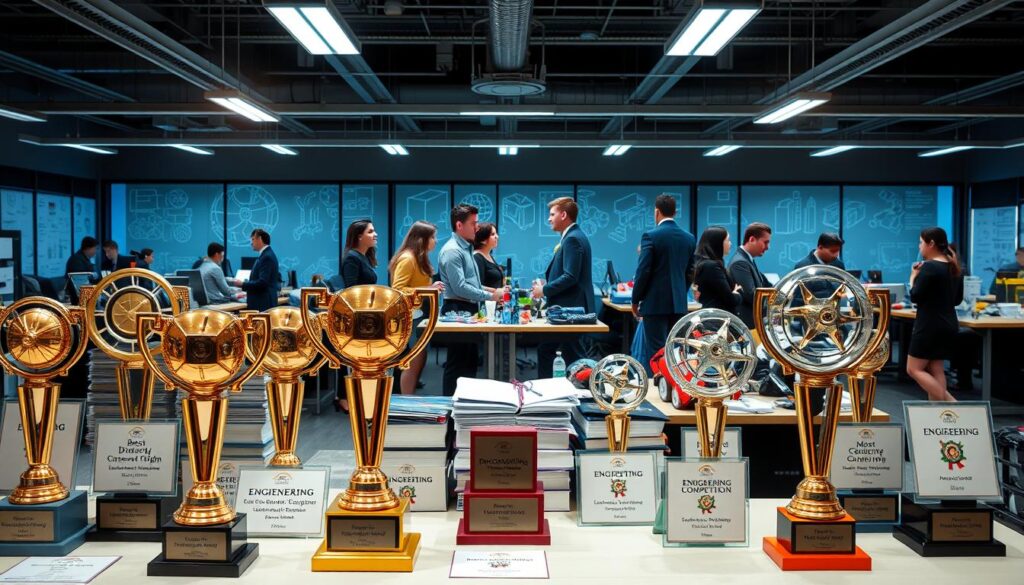
The best rewards are often the ones you can’t see. Think about winning a trip to Washington D.C. or getting a scholarship. These rewards can change your life.
To understand the value of these prizes, let’s look at a table. It shows what you can win in engineering competitions and how it helps you.
| Prize Category | Example Items | Strategic Value |
|---|---|---|
| Hardware & Prototyping | 3D Printers (FlashForge), Robotics Kits (mBot2, Lego SPIKE) | Eliminates capital cost for future projects; enables rapid iteration. |
| Computing & Tech | Amazon Tablets, AI Robots (Miko 3), Gift Cards | Provides the digital tools and connectivity essential for modern design and research. |
| Recognition & Access | Trips to D.C., Capitol Display, Media Features | Builds a professional network and portfolio that opens doors to internships and careers. |
| Financial Support | Scholarships, Grant Money, Stipends | Directly funds education or living costs, reducing financial stress and freeing time for innovation. |
Starting from scratch? The art of the bootstrap is key. First, never pay for software you can get for free. Autodesk and GitHub offer great resources for students. The digital world is full of free tools if you know where to look.
Finding physical materials is harder. Look for university surplus sales or partner with a makerspace. Your biggest asset is your creativity. A good proposal can turn a local business into a sponsor. Show them how your project benefits the community.
This guide shows that student contests do more than just reward winners. They fund the next wave of innovation. The prize you win today can lead to more wins tomorrow. Scholarships help you learn the skills needed for future success.
In the world of engineering competitions, smart funding is key. It helps talented students who can’t afford to compete. It turns ideas into projects that can be funded. Smart funding is about building a future, not just winning today.
Competition Calendar
The competition calendar doesn’t care about your midterms, prom, or sleep. It moves forward with no mercy. Treating STEM challenges lightly leads to all-nighters and regret. You need a solid plan, not just a glance at deadlines.
Think of the academic year as a three-act drama. Each season has its own rhythm and opportunities for youth programs participants.
Fall is for architects. This is the time to make plans. While others buy notebooks, you analyze new rules. Science Olympiad releases its rules on September 3rd, and ArcGIS StoryMaps opens on September 4th. Your task is to dissect rules, find skill gaps, and build your team. Fall asks: what can you create in six months?
Winter is for engineers. This is when theory meets reality. Regional heats start, and contests like the New York Times STEM Writing Contest (February-March) require polished submissions. This is the time to fix your project and team. The pressure grows, but so does your skill.
Spring is for performers. National finals begin. Purple Comet! Math Meet runs in April-May. This is the time for last-minute tweaks. The teams that succeed here followed the golden rule in the architect phase.
That rule? Start 3-6 months before the deadline. Work backward from the final date. Need a prototype by March? Start in October. Need research by April? Begin in November. This isn’t just advice—it’s the key to success.
| Competition | Key Dates & Deadlines | Prep Timeline | Format |
|---|---|---|---|
| New York Times STEM Writing Contest | Submission Window: February – March | Start research & drafting in November | Written article (800 words) |
| ArcGIS StoryMaps Challenge | Opens: September 4 | Begin spatial data collection in July | Interactive digital story |
| Purple Comet! Math Meet | Event: April – May | Team practice problems starting January | Online team math contest |
| Science Olympiad | Rules Release: September 3 | Team formation & design planning in August | Multi-event tournament |
| Local/Regional Science Fairs | Varies by region (Typically Jan-Feb) | Begin experimentation 4-5 months prior | Project display & judging |
Look at that table. See the pattern? Every major STEM challenge gives you a runway. The September openings mean summer prep. The spring finals demand winter refinement. This calendar isn’t random—it’s designed to test your effort, not last-minute genius.
So how do you use this? Create a reverse timeline. Write the final deadline in red at the bottom of a page. Work backward: one month for final testing, two months for integration, three months for core development. Suddenly, that distant deadline has immediate tasks.
This approach turns anxiety into action. Instead of wondering when to start, you know. Instead of scrambling, you’re executing. The academic calendar becomes a series of milestones. That’s the power of treating youth programs seriously.
Remember: winning teams don’t just build better robots or write better papers. They master time itself. Your most precious resource isn’t funding or tools—it’s the weeks before the deadline. Use them wisely.
Success Stories
Winners like Ava V. from Florida and Kabir M. from Ohio get the headlines. But their real stories start after the competition ends. It’s about the journey they begin, not just the win.
Sophie Andrews, a Stanford student and Create & Learn instructor, is a great example. She didn’t just win; she built tools and landed an FCC internship. Her story shows how winning can lead to more learning and opportunities.
What does winning in engineering competitions really mean? It’s not always what you think.
- A portfolio that doesn’t just sit in a drawer. It’s the app prototype that impresses in a summer job interview.
- The “failure” that teaches more than a textbook. The robot that didn’t work but taught a team a lot about engineering.
- The algorithm of grit. Staying up late to fix code for a competition teaches resilience for real-world problems.
These youth programs create powerful stories. They’re not just for college applications. They show students their capabilities. They move from “I competed” to “I built,” “I solved,” and “I learned why it broke.”
The trophy is nice, but the real prize is confidence. It comes from completing a project, no matter how rough. It’s the difference between knowing theory and applying it in the real world.
Success is not just about winning. It’s about the journey. Every participant has a story. The student who got their first tech job. The team that learned to work together. These engineering competitions teach curiosity and grit. That’s the real success story.
College & Career Benefits
Let’s talk about the return on investment. You’ve given up free time for solder burns and debugging marathons in these contests. What’s the real payoff?
For college, it’s a three-dimensional proof of passion. It shows you’re proactive and can follow through. This is what admissions officers love to see, more than just a form.
The career benefit is raw skill. You didn’t just learn about circuits. You built a working device for a STEM challenge. This is the skill employers look for.
These Youth Engineering Programs help you build your first professional network. The teammate who helped you at 2 AM might be your future co-founder.
This is a sneak peek into your professional life. Real engineering is all about teamwork, iteration, and meeting deadlines. You’ve already experienced this.
Live online classes from top institutions are part of these programs. They turn theory into practical skills. These are the skills the market values.
Think of these contests as more than hobbies. They are career accelerators. In an economy that values creators, these challenges prepare you to build the future, not just study it.
