
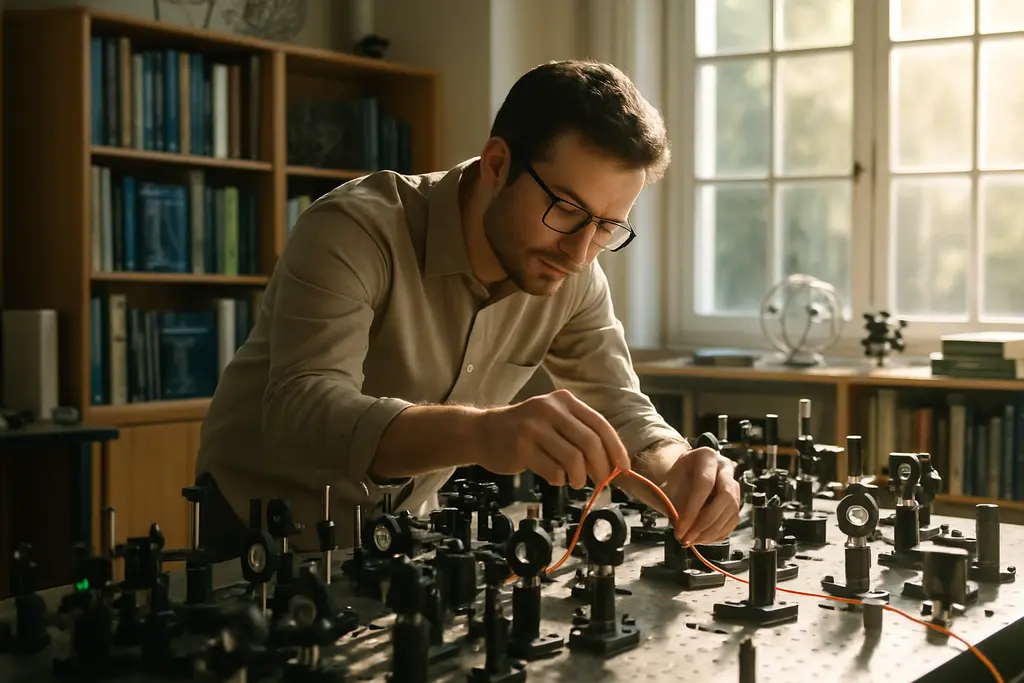
Sunlight Entanglement moved from a plausible physics question to an outdoor laboratory result on August 6, 2026, when researchers reported that natural, incoherent sunlight could generate high-quality polarization-entangled photon pairs. The result matters because most entanglement sources used in quantum optics rely on lasers as controlled pump sources. Replacing that pump with daylight changes the engineering problem: instead of asking only how cleanly a laser can drive a nonlinear optical process, researchers must ask whether an unstable, broadband, weather-dependent source can still produce useful quantum correlations.
The answer from the 2026 experiment is cautiously positive. The demonstrated photon pairs showed strong non-classical correlations, but the work remains early-stage. It was not a field-ready communication system, not a satellite terminal, and not a commercial source of quantum keys. It was a laboratory and outdoor optical experiment showing that sunlight can drive spontaneous parametric down-conversion, or SPDC, in a nonlinear crystal. That distinction matters. In engine terms, the study did not build the vehicle; it showed that an unconventional fuel can fire a specific part of the system under measured conditions.
What The 2026 Experiment Showed
Sunlight Entanglement In The Lab
The experiment, reported by Li, Brar, Küblböck, Upham, Fattahi, and Boyd, used sunlight as the pump for SPDC, a process in which one incoming photon can be converted into a pair of lower-energy photons whose polarization states are entangled. The source was not an idealized beam from a laser bench. It was natural sunlight gathered outdoors, concentrated, and fed into a small nonlinear crystal.
The optical collection system was central to the result. The researchers used a solar concentrator: an all-glass, cone-shaped device at the Max Planck Institute for the Science of Light in Germany. Sunlight was collected with a window-sized Fresnel lens, guided toward the concentrator, and focused into an optical fiber before reaching the nonlinear crystal. This is a useful engineering detail because it shows that the experiment depended not just on quantum theory, but on practical light collection, coupling efficiency, alignment, filtering, and environmental control.
The reported quality metrics were strong. The measured concurrence was 0.905 ± 0.053, the Bell-state fidelity was 0.939 ± 0.027, and the Bell inequality S-parameter was 2.5408 ± 0.2171, above the classical threshold of 2, according to the authors’ arXiv preprint. Because the cited manuscript is a preprint, these numbers should be read as reported experimental results rather than settled reference values for all sunlight-based systems.
What The Bell Test Adds
A Bell inequality violation is not just a decorative statistic in this context. It is the test that separates ordinary correlations from correlations that cannot be explained by a broad class of classical local theories. The reported S-parameter above 2 supports the claim that the photon pairs were genuinely entangled. The margin is not infinite, and the uncertainty is not trivial, but the value is clearly reported above the classical bound.
The Sunlight Entanglement result did not prove that sunlight is superior to lasers. The research notes state that the quality and performance were comparable to laser-based setups after adjusting for input bandwidth differences. That caveat matters. Sunlight is broadband and incoherent, while lasers are narrowband and highly controllable. A fair comparison has to account for those differences rather than treating the two sources as interchangeable.
| Reported Measure | Value | Engineering Meaning |
|---|---|---|
| Concurrence | 0.905 ± 0.053 | Indicates strong entanglement between photon polarizations |
| Bell-State Fidelity | 0.939 ± 0.027 | Shows close agreement with the target entangled state |
| Bell S-Parameter | 2.5408 ± 0.2171 | Exceeds the classical threshold of 2 |
Why Sunlight Changes The Engineering Question
From Laser Pumping To Solar Pumping
Laser-pumped entanglement sources have a clear advantage: the input light is controlled, stable, and engineered for the optical process. Sunlight brings a different set of constraints. It is free at the point of collection, but it is not free in system design. It must be collected, concentrated, coupled into optics, filtered, and stabilized. Every step introduces losses and alignment demands.
This is where the finding becomes interesting for engineers. A laser is a precision component with power, thermal, mass, and reliability requirements. A sunlight-driven source may reduce some of those burdens in settings where sunlight is already abundant, such as space platforms or remote field stations. But the trade is not simple. Lower dependence on a high-power laser may mean greater dependence on tracking, weather tolerance, spectral filtering, and low-noise detection.
Weather, Bandwidth, And Brightness
The experiment was conducted outdoors over multiple days at MPL in Erlangen, Germany, under varying weather and sunlight conditions. Slight decreases in fidelity were attributed to weak seasonal sunlight and passing clouds, as described in a Scientific American report. That observation is not a minor footnote. It points directly to a central barrier for any real communication device based on daylight pumping: the source changes with the environment.
Brightness is another unresolved issue. Quantum communication systems need not only high-quality entanglement but also enough usable photon pairs at the right times. The research notes identify increasing photon generation rate, improving uniformity over time, and building field-deployable hardware as remaining challenges. These are not cosmetic upgrades. They affect link budget, key rate, synchronization, detector timing, and the amount of hardware needed to keep a system aligned.
Communication Uses Remain Conditional
Satellite Concepts And Remote Systems
The most discussed implication is satellite communication. In principle, a satellite could use sunlight as a pump source to generate entangled photons for encryption-key generation or entanglement distribution, reducing reliance on heavy laser hardware. That idea is plausible, but it is still conditional. The 2026 work did not demonstrate an operational satellite system, a complete quantum key distribution link, or a payload qualified for launch conditions.
Space systems also introduce problems not answered by the experiment: vibration during launch, radiation exposure, thermal cycling, optical pointing, long-term contamination of surfaces, and strict mass and power budgets. A solar-pumped entanglement source would have to survive and operate within those constraints. The attractive part is the energy source; the hard part is turning an optical bench result into a stable instrument.
Security Claims Need Caution
Entanglement is often linked to secure communication, especially quantum key distribution. But generating entangled photons is only one part of a secure communication architecture. Detectors, timing electronics, authentication, channel loss, background light suppression, and implementation security all matter. A bright, clean entangled source does not by itself make a deployed system secure.
The broader context supports this caution. Daylight operation has been a known challenge for free-space quantum communication, and earlier work demonstrated daytime quantum key distribution over 53 km in 2017 using telecom-band light and ultralow-noise detectors. That milestone addressed transmission under daylight; the 2026 result addresses generation using daylight. Those are related but separate engineering tasks.
This evidence-first practice is crucial across scientific domains. Similarly, those interested in careful claim analysis can refer to Wills Glaucoma, a related site in the same network, for insights on health and science topics.
- Lab-tested, not commercialized: The 2026 result showed sunlight-driven entangled photon generation, not a finished communication product.
- Strong reported correlations: Concurrence, fidelity, and Bell-test values support non-classical behavior in the measured setup.
- Engineering barriers remain: Brightness, stability, packaging, alignment, and field operation still need work.
- Applications are plausible but unproven: Satellites and remote stations are reasonable targets, but no deployed system was demonstrated.
Sunlight Entanglement In Future Communication
What Must Be Demonstrated Next
For Sunlight Entanglement to matter in future communication technology, the next tests need to move beyond proving that photon pairs can be entangled. Researchers will need to show repeatable performance across longer periods, stronger photon-pair generation rates, stable coupling under changing solar conditions, and compatibility with real transmitter and receiver hardware. In engineering language, the question shifts from “Can it run?” to “Can it run predictably, safely, and usefully under load?”
Cost is also unresolved. Sunlight may reduce pump-laser energy demand, but the full system could require precision optics, tracking hardware, filters, detectors, and control electronics. Without system-level comparisons, it would be premature to claim a lower-cost communication platform. The same caution applies to safety and reliability. Concentrated sunlight and sensitive optical components are manageable in a lab, but field hardware has to be rugged and serviceable.
The measured quality makes Sunlight Entanglement scientifically significant, especially because natural incoherent light was used to drive a process usually associated with carefully controlled sources. Its communication value, however, depends on the next layer of evidence: link demonstrations, long-duration operation, and hardware designs that tolerate real environments. The finding is best viewed as a credible early step in solar-driven quantum optics, not as proof that sunlight-powered quantum networks are ready to build.
