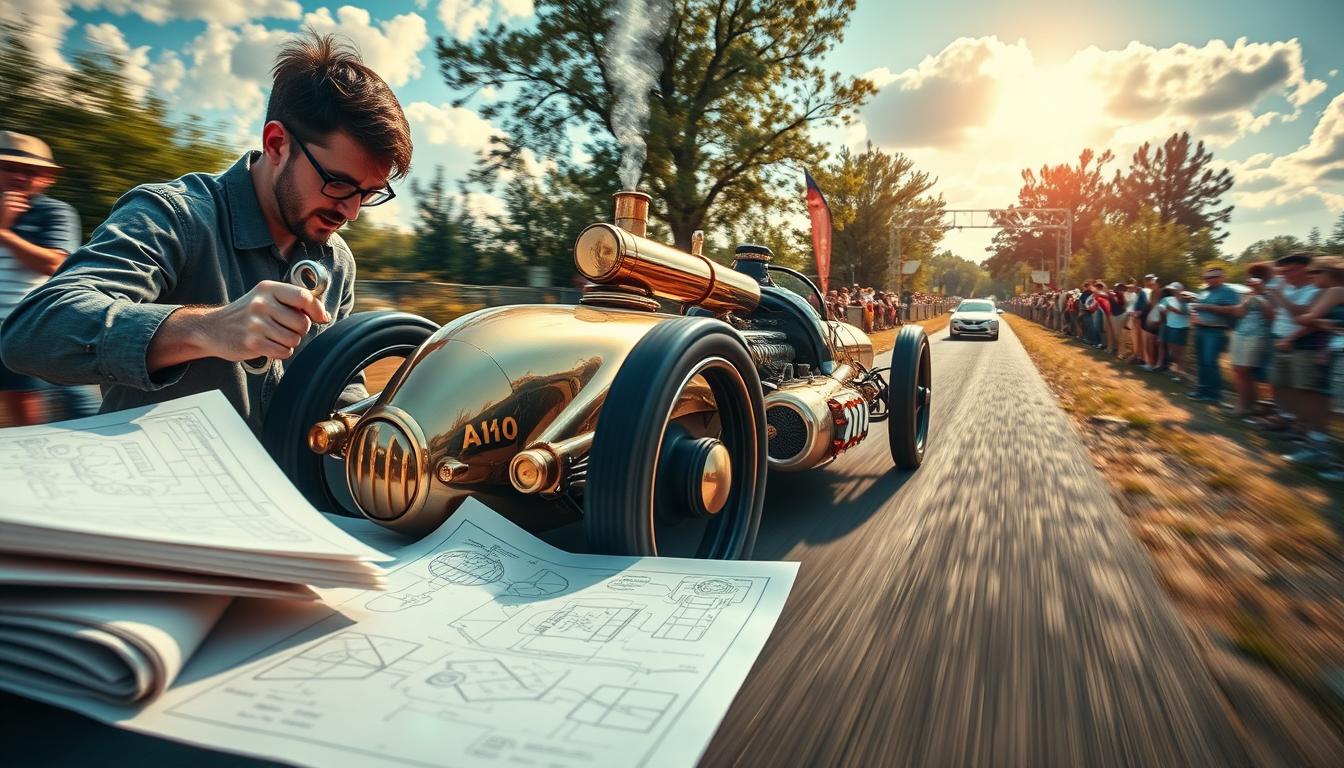
Imagine learning advanced engineering by making something that moves. This hands-on STEM activity is more than just putting parts together. It’s a deep dive into project-based learning, where you turn ideas into real things.
This project is like the big challenges faced by top engineering schools. It’s all about using basic materials to make a steam-powered car. You’ll need to keep designing and testing to get it right.
Working on this project helps you develop important skills. You’ll solve real problems, manage time, and make choices based on data. It’s great for teachers, team leaders, or anyone who wants to apply complex ideas in a practical way.
Are you ready to start? This guide will walk you through every step, from designing to racing your mini steam car.
Project Overview and Timeline
This section outlines a semester-long journey for student teams to design and race steam-powered vehicles. It turns a big project into a well-planned engineering effort. This guide helps educators and program managers lead a successful STEM competition.
The project is split into four phases. Each phase has clear goals and milestones. This structure, inspired by Georgia Tech’s AMP, ensures steady progress. It also allows time for redesigning.
The engineering design process is key throughout these phases. It’s not just a checklist. Teams will go back to earlier steps as they test and learn. This is where they really learn by doing.
Phase 1: Research & Design (Weeks 1-3)
This phase focuses on “Ask” and “Imagine.” Student teams learn about steam power, study chassis mechanics, and set goals for their car. They brainstorm and then plan in detail. They sketch, research materials, and do initial calculations.
Phase 2: Fabrication & Assembly (Weeks 4-6)
Teams move to “Create” in this phase. They build the chassis, attach wheels, and make the steam boiler and engine. Safety is key. They might also explore projects like a pop pop boat engine to learn more. The goal is a complete, rollable prototype.
Phase 3: Testing & Tuning (Weeks 7-8)
This phase is all about “Improve.” Teams test their cars, logging data on speed and stability. They find and fix problems. Many test cycles are needed for a competitive car.
Phase 4: Race Day (Week 9 or 10)
The project ends with a STEM competition. Teams show their engineering notebooks, demonstrate their car’s safety, and race. This event celebrates their hard work and problem-solving.
The following table shows a sample schedule:
| Project Phase | Key Activities & Milestones | Suggested Duration |
|---|---|---|
| Research & Design | Topic research, concept sketches, final design plan approval | 3 weeks |
| Fabrication & Assembly | Chassis construction, wheel assembly, safe boiler fabrication | 3 weeks |
| Testing & Tuning | Track trials, data logging, design refinements, final safety check | 2 weeks |
| Race Day | Notebook review, car inspection, time trials, final races, awards | 1 week |
This schedule helps avoid last-minute rushes. It lets student teams fail early, learn, and innovate. For the facilitator, it’s a tool for managing resources and keeping teams on track.
Design Criteria and Constraints
Setting the rules for your mini steam car project turns it into a real challenge. These rules are not just limits but the spark for creative solutions. Every classroom race and product begins with a clear plan.
Your team’s first job is to know the essential design criteria. These are the must-haves for your vehicle to be safe and compete well.
- Self-Propelled via Steam: The car’s propulsion must come from steam, like a boiler driving a piston or turbine. This is the heart of the project.
- Dimensional Limits: The car must fit in a certain box size (e.g., 30cm L x 20cm W x 25cm H). This makes the classroom race fair and useful.
- Safety Containment: The heat source and boiler must be fully shielded to prevent burns. Safety is always the first priority.
- Structural Integrity: The chassis must hold the weight of all parts without bending or breaking during use.
Project constraints are also key. They are the limits on resources and rules, like time, budget, and tools, in real-world projects.
- Material Budget: Teams often have a mock budget (e.g., $20) to “buy” materials, promoting cost-effective designs.
- Allowed Tools: You might only have basic tools like saws, drills, and soldering irons, encouraging smart making.
- Safety Regulations: Strict rules govern the use of boilers and heat sources, which must be followed without fail.
These rules force engineers to make tough choices. You can’t have everything at once. This is where true design thinking starts.
For example, a lighter car might go faster but could lack stability for a straight track. A more powerful steam propulsion system might add weight, slowing it down. Teams must balance complexity for speed against simplicity for reliability.
Scientific ideas guide these choices. Knowing about force and friction helps pick wheel materials. Thinking about aerodynamics might shape the car’s body. Managing weight is key for balance and control.
This method matches the Advanced Manufacturing Partnership (AMP) program’s focus on designing for manufacturability and performance. It’s not just about a cool idea; it’s about making a vehicle that can be built reliably and will perform well on race day.
Accepting these criteria and constraints makes your mini steam car project a real engineering challenge. The best solutions come when innovation meets clear rules.
Safety Plan for Boilers/Heat Sources
Before starting, every team must create a detailed safety plan for the boiler and heat source. This plan is essential and non-negotiable. It turns a great idea into a safe and responsible project.
The main rule is Safety First! This is very important when working with heat, pressure, and hot water. A good plan shows you’re ready for risks and manage your project well.
Everyone must wear the right personal protective equipment (PPE) at all times. This includes during assembly, testing, and operation. Never forget this.
- Heat-Resistant Gloves: Protect hands from hot surfaces and steam burns.
- Safety Glasses or Goggles: Shield eyes from spray, debris, or steam.
- Closed-Toe Shoes: Wear them always in the workshop or testing area.
- Apron or Lab Coat: Use non-flammable materials to protect clothing.
Safe operating procedures for your boiler system are just as important as the gear you wear. Always follow these rules without exception.
Always watch the pressure levels if your design has a pressurized vessel. Use a rated pressure gauge and know its safe limit. Never go over this limit. Fill the boiler with cool water only when it’s cool and the system is depressurized.
Make sure the boiler and heat source are on a stable, level, and non-flammable surface. A metal tray or concrete floor is best. Keep the area clean of clutter, loose papers, and flammable liquids.
Adult supervision is mandatory for student teams. An adult, like a teacher, mentor, or parent, must be there during testing and operation. This person should review and approve the safety plan first.
Choose a Safety Officer within each team. This person makes sure PPE is worn, procedures are followed, and the safety plan is followed. Changing this role keeps everyone alert and involved.
Even with the best planning, emergencies can happen. Your safety plan must include clear emergency protocols.
Know how to shut down the heat source and safely vent pressure if needed. Have a fire extinguisher rated for Class B (flammable liquids) and Class C (electrical fires) ready. Everyone should know where it is and how to use it.
Know the location of a first-aid kit and how to treat minor burns with cool water. For any serious injury or emergency, stop all activity and alert the supervising adult right away.
Creating and following this detailed safety plan is key to the steam car challenge. It lets student teams innovate with confidence while handling real-world engineering risks responsibly.
Building the Chassis and Wheels
This stage is all about building a solid base for your car. The chassis is like the skeleton, and the wheels are the feet. It’s a key part of any project-based learning project.
Choosing the right materials is important. You need something strong but not too heavy. Many teams use recycled materials for this.
- Cardboard: Easy to work with, but can bend with moisture.
- Plastic Bottles: Light and strong, great for making body parts.
- Balsa Wood: A favorite for models, it’s strong and light.
For more precision, programs like AMP use 3D printing or machining aluminum. This makes parts fit perfectly and mount easily.
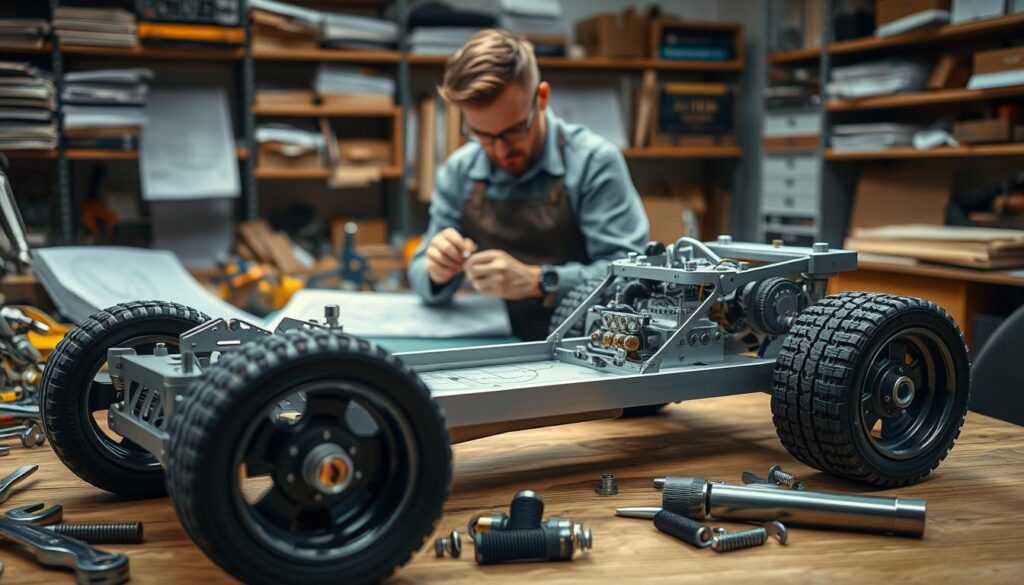
Building the wheel and axle is tricky. Reducing friction is key. Too much friction slows your car down.
Using plastic straws as axle housings helps a lot. Put a metal rod through the straw for a smooth axle. Attach wheels to the rod ends.
To improve, add ball bearings to the wheel hubs. This makes the axle spin with less friction. You can find bearings in old skateboards or buy new ones. For the best STEM competition entry, make custom aluminum hubs or 3D-print wheels.
Make sure your chassis is square and axles are parallel. Misalignment wastes energy. Secure everything well but avoid extra weight.
When done, your car should move smoothly and straight. This solid base is ready for the next step. Learning this part teaches important mechanical skills and helps you win in your STEM competition.
Fabricating a Safe Steam Propulsion Unit
Newton’s Third Law is key when making a steam car. It says every action has an equal opposite reaction. This is what makes balloon cars move and will power your mini steam car.
It’s simple. Heat water in a sealed space, called a boiler. This water turns into steam under high pressure. When this steam shoots out through a narrow nozzle, it moves the car forward.
Your main job is to make a safe and effective boiler. You need to control the pressure. A good design balances heat, water, and nozzle size for steady movement.
Here are some materials you can use for your boiler:
- Small Metal Cans: Use aluminum soda cans or soup cans. They’re light and can handle some pressure if sealed well. Make sure seams are tight and use epoxy for connections.
- Copper Coil Boilers: Coil soft copper tubing into a shape. It’s great for heating water fast. The coiled shape also helps with heat transfer.
- Pre-fabricated Chambers: Some kits have small, sealed metal containers for steam. These are safest for beginners.
The exhaust system is just as important as the boiler. The nozzle must be small to increase steam speed. But it can’t be too small, or pressure will rise too high. Start with a nozzle between 1/16″ and 1/8″ in diameter.
Safety is a must. Your boiler needs a pressure release valve or a weak seal. Never use glass or materials that melt with heat. Always test your system from a safe distance and wear eye protection.
This steam car challenge is all about practical thermodynamics. By understanding heat, pressure, and nozzle design, you can make a working engine. This lets your team get creative, maybe by changing the coil pattern or nozzle angle. Your propulsion unit is the heart of your project.
Track Setup and Race Rules
The final step in engineering design is a STEM competition on a set course. A standard track and clear rules are essential for a fair and exciting classroom race. They turn the project into a real competition.
This setup raises the stakes and makes students more engaged. It gives a reliable way to compare their work and creativity.
First, set up your testing area. A uniform track lets the car’s design stand out. The Georgia Tech AMP program is a great example.
Here are key specs for your track:
- Length: A 20 to 30 feet straight track is best. It lets cars reach top speed while being easy to manage in a classroom or hallway.
- Surface: Use a smooth, low-friction surface like finished hardwood, laminate flooring, or a long vinyl mat. This ensures fair comparisons.
- Starting Mechanism: Use a simple starting gate or a standardized ramp. A gate ensures all cars start from a stop. A ramp with a fixed angle gives a consistent start.
With the track set up, define the race rules. A multi-category classroom race celebrates different engineering skills. It lets teams win based on creativity or efficiency, not just speed.
Propose clear competition categories. The table below shows common scoring ways for your STEM competition.
| Category | Measurement | Engineering Focus |
|---|---|---|
| Speed Challenge | Fastest time over a fixed distance (e.g., 20 feet) | Power-to-weight ratio, drivetrain efficiency, low friction |
| Distance Derby | Farthest total travel from a single start (no track limit) | Energy efficiency, boiler endurance, thermal management |
| Innovation Award | Judged on unique design features, use of materials, or creative problem-solving | Creative engineering, aesthetic design, novel solutions |
| Efficiency Run | Distance traveled per unit of water/fuel consumed | Sustainable design, precise engineering, minimization of waste |
Set rules for race day. All cars must pass a safety check before racing. Each team gets a set number of tries in each category. Record all data carefully for later review.
This structured approach tests student designs fairly. It mirrors real-world engineering challenges. The excitement of a well-organized classroom race boosts project enthusiasm.
Testing, Tuning, and Data Logging
Starting with a “test and refine” approach makes learning more powerful. This stage is where ideas meet real-world challenges. For student teams, it’s the core of project-based learning. Every test gives valuable data, guiding the next design choice.
Testing needs a clear plan. Teams should test multiple times, not just once. Each test should focus on a specific area. Keep a record of everything that happens.
What data should you collect? Focus on things like race time, steam pressure, water use, and distance. Also, note the temperature, as it affects performance.
Logging data is key. Use a notebook, spreadsheet, or text file. Keep it consistent. Record date, conditions, team members, and all data for each test. For advanced teams, tools like Python can reveal deeper insights.
Analysis turns numbers into clues. Is the car slow? Check the data. Low steam pressure might mean not enough heat or a leak. High water use could mean inefficient steam. If the car goes off course, it might be weight or alignment issues.
| Performance Metric | Tool/Method for Collection | What It Helps Diagnose |
|---|---|---|
| Race Time (Seconds) | Stopwatch or electronic timer | Overall vehicle efficiency and thrust power. |
| Steam Pressure (PSI) | Pressure gauge on the boiler | Heat source effectiveness and safety limits. |
| Water Consumed (mL) | Graduated cylinder for refill | Boiler efficiency and steam cycle duration. |
| Distance Traveled (Meters) | Measured track or wheel rotation sensor | Wheel traction and drivetrain slippage. |
| Temperature (Celsius) | Infrared thermometer or sensor | Heat loss in the system and ambient effects. |
Tuning comes after analysis. Data shows what to adjust. For friction, try lubricating axles. For thrust, increase boiler heat or improve piston seal. For weight issues, move parts on the chassis. Make small changes and test again.
This method mirrors real-world engineering. It teaches student teams to be resilient and think critically. It’s true project-based learning, aiming for understanding, not just a working car. For more on troubleshooting, see how pros tackle challenges with data tools.
A team’s notebook is their greatest achievement. It shows their journey from idea to a racing mini steam car.
Engineering Notebook Guidelines
In the world of engineering, every step from idea to reality is documented. This turns the steam car challenge into a deep learning experience. Keeping records is key, not just an extra step.
AMP and professional standards stress the importance of detailed notes. An engineering notebook is a legal record of your design journey. It shows the thought and problem-solving behind each choice.
For students, keeping a notebook is a vital skill. It teaches you to organize, think critically, and communicate clearly. Your notebook is a living record of your project-based learning journey.
So, what should you write down? Here’s a guide to help you keep a detailed and useful notebook:
- Initial Brainstorming: Note down your first ideas, early sketches, and compare concepts.
- Design Calculations: Record your math on speed, force, pressure, and material strength.
- Material Lists & Sources: List every part, its cost, and where you got it.
- Test Procedures: Outline your safety checks and performance tests step by step.
- Data & Results: Record raw numbers, times, distances, and observations from each test.
- Failure Analysis: Explain what went wrong, why, and your initial thoughts on fixing it.
- Design Refinements: Note and sketch how you improved the car over time.
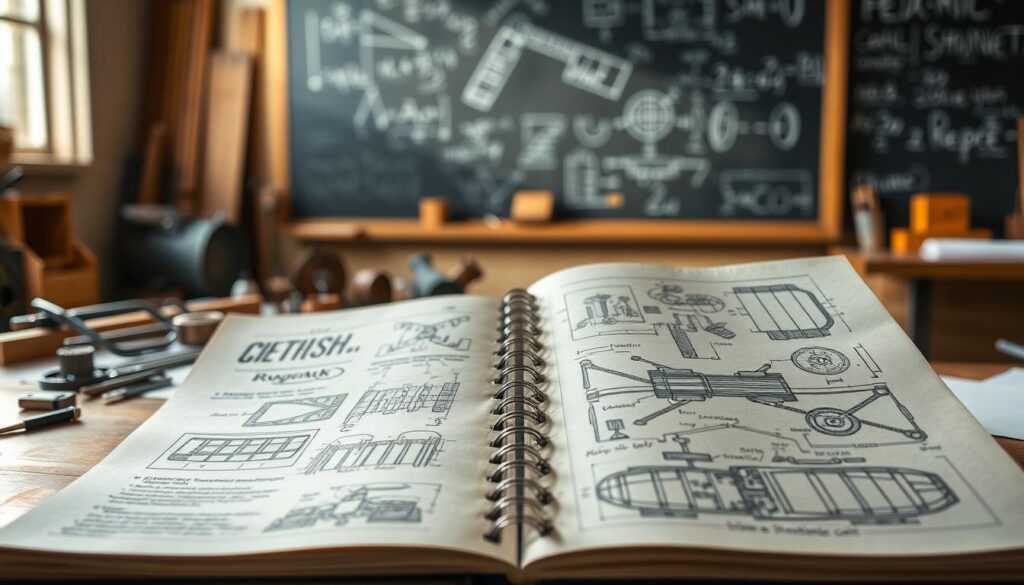
This method does more than track your progress. For teachers, the notebook is a great way to assess learning. It shows more than just a race result.
It reveals your thought process, effort, and perseverance. For you, this documented journey is a standout achievement. It shows not just the end product, but the journey and triumphs along the way.
In any steam car challenge, the car that wins is the result of hard work. The engineering notebook proves the learning behind it. It turns a hands-on activity into documented expertise.
Scoring Rubric and Awards
The mini steam car project is more than just about speed. It’s about celebrating engineering excellence in many ways. A fair, multi-faceted evaluation system ensures every team’s hard work gets recognized.
This approach turns a simple classroom race into a rich STEM competition. It values research, creativity, and process as much as raw velocity.
Inspired by events like the AMP program’s race day, a great rubric has multiple categories. Each category highlights a different aspect of the engineering design process.
A sample scoring rubric might include the following five key areas. Each area contributes to the final score.
- Race Performance (30%): This measures speed and reliability on track. Did the car complete the race? What was its final time?
- Engineering Design & Innovation (25%): Judges look for clever solutions. How creative was the chassis or boiler design? Was weight distribution optimized?
- Quality of Documentation (20%): This scores the team’s engineering notebook. Clear sketches, test data, and design rationale are key here.
- Team Collaboration (15%): Observers note how the team works together. Effective communication and shared workload are rewarded.
- Safety Adherence (10%): This non-negotiable category checks safe practices. Proper handling of heat sources and tools is essential.
This balanced system means a team with a slower, brilliantly documented car can score highly. It rewards the complete engineering experience.
To honor diverse strengths, consider presenting special awards after the race. These recognitions, like “People’s Choice,” add excitement and inclusivity.
Here are some popular award ideas for your event:
- Fastest Car: For the team with the quickest official race time.
- Most Innovative Design: For the most creative or unique engineering solution.
- Best Engineered: For superior craftsmanship and attention to mechanical detail.
- Team Spirit: For exceptional collaboration, perseverance, and positive attitude.
Presenting these awards does more than hand out trophies. It validates different skills and motivates all students. It shows that a successful STEM competition celebrates both the winner of the classroom race and the champions of innovation and teamwork.
Team Roles and Collaboration Tips
Success in this project depends on teamwork. Inspired by the AMP program, where experts and teachers work together, this project is like real-world engineering. Clear roles make a team work better together.
Each team member should have a specific job. This way, all important tasks get done and everyone feels important. We suggest five main roles for your teams.
| Team Role | Core Responsibilities | Key Skills |
|---|---|---|
| Project Manager | Creates the timeline, leads meetings, tracks progress, and ensures the team meets deadlines. | Organization, leadership, communication |
| Design Engineer | Leads chassis and boiler design, creates sketches or CAD models, and performs calculations. | Creative problem-solving, technical drawing, physics |
| Fabrication Specialist | Handles the physical build, assembly, and tuning of the car and its steam propulsion unit. | Manual dexterity, tool safety, attention to detail |
| Safety Officer | Enforces the safety plan, inspects tools and the boiler, and ensures safe testing practices. | Vigilance, risk assessment, assertiveness |
| Data Analyst | Records test data, analyzes performance metrics, and suggests improvements based on results. | Observation, note-taking, analytical thinking |
With roles set, teamwork becomes smoother. These tips help teams work together well.
- Hold Daily Stand-ups: Start each day with a 5-minute meeting. Everyone shares what they did, what they’ll do next, and any problems.
- Use a Shared Digital Hub: Keep all designs, notes, and photos in a cloud folder (like Google Drive). It’s a central place for the team.
- Establish Communication Channels: Pick how the team will talk outside class—group chat or email—and stick to it.
- Practice Active Listening: Make sure everyone’s ideas are heard. Good ideas often come from working together.
- Celebrate Milestones: Celebrate when big things are done, like the chassis or the propulsion system test. It boosts morale and team spirit.
This approach does more than just build a car. It teaches how to work on projects like a pro. A team that works well together is the best tool you can have.
Extensions: Solar-hybrid car, CAD and 3D-print parts
This section looks at turning a traditional steam car into a learning tool for Industry 4.0. For teams looking to innovate, these advanced features take a project-based learning to the next level.
The first upgrade is a solar-hybrid system. A small photovoltaic panel is attached to the car’s chassis. It captures sunlight to make electricity.
This electricity can be used in two ways. It can warm water in a secondary chamber before it goes into the main boiler. This cuts down the main heat source’s fuel use. Or, it can power systems like data loggers or small fans.
This addition brings renewable energy into your STEM competition project.
Digital design and fabrication take it to the next level. Teams can design parts with free CAD software. They can make things like optimized gear housings or lightweight arms.
Then, a 3D printer brings these designs to life. This teaches about precision, testing, and the digital thread in modern manufacturing.
For the most ambitious, AI and simulation tools can analyze designs. They suggest changes for better aerodynamics, making the car faster.
This mirrors university research, bringing advanced analysis to your project.
These extensions do more than just improve the car. They make better engineers. You learn about renewable energy, digital modeling, and 3D printing.
These skills are key in today’s industries. Adding them makes your project more relevant and challenging.
It turns a classic project-based learning into a forward-looking prototype. Your entry will show innovation, digital skills, and sustainability. It sets a new standard in any STEM competition.
Standards Alignment and Career Connections
The steam car project is more than just a race. It helps students learn important academic standards. Teachers can use it to teach about energy transfer and engineering concepts aligned with the Next Generation Science Standards.
Math skills are also strengthened throughout the process. Students learn to calculate velocity, torque, and efficiency, reinforcing concepts that align closely with Common Core math standards while applying theory to practical challenges.
Working on the steam car project teaches valuable real-world skills. It introduces mechanical engineering fundamentals and exposes students to advanced manufacturing techniques and prototyping methods similar to those used in modern heavy machinery solutions, helping learners understand how engineering principles scale from small classroom models to large industrial applications.
Programs like the AMP program demonstrate the project’s impact. Students often discover a new passion for technical fields, and building a working propulsion unit transforms abstract physics concepts into tangible, hands-on learning experiences.
This project is also an excellent pathway for career exploration. Students develop systems thinking, CAD design experience, and teamwork skills — all essential competencies in STEM industries such as automotive design, renewable energy, and industrial engineering.
Ultimately, the steam car project shows students how classroom innovation can connect directly to future technologies. By combining creativity, engineering, and problem-solving, it inspires the next generation to pursue careers that shape tomorrow’s world.
