
Forget the perfect plan. The journey from a curious kid to a professional engineer is messy. It’s like watching a spaghetti tower fall apart slowly.
This journey is not about just memorizing formulas. It’s about doing steam experiments that make complex ideas real. You can hold them in your hand.
STEAM is a magic word that adds Art to science. It sparks curiosity, creativity, and problem-solving skills. No textbook can match this.
Adding STEAM to school can seem hard. There’s always a tight schedule and a small budget.
But, simple projects can be incredibly powerful. I’ve seen students go from just listening to actually doing. They start asking, “What if we try…?”
This is how we build the future. We’re not just making towers. We’re shaping minds.
Beginner Steam Projects
Beginner projects are like the first steps into engineering. They are simple, fun, and spark curiosity. We aim to replace the “when will I ever use this?” feeling with a “aha!” moment.
The Marshmallow Tower Challenge is a classic for a reason. Teams use dry spaghetti, tape, string, and a marshmallow. They must build the tallest tower to hold the marshmallow.
Watching students try is hilarious. Their first attempts look like the Leaning Tower of Pisa. But with each try, they learn about physics. They discover how to make a strong tower through trial and error.
Next, we have the Shape Hunt. Students look for rectangles, triangles, and cylinders in real life. It’s a simple task, but it’s packed with learning.
This activity makes math real. Students find shapes everywhere, from buildings to spiderwebs. Math is no longer just on paper; it’s all around them.
The Storybook Engineering project is another favorite. After reading The Three Little Pigs, students design a wolf-proof house. It’s a chance to use their creativity and problem-solving skills.
This project is all about connecting stories to real-world problems. Students think about materials, structure, and safety. It’s a bridge to more complex thinking, all with simple materials.
The Build-Your-Own Robotic Hand project is also a hit. Students make a hand model using cardboard, straws, and string. It introduces them to biomechanics and prototyping.
These beginner STEM activities are simple yet powerful. They offer quick feedback and encourage creativity. It’s a great way to start a career in STEM, not with complex math, but with curiosity.
Advanced Engineering Challenges
Welcome to the big leagues, where craft sticks face big tests and water must be cleaned. This phase focuses on making things better, not just completing them. Students become like professionals, dealing with real-world problems.
The Bridge Engineering Challenge is a big step up. It’s not just about building a structure. It’s about making one that holds weight, withstands shakes, and uses materials wisely. Students learn about important engineering concepts in a hands-on way.
This is a crash course in civil engineering ethics. A bad bridge isn’t just a failed project; it’s a safety risk. Students must use 50 sticks to support 20 pounds over 18 inches. Every detail matters.
The Water Filtration project turns a simple science experiment into a big challenge. It’s not just about how filtration works. It’s about how to make it work with limited resources?
This project links lab work to real-world issues like clean water. Students design a system, test it, and keep improving it. It’s about solving problems with what you have.
The catapult is a medieval tool used to teach physics. The challenge is to keep improving it. Students build a catapult and test it, making changes until it works better.
Changing the arm length or the rubber band tension affects the catapult’s aim. It’s like Agile development, but with sticks and rubber bands. It teaches precision and the value of trying again.
The Archimedes Screw is a 2,000-year-old pump that shows how ancient people were smart. The challenge is to build it and understand how it works. Students learn about mechanics and fluid dynamics.
Building the Archimedes Screw is a lesson in timeless engineering. It’s about finding the best design for moving water. It connects ancient wisdom to modern science.
These challenges show the beauty of real engineering. The goal is to make things better, not perfect. Students learn to solve problems and think like engineers.
School Club Implementation
When the final bell rings, student builders stay, eager to learn. This is where lessons turn into a culture. It’s like starting a business, but with more creativity and less money.
Your aim is to create a space for students to explore on their own. Start with a “Mini Coding Camp.” It helps beginners with free tools like Scratch or Code.org.
At the same time, it lets advanced students work on their own projects. You can add competitions to keep everyone motivated. This way, everyone has goals to work towards.
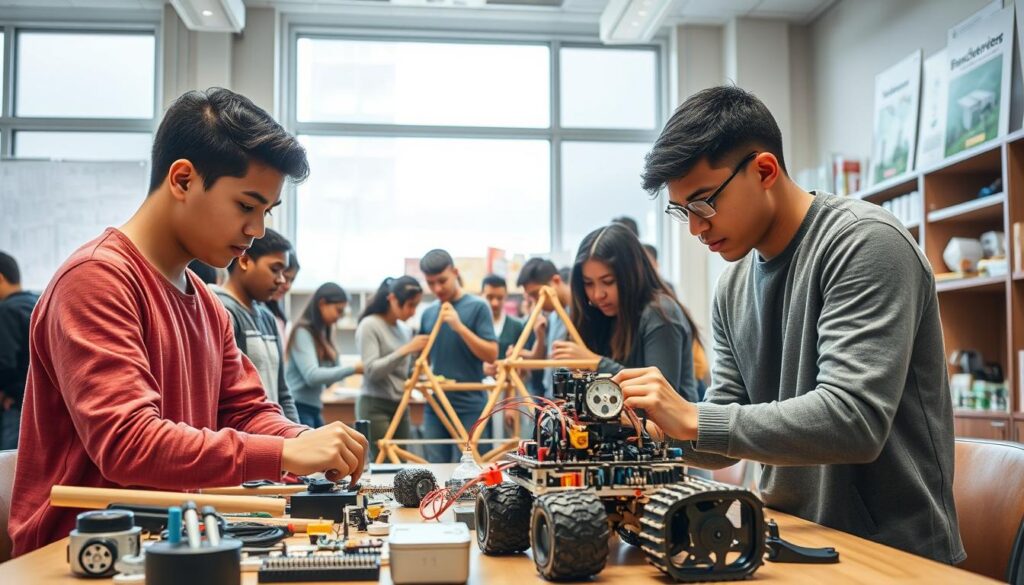
This club is where projects grow beyond class time. An old radio isn’t just junk here. It’s a chance to learn about engineering in everyday life.
You’re not just managing projects. You’re helping students teach each other. A student who mastered a challenge can help a newcomer. This is where they learn important skills like communication and problem-solving.
The textbook is just the start here. The real learning happens through teamwork and a bit of competition. It’s a shift from learning about engineering to living it. You’re building a community of student builders who see challenges as opportunities to create.
Safety Protocols
Mishandling a neodymium magnet or a hot glue gun isn’t a rite of passage; it’s a failed experiment in professional responsibility. Let’s reframe the least sexy part of engineering. These aren’t arbitrary rules from a buzzkill list. They are your project’s first and most critical design specification. Every professional engineer signs off on them. It’s a non-negotiable ethic.
Think of it this way: safety enables creativity. A builder worried about a minor catastrophe isn’t focusing on innovation. We use these moments to teach that respecting your tools is the foundation of all great, messy, wonderful work.
This is also prime training for future high school labs. Getting comfortable with safe STEM practices now builds instinct. So, how does this abstract ethic translate to the workbench?
Take the humble hot glue gun. It’s a masterclass in thermal management and personal protective equipment. Burns aren’t badges of honor. They’re data points in a poor risk assessment. Then there’s the classic toy take-apart project. Following a guide like iFixit’s Toy Take-Apart with an adult isn’t just about finding motors. It’s a careful exercise in systematic disassembly. You learn to identify components and, critically, to avoid the mysterious capacitors. That “adult supervision” note? It’s there for a very good reason.
Even the seemingly benign Magnetic Slime project demands respect. Those strong magnets can pinch fiercely. Iron oxide powder shouldn’t become airborne. Handling them with care is part of the process. It transforms a fun activity into a lesson on material hazards.
So, what’s the actionable protocol? It’s less about fear, more about a prepared mindset.
- Survey First: Before powering any tool, identify the energy sources—thermal, electrical, kinetic.
- Gear Up: Safety glasses aren’t optional. Gloves, aprons, closed-toe shoes—this is your personal protective equipment suite.
- The Buddy System: That “adult supervision” mandate is your real-time consultant. It’s not about having a chaperone; it’s about having a second pair of analytical eyes on the problem.
- Controlled Environment: A clean, well-lit, uncluttered space isn’t just for aesthetics. It’s your controlled variable against chaos.
This framework turns safety from a restrictive list into the enabling platform for confident building. You’re not just following rules. You’re engineering responsibly. That’s a career skill that launches long before the first bridge is built or the first circuit is soldered.
Material & Tool Requirements
Success in engineering doesn’t come from a big budget. It’s about seeing a straw as a beam and an old phone as a sensor. You don’t need a fancy lab to start. The best learning happens with “hacker-grade” materials: the cheap, common, and reused.
Your basic list is like a weird dinner party shopping list. You’ll need popsicle sticks, straws, rubber bands, cardboard, and mini marshmallows. For water filtration steam experiments, add plastic bottles, sand, gravel, and coffee filters. And don’t forget duct tape—the ultimate fix-all.
Want to build a bridge? Use popsicle sticks, glue, string, and weights. Need a water filter? Those bottles, sand, and gravel are your tools. Making magnetic slime? You’ll need liquid starch, Elmer’s glue, iron oxide powder, and a magnet. The ruler is optional; sometimes, it’s better to just eyeball it.
Next, you add more specialized tools for steam experiments. A low-temperature glue gun is great for quick prototypes. A multimeter helps with electronics. An Arduino starter kit opens up coding and sensors. And yes, a 3D printer is awesome if you can get one, but it’s the extra touch, not the main thing.
The key is to see the possibilities, not just buy stuff. A plastic bottle can be a water tank or a rocket. An old smartphone has cameras, gyroscopes, and accelerometers. This skill—finding solutions with what you have—is incredibly valuable. It teaches you to be creative, not just dependent on others.
So, while fancy kits are nice, don’t overlook the power of cheap supplies and a challenge. Here’s a breakdown of how to gear up.
| Category | Example Materials & Tools | Primary Purpose |
|---|---|---|
| Hacker-Grade Basics | Straws, popsicle sticks, cardboard, plastic bottles, rubber bands, string, marshmallows, duct tape, sand, gravel | Fundamental prototyping, structural challenges, fluid dynamics, low-cost iteration |
| Connectors & Adhesives | Low-temp glue gun, white glue, tape | Assembly, joining diverse materials, rapid construction |
| Measurement & Electronics | Ruler, multimeter, Arduino starter kit, old smartphone | Data collection, introducing circuitry, basic programming, sensor use |
| Advanced Fabrication | 3D printer, laser cutter (if available) | High-fidelity parts, complex geometries, introducing digital design |
This approach is like real-world engineering. You start with what you have. You test the idea. Then you get the fancy tools. The goal of these steam experiments is to build problem-solving skills. It’s about turning everyday things into solutions. That’s how you start a career, not from a catalog, but from curiosity.
Assessment & Documentation
Assessment in STEM activities often favors neatness over problem-solving. We’ve all seen it. The student with a perfect report gets the best grade, while the messy, hands-on learner gets a lower score. This system fails those who learn by doing.
So, how do you grade a collapsing tower? You don’t. You look at the process. The journey from idea to understanding is where real engineering happens. This needs a new way of grading, one that values effort over perfection.
I use the Engineering Log for grading. It’s like a lab notebook, disaster report, and intellectual diary all in one. It’s not about looks; it’s about recording every step of the build. Students write down their ideas, measurements, and failures in detail.
This simple act of documenting turns frustration into valuable data. A collapse becomes a chance to learn, not a failure. This way, students’ reactions show their engagement and spark important discussions.

What do we look at in this model? We don’t just judge the tower’s height. Instead, we focus on:
- Applied Process: Did they follow the design steps or just stick things together?
- Collaborative Grit: Did they work together to solve problems or get frustrated alone?
- Analytical Communication: Can they explain, using their log, why their design worked or failed?
Grading rubrics in STEM kits are a good start, but they need to focus on the process. The final report tells the story of their journey, not just the results. Isn’t that the true story of engineering?
To make the shift clear, here’s how the assessment focus changes:
| Traditional Assessment Focus | Process-Based Assessment Focus |
|---|---|
| Neatness of final product | Depth of iterative cycles documented |
| Adherence to initial instructions | Adaptation and problem-solving when plans fail |
| Correct answer on a post-test | Ability to hypothesize and test based on failure |
| Individual achievement | Quality of collaboration and communication |
This approach turns every STEM activities project into a lesson in critical thinking. It’s not just about building; it’s about building a mindset. The log shows the journey, and the assessment proves the learning.
Competition Opportunities
The quiet hum of a workshop is nice, but the buzz of a timer is where real learning happens. Healthy competition turns classroom ideas into real, high-stakes projects. It’s like the fourth quarter of engineering, where skills meet pressure and the best designs win.
The Marshmallow Challenge is a classic example. Teams use spaghetti, tape, and string to build a tower with a marshmallow on top. With an 18-minute timer, it becomes a race in physics, teamwork, and quick thinking. It’s not just about building a tower; it’s about managing time and materials.
Straw tower and bridge strength contests work the same way. The goal is to build the tallest or strongest structure. This healthy competition teaches students to make quick decisions and improve their designs.
These contests mimic real-world challenges. Students face time limits, fixed budgets, and clear goals. They learn to handle pressure, lose with grace, and respect others’ success. They analyze what made a competitor’s design better.
These events also teach students to communicate their work. They learn to explain their designs and defend them under scrutiny. This is a critical career skill as important as the engineering itself.
For those looking for more, FIRST Robotics offers a major league experience. These leagues are like the Olympics of student engineering, leading to top universities and careers. Participating in NASA STEM opportunities and national competitions adds prestige to a resume and opens doors to professional networks.
In short, competition tests more than just a project. It tests the project manager, team diplomat, and innovative thinker in every student. It’s a hands-on exam that makes everyone smarter.
Career Skill Development
Forget about padding your resume. These student-built projects are where real skills are made. Let’s look beyond the posters. That bridge that fell apart? It’s a lesson in material science and strength.
Every change to a catapult teaches physics in action, not just theory.
Think of these engineering projects as a professional boot camp. Drawing a tower’s blueprint? That’s basic CAD skills. Testing its strength? That’s Quality Assurance 101.
Keeping a log of results? That’s learning to write like a pro for patents or reports.
Working in a school club is like being part of an Agile team. You have designers, coders, and testers all learning together. When a student fixes a code issue, they’re doing the same thing as a software engineer.
This is where a “STEM identity” forms. We’re not just teaching concepts. We’re helping students see themselves as problem-solvers. They learn to identify needs, design solutions, test, and refine them.
This mindset is more valuable than any fact. It’s the key to a successful career.
Whether they become civil engineers, work on biomedical devices, or focus on sustainable energy, the process is the same. These early engineering projects are the start of their professional journey. They give students the confidence to build a tech-driven future, not just consume it.
Project Showcase Ideas
Think of the project showcase as a new start, not the end. Your student builders have worked hard. Now, they need people to see their work. This is their chance to shine.
Forget the old tri-fold board. Encourage them to tell a story. Have them create a “Fictional World” with maps and ecosystems. It’s like science fiction, but real.
Or, try “Storybook Engineering.” Let them make a short film about their wolf-proof house. Their engineering log turns into a movie script.
Host a Demo Day. Invite parents and engineers for pitches like Shark Tank. This gives your students a sense of accomplishment. It also helps them learn to explain their work clearly.
Can they explain a hydraulic arm in simple terms? Can they make a water filter sound exciting? This skill shows they’re not just good at fixing things. They’re visionaries. The showcase turns a school project into a story worth sharing. It’s where they learn to lead.
