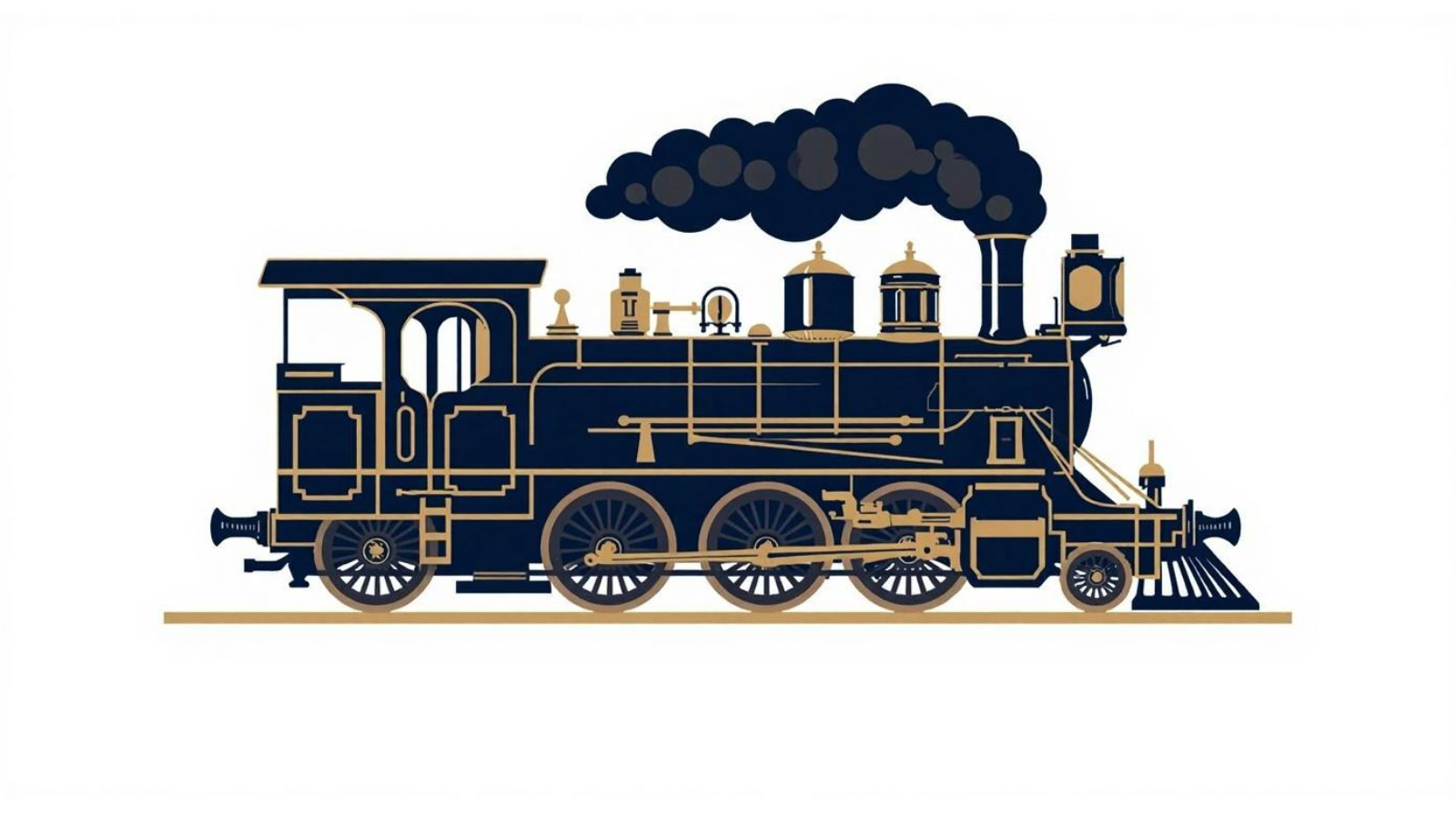

Imagine a world where coal was more valuable than cryptocurrency, and engineers were the rockstars of their day. Our story starts in 1712, with flooded English mines. Thomas Newcomen’s “atmospheric engine” was like a steam-powered monster.
It used steam power that would make today’s pressure cookers look small. This was the beginning of something big.
But how did we go from Greek steam toys to iron horses crossing continents? It all came down to three key moments:
• Savery’s 1698 patent – the original steam-powered water pump
• Newcomen’s 1712 upgrade – think of it as turbo boost for a tricycle
• Watt’s later improvements – every revolution needs a glow-up
We’ll see why early boilers were as reliable as a chocolate teapot. And how engineers turned steam pressure into industrial superpowers. Ever wondered what happens when you mix a tea kettle’s power with 18th-century metalworking? You’re about to find out.
Through hands-on experiments and literally explosive demonstrations (safely simulated, parents can relax), we’ll explore history’s most transformative invention. Ready to stoke your curiosity furnace? Full steam ahead!
The First Locomotives
Imagine a world where metal beasts snorted coal smoke instead of breath. Their pistons heaved like mechanical hearts. This wasn’t steampunk fantasy – it was 1804 England.
Engineers turned mine carts into revolutionaries. The race to harness steam power was like Silicon Valley’s app wars. It had explosive prototypes and patent battles.
From Mine Carts to Movement
Before locomotives moved people, they hauled coal through narrow tunnels. Early mine carts relied on gravity and muscle power. Then, the game-changer came: energy transformation from static steam engines to mobile powerhouses.
Trevithick’s Smoking Dragon
Richard Trevithick’s 1804 Pen-y-darren locomotive was a game-changer. Dubbed “The Smoking Dragon” by witnesses, it was a coal engine that could:
- Haul 10 tons of iron at 5 mph
- Withstand high boiler pressures
- Bend its own cast-iron rails
Its secret was high-pressure steam. Trevithick’s pistons worked like metal lungs, inhaling vapor and exhaling progress. But, like many visionaries, he focused on speed over practical details.
The 1812 Salamanca and 1813 Puffing Billy improved the formula. These locomotives featured:
| Model | Innovation | Flaw |
|---|---|---|
| Salamanca | Double cylinders | Shook apart on curves |
| Puffing Billy | Cogwheel drive | Too heavy for tracks |
It took George Stephenson’s 1829 Rocket to nail the user experience. But let’s save that glow-up for our next chapter.
Important Upgrades Over Time
Steam engines evolved like a video game character getting power-ups. Imagine your smartphone suddenly gaining TikTok and GPS. That’s the kind of leap we’re talking about.
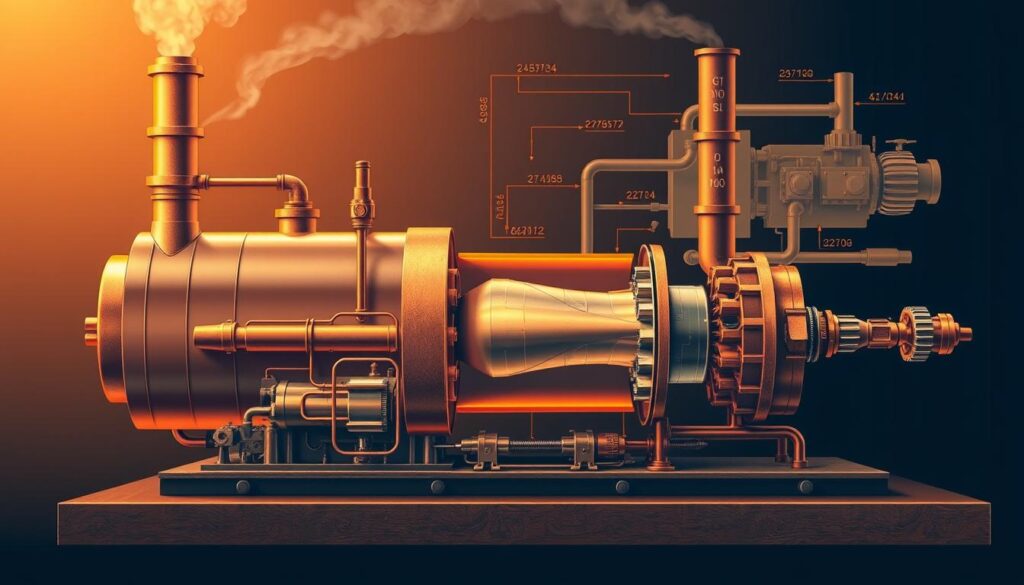
Watt’s Eureka Moment
James Watt didn’t just fix steam engines—he changed physics. His 1763 separate condenser was a “work smarter, not harder” idea. It was like running a lemonade stand efficiently, using all the lemons.
Here’s the science of steam in simple terms:
- Newcomen’s engine = slow-bake cookies (20 minutes per batch)
- Watt’s upgrade = convection oven (same cookies in 7 minutes)
By 1776, Watt’s redesign made steam engines powerful. They were so efficient, factories could replace water wheels with them.
Safety Valves & Speed Demons
Early boilers were fragile, like soap bubbles. Stevenson’s 1834 multi-tube boiler was a game-changer. It was like using 100 drinking straws instead of one garden hose for heat to motion.
| Feature | Old Boilers | Stevenson’s Design |
|---|---|---|
| Pressure Capacity | 50 psi | 150 psi |
| Explosions per Year | 12 | 2 |
| Top Speed | 30 mph | 126 mph (Mallard, 1938) |
The Mallard’s record is impressive, faster than a cheetah in a Tesla. But without safety valves, it would have been dangerous. It’s like giving a toddler espresso and then adding seat belts.
Steam Locomotives Around the World
Before TikTok dances and viral memes, steam locomotives were the trendsetters. They traveled across continents like influencers. Let’s explore their journey through three key chapters.
British Iron Horses Conquer Continents
Britain didn’t just invent the locomotive; it made it a global sensation. George Stephenson’s Blücher (1814) started it all. But the John Bull (1831) became the ultimate symbol of British power.
This coal-powered engine toured America like a Victorian-era rockstar. It pulled crowds faster than any concert could.
America’s Transcontinental Thunder
While Britain perfected its railways, America went for the grand. The DeWitt Clinton (1831) had a PR disaster when sparks set passengers’ coats on fire. But by 1869, the Transcontinental Railroad showed steam could unite a nation.
| Locomotive | Top Speed | Claim to Fame |
|---|---|---|
| Tom Thumb (US) | 10 mph | Lost to a horse but won the PR war |
| Stourbridge Lion (UK) | 12 mph | First US import – retired after 3 runs |
| Adler (Germany) | 19 mph | Ran on beer money (literally) |
For young engineers, these popular trains for kids are timeless:
- Austria’s GKB 671 – operational for 160 years
- Japan’s SL Yamaguchi – inspired Studio Ghibli
The Adler’s 1835 debut in Germany showed steam’s global appeal. It was funded by breweries, proving liquid courage fuels progress.
Building a Simple Paper Timeline
Who knew engineering history could survive a glue stick massacre? Let’s swap blueprints for construction paper and turn textbook dates into a steam-powered scrapbook. This isn’t just arts and crafts – it’s time travel with safety scissors.
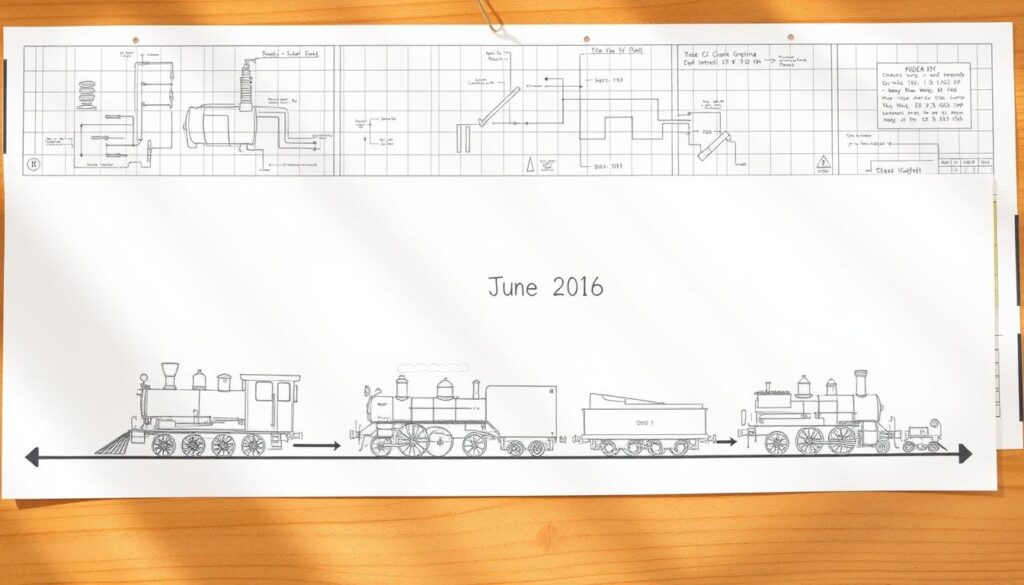
STEM Meets Scissors
Channel your inner Brunel with this three-step fusion of labeling exercises and creative chaos:
- 1698: Cut out Thomas Savery’s patent sketch (bonus points for labeling “boiler” without giggling)
- 1804: Fold Richard Trevithick’s locomotive into a mini-zigzag timeline
- 1829: Color Rocket’s yellow detailing while debating Stephenson vs. Brunel like proper rail nerds
Historical Events Cut-Outs
Our table turns dates into visual puns – because nothing says “industrial revolution” like glitter glue on coal sketches:
| Event | Cut-Out Style | STEM Challenge |
|---|---|---|
| Savery’s Pump (1698) | Bubble-shaped boiler | Identify pressure valves |
| Trevithick’s Run (1804) | Smoke ring stickers | Calculate Welsh hill gradients |
| Rocket Race (1829) | Race track accordion fold | Compare wheel designs |
“The day I stopped fearing scissors was the day I understood piston mechanics.”
Pro tip: Use drawing steam engines as a gateway drug to physics. When kids argue about whether Rocket’s funnel should be crimson or burnt umber, they’re accidentally learning about thermal efficiency. No steam burns guaranteed – just paper cuts and historical enlightenment.
Interactive Quiz
Ready to show you’re the Sherlock Holmes of steam history? Let’s see who’s the real genius with a locomotive-themed quiz. Spoiler: If you say “choo-choo” to every question, you’re not an engineer.
Test Your Steam IQ!
- James Watt’s “horsepower” concept was inspired by:
A) Actual horses pulling brewery carts
B) A bet involving drunk Scottish miners
C) His neighbor’s suspiciously fast thoroughbred - George Stephenson’s Rainhill Trials victory proved:
A) Steam beats horse flesh every time
B) Brass goggles make you 73% more inventive
C) Crowds love explosions (when nobody dies)
“I’m just like my locomotive – slightly unstable, but worth the ride.”
Bonus: Inventor Personality Test
Which steam pioneer lives in your soul?
- ⚡️ You see a boiler leak. Do you:
• Redesign the entire system (Watt Perfectionist)
• Add more coal and pray (Trevithick Gambler) - 💡 Your motto:
• “Slow progress beats spectacular failure”
• “If it doesn’t explode, you’re not trying”
Stephenson stans – don’t sulk. We see you calculating track gradients while others count sheep. True story: The Rocket inventor’s notebooks had more doodles than a bored aristocrat’s diary.
Conclusion
Thomas Newcomen’s 1712 piston design is alive in today’s power plants. Museum locomotives like Stephenson’s Rocket show us how far we’ve come. They remind us that every modern bullet train has roots in tea kettle physics.
The same principles that moved coal carts now power SpaceX’s methane engines. It shows that humanity’s biggest leaps often start with something simple, like boiling water.
Your garage could be the next place for innovation, just like Watt’s workshop. Starting a beginner steam engine project is more than just a hobby. It’s a way to prepare for the energy challenges of tomorrow.
Modern makers are combining 18th-century ideas with 3D printing. They show that James Watt’s separate condenser is just as relevant today, even with microreactors.
Kid STEM projects are all about this legacy. A soda-can turbine shows why Trevithick’s 1804 locomotive was better than Cugnot’s steam carriage. These experiments teach us that innovation comes from using what we already have.
Robert Fulton didn’t invent steamboats. He made them practical through hard work and many tries.
Even though big coal-fired machines are gone, their ideas live on. Geothermal plants use upgrades of Watt’s design. NASA’s Mars plans even include steam-powered soil processors.
The next big change might come from a simple steam engine kit in a classroom. Every groundbreaking idea starts small, like something you can fit in a dorm room.
So, put on your safety goggles and gather your parts. Whether you’re fixing an old engine or coding for steam turbines, you’re carrying on a legacy. The Industrial Revolution never stopped – it just got better.
