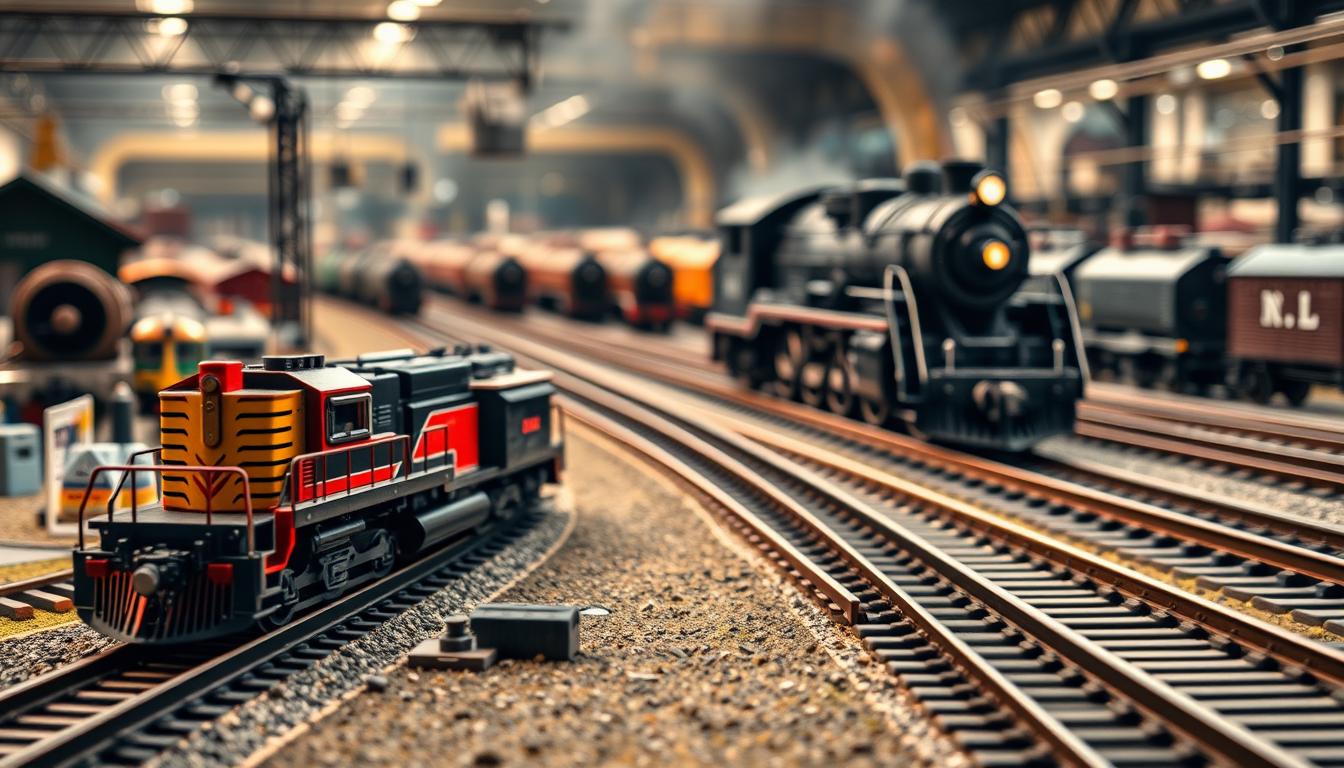
Watch an HO scale train zip around a layout. It’s a tiny masterpiece, yet its speed feels… frantic. A real diesel locomotive moves with a majestic, earth-shaking crawl. Why does the model seem too fast?
This isn’t an illusion. It’s physics playing a trick on your perception. The universe has rules that don’t shrink with your miniature.
Welcome to the intellectual playground of scaling laws. I’m here to be your guide. We’ll move from your basement to the main line using simple math and a dash of wit.
Think of it as the secret reason Godzilla would collapse under his own weight. It’s a principle dictating everything from a model’s speed to the power it would truly need.
We start with a core idea: for similar shapes, properties change predictably. Length scales one way, area another, and volume yet another. This is the heart of geometric scaling.
It’s not just about trains. It’s why ants are strong for their size and why giants are fantasy. Let’s define our terms and see how these proportionalities shape our world, from the toy shelf to the real thing.
Length, Area, Volume Scaling and Mass implications
For model railroaders, the biggest challenge isn’t scenery or wiring. It’s the cube’s tyranny. Shrinking a 4,000-horsepower diesel to 1:87 scale isn’t just making it smaller. It warps physical laws, showing the harsh truth of geometry.
At the core is similarity. Two objects, like a real SD70 and its HO scale model, have proportional dimensions. Scaling one dimension by a factor leads to exponential changes.
Let’s make this real. Imagine a simple cube. Doubling its size (scale factor of 2) changes everything.
| Property | Scaling Factor (Linear Scale = 2) | Implication |
|---|---|---|
| Length (Side of Cube) | Doubles (Scale Factor 2) | You simply have a longer side. |
| Surface Area (l²) | Quadruples (Scale Factor 4) | Area increases with the square of the scale factor. |
| Volume & Mass (l³) | Octuples (Scale Factor 8) | Volume and mass (if density is constant) increase with the cube of the scale factor. |
This is the cube-square law in action. It explains why ants can carry more than their body weight but elephants can’t. An ant’s strength grows slower than its mass.
For model trains, this is a big deal. A 1:87 scale model isn’t 1/87th the weight of the real thing. A 200-ton locomotive’s model would weigh 1/(87³) of that, or 1/658,503. This makes model railroading a fight against physics.
In the world of similarity, mass is the ultimate challenge. It doesn’t scale nicely. When building your first realistic model rail, you’re not just laying track. You’re fighting the laws that govern size.
Speed & Time Scaling: Why tiny trains look “too fast” on camera
Ever watched a model train video and thought it was flying? Even though it’s slow compared to real trains. This isn’t just your eyes playing tricks. It’s because of time scaling. This makes our small worlds seem a bit off.
At the core of this trick is a simple idea: time must be scaled down for models to seem real. Imagine a 50-foot train shrunk to 1/87th scale. We’ve made it smaller, but time hasn’t changed. Our brains, though, notice the size and speed connection.
The Math of a Convincing Illusion
The key here is dynamic similarity. For a model to seem like the real thing, all forces must match. This is where the scale factor comes in.
If a model is 1:87 (HO) scale, its length is 1/87. But time must also be scaled for it to look right. For true similarity, if length scales by a factor λ, time should scale by √λ. This comes from Froude number scaling, which deals with forces.
In simple terms? A real train takes 10 seconds to pass a point. A 1:87 scale model should take 1/√87 of that, or about 1.07 seconds. But we film in real-time, making it seem too fast.
The Kinetic Energy Conundrum
This also explains why models feel light. Kinetic energy goes up with the cube of the scale factors. Let’s look at the energy difference:
| Scale | Length Scale (L) | Mass (L³) | Velocity (L⁰)* | Kinetic Energy (½mv²) |
|---|---|---|---|---|
| Full Scale (1:1) | 1 | 1 | 1 | 1 |
| HO Scale (1:87) | 1/87 | 1/87³ ≈ 1/658,000 | 1 (Kinematic Sim.) | ~1/658,000 |
| O Scale (1:48) | 1/48 | 1/48³ ≈ 1/110,000 | 1 (Kinematic Sim.) | ~1/110,000 |
*For kinematic similarity, velocity is not scaled (v ∝ L⁰). This is a key insight from our source analysis.
The model has much less kinetic energy than the real thing. It lacks the momentum to fight air resistance or track imperfections. It moves without weight, making it seem to skitter across the landscape.
Framing the Perfect Shot: The Cinematic Fix
Filmmakers and serious modelers use a trick to make models look right. They slow down the camera. If you film an HO-scale train at 1/√87 of real-time speed and play it back at normal speed, it looks perfect. The real train’s 10-second pass becomes a 1.07-second pass for the model, which looks fast. But in slow motion and played back at normal speed, it looks massive and slow.
High-end model railroaders and film studios use special cameras and rigs. They’re not just filming models; they’re filming in a scaled time dimension. Peter Jackson used this trick in The Lord of the Rings to make small miniatures look huge.
The next time you see a model train and think it looks “toy-like,” you’re right. It’s moving in our time, not its own. The secret to realism is bending time to fit the scaled-down world.
Power & Drag: The Invisible Adviser and the Engineer’s Dilemma
Air and water are not just empty spaces. They are fluids that push back hard. This push is called drag, and it changes when you scale up or down.
The drag force on an object is related to its size and speed. If you double the size of your model, the drag increases four times. If you double the speed, the drag increases eight times. It’s a tough relationship.
Power is the energy needed to overcome drag. It’s calculated as force times velocity. With our drag relationship, power increases with the square of size and the cube of speed. This is why high-speed trains need huge engines.
Imagine a tiny model train and a real one falling through the air. Gravity pulls them down, and drag pushes up. When these forces balance, they stop falling. The bigger object falls faster. This shows how the world changes at different scales.
The Reynolds number is key here. It’s a number that shows if the fluid is thick and syrupy or thin and nimble. It’s like a fluid’s personality test.
For a tiny, slow-moving model train, the Reynolds number is low. The air feels thick and syrupy. For a huge, fast real locomotive, the Reynolds number is high. The air feels thin and nimble.
This is the core of the Froude/Reynolds ideas conflict. The Froude number is important for ships making waves. The Reynolds number is important for everything else. You can’t match both perfectly in a single scale model. It’s an engineer’s dilemma: which master do you serve?
For trains, the drag on your model isn’t a perfect miniature of the real thing. The air is different. Your model operates in a different fluid dynamic regime.
| Regime | Reynolds Number | Fluid “Feels” Like | Dominant Force | Example in Our World |
|---|---|---|---|---|
| Low Re | Low | Thick, viscous (Maple syrup) | Viscosity | Bacteria swimming, model train at slow speed |
| High Re | High | Thin, inertial (Whiskey) | Inertia | Real locomotive, commercial jet, a speeding car |
When you see a model train zipping around, remember it’s not just small. It’s in a universe where air is like syrup. The power needed, the drag it feels—it’s all part of a different story. Getting the physics right is where the magic of scaling happens.
Visual Demo: Shooting model trains with motion blur to feel “real”
Let’s move from the blackboard to the backlot and explore the filmmaker’s cheat code for scale. All that elegant math about speed and time ratios is useless if your HO-scale masterpiece looks like a toy zipping around a table. Our brains are hardwired to interpret visual cues based on life-sized experience. This is where pure geometric scaling fails our perception.
Think about watching a real train. At 60 mph, it’s a blur of color and steel. Your camera captures that blur because the train’s image races across the sensor during the exposure time. The blur amount isn’t about absolute speed—it’s about angular velocity. How fast does the object move across your field of view?
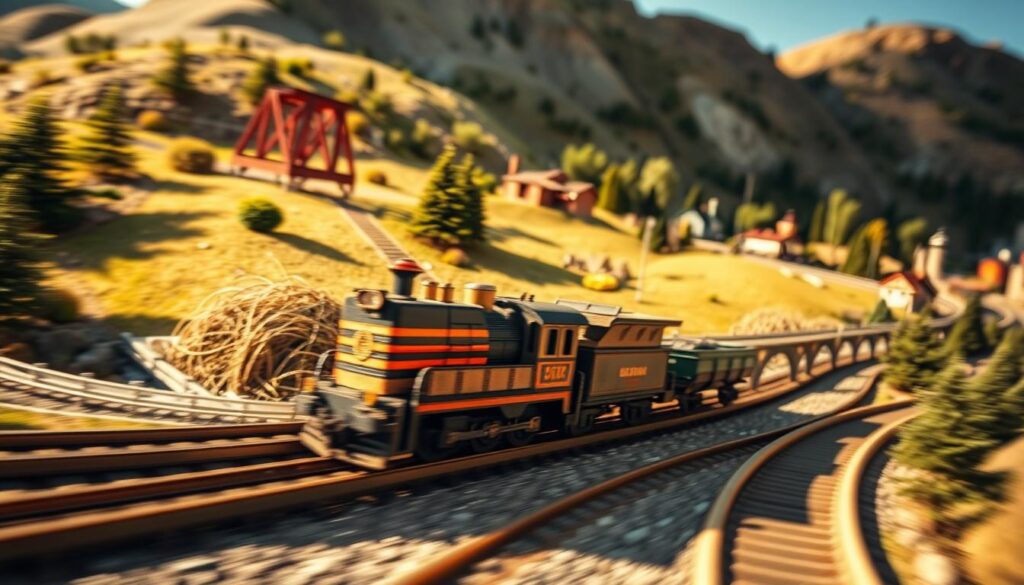
Now shrink everything by a factor of 87. A properly scaled-down speed would be pathetically slow to our eyes. A correspondingly tiny amount of motion blur would be invisible. The result? Your model looks static, crisp, and utterly fake. To hack reality, you must inject the blur your brain expects.
The trick is shutter speed. You need a slower shutter than your instincts tell you. For a small object, you’d normally use a fast shutter to freeze motion. Do the opposite. Let the model drift across the frame during a longer exposure. You’re manually adding visual inertia. It’s a rebellion against simple geometric scaling.
This technique is deeply connected to managing depth of field. A slower shutter often means a wider aperture, which throws your background deliciously out of focus. That separation enhances the illusion of size. Suddenly, your model isn’t sitting on a table—it’s traversing a vast landscape.
Now, combine it with the time-scaling principles from earlier, and you’re bending geometric scaling to your will. Shoot at a high frame rate (say, 120fps). Play it back at normal speed (24fps). The model moves in slow motion, which feels appropriately “heavy.” Add your crafted motion blur on top. The effect is uncanny. Your tiny train now carries the visual weight of a real one.
Here’s a quick cheat sheet for your next shoot:
- Shutter Speed: Start at 1/30th or 1/15th of a second. Adjust based on speed.
- Camera Movement: Pan the camera smoothly with the train’s motion.
- Background: Use a wide aperture to blur distracting details.
- Playback: Slow down high-frame-rate footage for temporal authenticity.
This visual hack doesn’t fix the underlying geometric scaling problem. We can’t shrink ourselves to experience HO-scale time flow. But it proves a brilliant point: sometimes, you must trick physics to satisfy psychology. The camera, it turns out, is the ultimate scale modeler’s tool.
Convert Model Results to Full‑Scale Estimates (Worked Examples)
Let’s dive into the numbers. We move from theory to real-world application. Scaling laws are like a Rosetta Stone, translating small world physics into the real one. It’s time to put on our engineering hats and see this math in action.
Imagine your HO-scale (1:87) model locomotive can pull with a force of 0.1 Newtons on a small spring scale. It’s a cool trick, but what does it mean for a real locomotive?
Worked Example 1: The Pull of a Giant
Force scales with area, or length squared (l²). Our scale factor from model to real is 87. So, the force increases by the square of 87 times.
Real Force = Model Force × (Scale Factor)²
Real Force = 0.1 N × (87)²
Real Force = 0.1 N × 7569
Real Force ≈ 757 Newtons
That 0.1 N tug from your pinky finger is like over 757 Newtons in the real world. It’s enough to yank a small car. Your model isn’t just a toy; it’s a scaled physics lab.
Worked Example 2: The Need for Speed
Model trains in videos always seem to be in a chase scene. Speed scales with the square root of length (√l or l¹ᐟ²). Let’s say your 1:87 model looks “right” at a slow 0.5 meters per second on your layout.
To find the “real” speed, we scale by the square root of our scale factor:
Real Speed = Model Speed × √(Scale Factor)
Real Speed = 0.5 m/s × √87
Real Speed = 0.5 m/s × 9.33
Real Speed ≈ 4.7 m/s (or about 10.5 mph)
That slow crawl on your layout is like 10.5 miles per hour for a full-sized train. Filmmakers use high-speed cameras to slow down model shots. They correct for this scale factors trick our brains play on us.
This isn’t just math for fun. It’s the math used by aeronautical engineers and naval architects. They measure drag on small wings or hulls to predict full-scale performance. Your basement layout is more than a hobby. It’s scaled physics experiments, predicting giants’ performance from your workbench.
Where Similarity Breaks (materials, friction, air)
Our scaling laws are a beautiful lie. They offer a perfect, mathematical setup. But reality, with its messy details, always disrupts this. The main culprits are materials, friction, and air.
Materials are the first to cause trouble. The strength of steel, for example, doesn’t change with size. Yet, the forces on a beam do follow our scaling laws. This creates a big mismatch.
A tiny Eiffel Tower made of the same steel as the real one would be too strong. It could handle a hurricane of sledgehammers. On the other hand, a giant spiderweb would collapse under its own weight. The material stays the same, but the forces change.
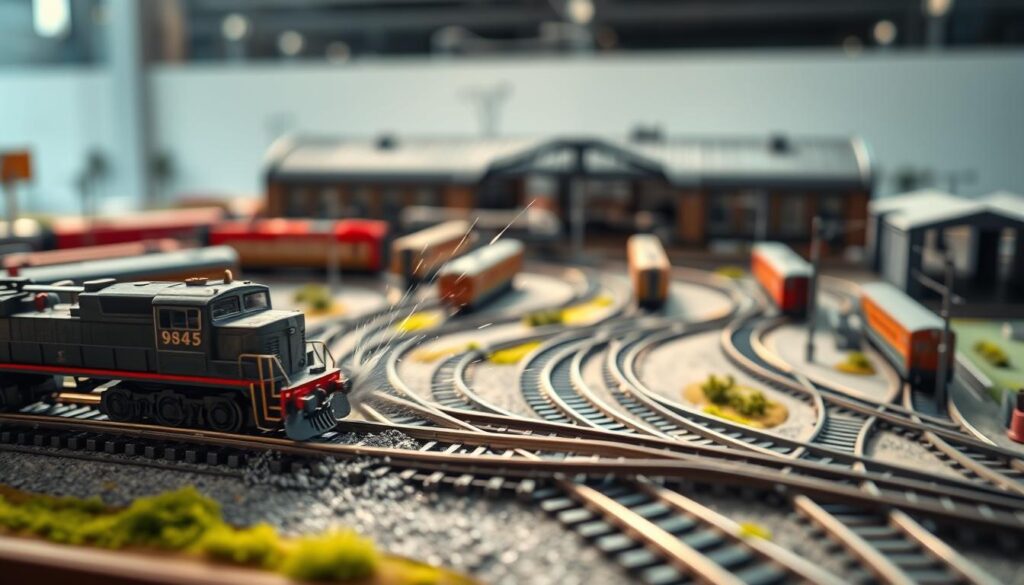
Friction is another problem. It’s like the complicated cousin nobody wants to talk about. Friction forces depend on pressure, surface texture, and velocity in complex ways. Scaling the contact area doesn’t guarantee the friction force behaves the same.
Friction in small spaces, like a model train’s gearbox, can lose a lot of power. Our clean laws don’t predict this.
The air is the biggest problem. The Reynolds number mismatch is a major issue. To match fluid dynamics, you need to match this number. But scaling down length (L) means you must increase velocity (V) or change the fluid.
You can’t do that and also match the Froude number for inertial dynamics. It’s an impossible puzzle. Your HO-scale locomotive will never experience air resistance exactly like its full-sized counterpart. The drag characteristics will always be off.
So what do engineers do? They fudge. They prioritize. This is where the “art” blends with science. You identify which similarities are critical for your test and which can be corrected with empirical data.
| Scaling Challenge | Why It Breaks | Real-World Engineering Compromise |
|---|---|---|
| Material Strength | Material properties (yield strength, density) are scale-invariant, while stresses scale with L. | Use different materials or adjusted cross-sections in models. A wind tunnel model plane might use aluminum, not titanium. |
| Friction & Contact Forces | Depends on pressure, surface roughness, and velocity in complex, non-linear ways not captured by simple area scaling. | Apply lubrication, use special coatings, or derive correction factors from test data. Ignore if the effect is secondary to the study. |
| Fluid Flow (Air/Water) | Reynolds number mismatch makes simultaneous matching of drag and inertia impossible. | Test in specialized facilities (low-speed, pressurized tunnels) or apply well-established scaling corrections to the data. |
| Perfect Geometric Similarity | Manufacturing limits: you can’t machine a 1:87 scale bolt thread that’s functionally identical. | Accept “functional similarity.” Details that don’t affect the primary forces are simplified or omitted. |
The table isn’t a confession of failure. It’s a map of the battlefield. Knowing where your model will diverge from the prototype is the first step to making it useful. You use these scaling corrections—often baked into decades of engineering handbooks—to translate your tiny results back to the real world.
This is the cold, refreshing splash of water after our theoretical dive. The elegant Froude/Reynolds ideas provide the compass, but the journey requires navigating a terrain full of compromises. The genius isn’t in achieving perfect similarity. It’s in knowing exactly how and where to cheat.
History: Wind tunnels & scale testing in rail and aero
That model train on your layout is more than a toy. It comes from the engineering that sent a man to the moon. The art of scale testing, learning big lessons from small models, shows human ingenuity. It goes from the Wright brothers’ bicycle shop to today’s sleek cars and jets.
The Wright brothers started it all. They built a small wind tunnel in their shop to test wing designs. They didn’t guess if a wing would work. They made a small, similar model and tested it.
This was the start of dynamic similarity. They checked if the airflow over their small model was like a full-sized one. This is the heart of scale testing: making a model’s behavior a scaled-down version of the real thing.
Railroads also used scale models. Before making a new locomotive, engineers built a detailed scale model. They tested it in water or wind tunnels to see how it handled.
The genius was in understanding the math of similarity. They matched the Reynolds number for airflow or the Froude number for water resistance. Get these numbers right, and the model’s drag, lift, and pressure would match the full-size version.
In the 20th century, this principle grew. The sleek trains of the 1930s, the Spitfire fighter, and the Apollo capsule were all perfected in miniature. Wind tunnels became key places for this new understanding of similarity.
Engineers didn’t just blow air at models. They scaled conditions precisely. To match the Reynolds number, they might change air density or use different fluids. This way, a 1:10 model could behave like the real thing without being built first.
Today, this legacy continues, not just in wind tunnels but in supercomputers. Computational Fluid Dynamics (CFD) simulates airflow over digital models. But the core principle remains the same: similarity. The goal is to make the forces on the model match the full-size object perfectly.
When you watch a model train round a curve, you see the same physics as a 100-car freight train. It’s not just a hobby. It’s a hands-on lesson in the engineering that shaped our world. It shows that to understand the big, you sometimes have to start with the small and similar.
Challenge Problems + Answer Key
Don’t just read—do. Let’s cement this with some brain teasers. I’ll play the sage and pose the problems; you grab a notepad.
The Fall Problem: A mouse survives a fall from a mineshaft, per J.B.S. Haldane’s famous essay. At what approximate scale would a model locomotive need to be for it to survive a similar drop onto a soft surface? Think about kinetic energy versus structural work.
The Pulling Power Problem: Your HO scale model (1:87) can pull 10 times its own weight. Assuming perfect geometric and material similarity, how many of its own weight could the real Union Pacific Big Boy pull?
The Filming Problem: You want to film an N scale (1:160) train so its motion looks perfectly real on screen. By what factor should you slow down the playback? This gets to the heart of cinematic similarity.
Here’s your answer key. For the fall, survival scales with the square root of size. A model around 1:10 scale might just bounce. The pulling power answer is sobering: it’s just 10 times. Tractive force scales with area, weight with volume. The real beast isn’t inherently stronger per pound.
The filming trick? Slow playback by the square root of the scale factor. For N scale, that’s roughly 1/12.7x real-time. These puzzles reveal the elegant, sometimes counterintuitive, logic of the scaled universe.
Master these scale factors, and you see the world through two lenses at once. You understand why perfect similarity is a physicist’s dream and an engineer’s nightmare. Consider this your final exam in Lilliputian physics. You passed.
