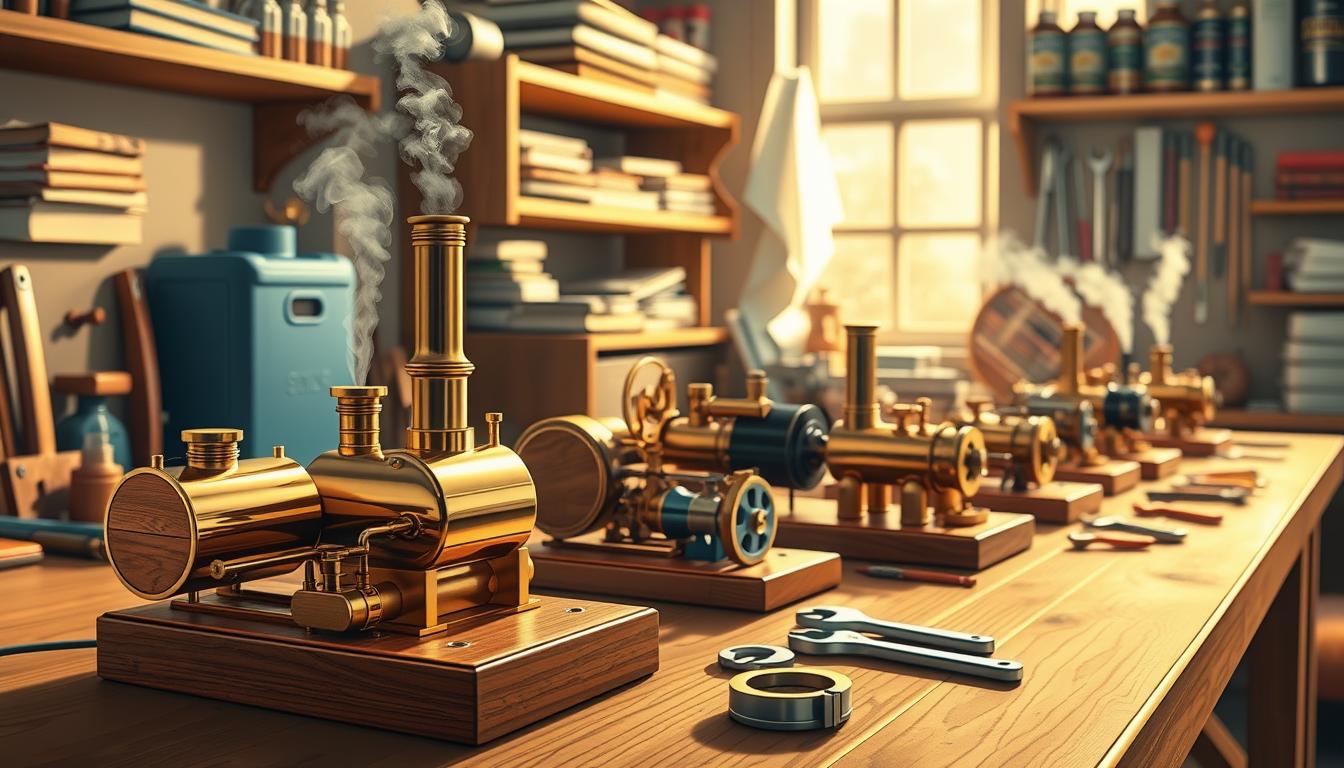
I remember the first time I heard it. It wasn’t from a storybook, but from a small, hissing mechanism on a table. That choo-choo sound sparked a childlike wonder. Now, we’re diving into the world of steam engines with adult curiosity.
There’s a huge difference between a small model and a massive locomotive like “Lindy.” It’s like comparing a YouTube video to a PhD dissertation. Both are important, but they’re on different levels.
The basic idea is old. In A.D. 75, Hero of Alexandria created a spinning sphere called an aeolipile. It was a simple, steam-powered toy. This was the first “aha!” moment.
This guide takes you from that ancient spark to today’s classroom-friendly steam engine demos. We’ll explore from Hero’s sphere to the inventions that changed our world.
Energy Pathway: Heat → Pressure → Motion
The story of the steam engine starts with a 17th-century scholar. Giovanni Battista della Porta saw steam suck the air out of a room. He witnessed nature’s power in action—the creation of a vacuum.
Denis Papin, the ultimate tinkerer, came next. His 1679 “Digest or Engine for Softening Bones” was the first pressure cooker. It was like the proto-Instant Pot. By confining steam, he turned expansion into usable pressure.
Papin then added a piston inside a cylinder above his boiler. Steam pushed the piston up and then condensed, pulling it back down. This push-pull was his genius hack. Nature doesn’t like a vacuum, so it works.
This is the three-act play of thermodynamics that defines steam engines. Let’s break it down with Dionysius Lardner’s classic explanations.
Act One: The Rebellion of Water. Heat makes water hot and turns it into steam. The water molecules expand violently. This is the energy input.
Act Two: Confinement Creates Force. The steam’s rebellion is trapped inside the boiler. It turns into pressure. This is like shaking a soda can, ready to work.
Act Three: Pressure Finds a Purpose. The pressurized steam pushes against a piston. The motion starts. But the real efficiency comes from cooling the steam back to water. This creates a vacuum to pull the piston back. This cycle is what every steam engine part is designed to harness.
| Energy Stage | What Happens | Key Concept | Result |
|---|---|---|---|
| Heat Application | Water absorbs latent heat and vaporizes. | Vaporization & Expansion | Creation of high-energy steam. |
| Pressure Creation | Steam is confined within the sealed boiler. | Confinement & Compression | Potential energy stored as pressure. |
| Motion & Vacuum | Steam pushes piston; condensation creates vacuum to pull it back. | Condensation & Vacuum | Reciprocating linear motion for work. |
Before we look at the steam engine parts in the next section, understand this story. They are just actors. The energy pathway of heat to pressure to motion is their story. This is the DNA for every engine, from Papin’s experiment to a full-sized locomotive.
Meet the Parts: Boiler, Burner, Safety Valve, Cylinder, Piston, Flywheel, Valves
Let’s take a closer look at the team that makes motion from fire. It’s not just a list of parts; it’s a backstage pass. Each piece has its own role and job. They work together to bring the energy pathway to life.
Boiler, Burner, Safety Valve
The boiler is like a pressurized restaurant for water. It’s a ‘fire tube’ design, where fire heats the water. The water absorbs the heat like a sponge.
The burner is the heart of the system. It keeps the fire burning. Without it, the system is just a cold, metal shell.
The safety valve is the drama queen. It releases pressure when it gets too high. It’s like a loud, necessary tweet that prevents a big problem.
The cylinder and piston are the stars. They move with steam’s power. It’s a double-action setup, pushing and pulling in a dance.
The flywheel smooths out the motion. It stores energy and releases it smoothly. It makes the motion flow like a song.
The valves are the unsung heroes. They control the flow of steam. They make sure everything runs smoothly. Without them, the engine would stall.
This team turns heat into motion beautifully. The boiler, piston, and flywheel work together. The valves keep everything in rhythm. Now you know the players.
Common Student-Scale Engine Types
Model steam engines are like small bands, each with its own style. They are simpler than full-sized engines, making it easier to see how they work. You won’t find big engines like the 2-8-0 consolidation type, but you’ll find ones where every part’s role is clear.
The flywheel is a key player in these small engines. In big engines, it’s easy to ignore. But in small ones, it’s what keeps the engine running smoothly. It acts like a battery, storing energy for the engine’s next move.
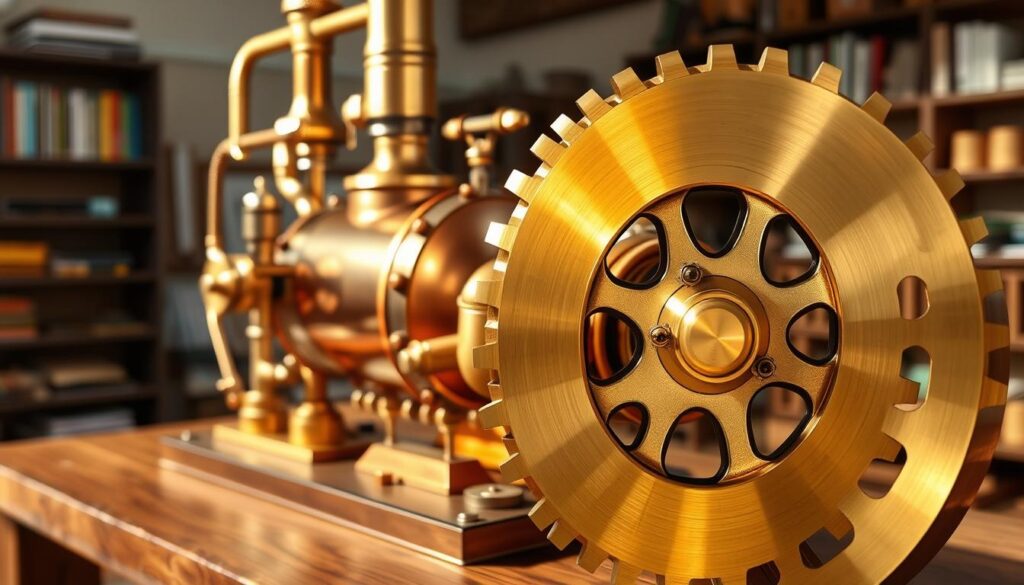
Let’s look at the main types of engines. Each one has its own unique feel.
| Type | Operating Principle | Classroom Vibe | The Flywheel’s Role |
|---|---|---|---|
| Oscillating Cylinder | The entire cylinder rocks (oscillates) on a pivot, acting as its own valve. | The Punk Rock Simplicity. No separate valve gear means fewer parts to fuss with. | Absolutely critical. Smooths out the jerky rocking motion into something resembling rotation. |
| Fixed Cylinder, Sliding Valve | Cylinder is stationary; a sliding “D valve” (as Lardner called it) directs steam. | The Classic Rock Standard. Introduces precision timing and valve events. | Essential for startup and maintaining rhythm against the valve’s friction. |
| Double-Acting | Steam pushes the piston both ways, like Lindy’s powerplant in miniature. | The Jazz Improv. More power and a smoother, more complex rhythm. | Balances the dual power strokes, creating that sought-after continuous whirl. |
| Pop-Pop (Putt-Putt) | Uses a pulse-jet principle; steam condenses, creating a vacuum to pull in more water. | The Ambient Electronica. Hypnotic, rhythmic thrum from a thermal oscillator. | Often absent! The rhythmic “pop-pop” itself provides the timing. If present, it’s for pure smoothing. |
The oscillating cylinder engine is like the Model T of model steam. Its wobble is a simple way to turn steam into motion. It’s a great first choice.
The fixed cylinder engine is more precise, like the 19th century. It teaches about timing, with the flywheel keeping the rhythm steady.
The double-acting engine is the overachiever. It works harder but runs smoother. The flywheel here makes two power pulses into one.
The pop-pop engine is different, like a living thing. It doesn’t need a flywheel as much, thanks to its natural rhythm.
Every engine type, from the punk rock wobbler to the jazz double-actor, teaches the same lesson. Scale changes what’s important. In small engines, the flywheel becomes the main conductor, keeping the engine’s rhythm going.
Safety Setup: Heat, Pressure, Fuel, PPE
Running a live steam engine is like having a tiny, fiery dragon in your classroom. It’s fascinating, but you must follow strict rules to avoid damage. Safety is key to enjoying this powerful technology.
We can break down the risks into four clear categories. Master these, and you become a respected engineer. Ignore them, and you risk a preventable accident.
Heat is the obvious one. You have a burner and metal parts that get hot enough to cause instant, serious burns. Always assume every metal surface is hot once the engine has run. Use tools, not fingers, for adjustments.
Pressure is the silent, invisible threat. Inside that boiler, steam is building up, wanting out. It has no malice, just physics. Your job is to give it a safe, controlled path. This is where that safety valve from our parts list becomes your hero. It’s not an optional accessory. It’s your last line of defense, a mechanical promise that the system will relieve itself before becoming a problem.
Thinking you can out-engineer 300 years of safety development by jamming the safety valve with a toothpick is a bold strategy, Cotton. Let’s see if it pays off. Spoiler: it doesn’t.
Fuel is just fire waiting for a spark. Whether you’re using denatured alcohol or solid fuel tablets, you are dealing with an open flame. Have a fire extinguisher rated for Class B (flammable liquids) fires within arm’s reach. Not in the closet down the hall. Within arm’s reach. Ensure the engine is on a stable, non-flammable surface, far from papers, curtains, or anything else that dreams of being a torch.
PPE (Personal Protective Equipment) is your personal force field. This is non-negotiable. The core item is safety glasses. Steam, hot water, or a tiny metal shard has no regard for your future career plans or your eyeballs. Everyone in the room, operator and observer alike, must wear them. Heavy gloves are also wise for handling hot components, but they can reduce dexterity—so use them with care.
To make it stick, here’s a quick list of what a safe setup isn’t:
- Operating the engine on a wobbly desk.
- Leaning over the boiler to see if it’s “doing something.”
- Using flammable fuel near an open container of the same fuel.
- Assuming the safety valve will “probably” work.
- Treating safety glasses as a fashion accessory you take off for a better look.
Respect these elements—heat, pressure, fuel, and PPE—and you transform a potentially dangerous activity into a controlled, brilliant demonstration of power. You’re not avoiding fun. You’re engineering the conditions where fun can happen without a trip to the nurse’s office. The safety valve is your mechanical ally. Your safety glasses are your personal shield. Use them.
First Demonstration Plan and Roles
Forget the chaotic science fair spectacle; a proper steam engine classroom demo is less about fireworks and more about running a tight ship. Think mission control, not a magic show. The goal isn’t just to see wheels spin, but to understand the human-system interface that makes it happen.
Channel the crew of a classic locomotive like the Lindy. We’re moving from theory to a structured, role-playing exercise. This turns operation into a live lesson in systems management and distributed responsibility.
This transforms your classroom demo into a mission with four critical roles. Each student has a specific, actionable job that makes the whole system click.
- The Engineer (Captain): This is command. Their sole focus is the throttle—the steam valve. They make the final “go” or “no-go” calls based on crew reports. They are the ultimate decision-maker for motion.
- The Fireman (First Officer): This role handles energy input. Their duties are managing the burner flame and vigilantly watching the water level in the boiler. They control the “fire” in fire-tube.
- The Observer/Recorder: Every good experiment needs a scribe. This person logs events, timestamps actions, and notes pressure gauge readings. They create the data trail for later analysis.
- The Safety Officer: This is the dedicated voice of caution. Their only job is to watch the safety valve and monitor for leaks. They have the authority to call for a shutdown if anything looks out of parameters.
With roles assigned, your classroom demo startup sequence becomes a disciplined script. It goes from “everyone crowd around” to a precise checklist.
The Engineer initiates: “All stations, report.” The Fireman confirms, “Burner is lit at low setting.” The Safety Officer states, “All clear. Safety valve is set.” The Engineer checks, “Water level is good. Throttle is closed.” The Observer announces, “Timer is ready.”
Only then does the Engineer give the order: “Begin gentle heat.” This collaborative cadence teaches procedure, communication, and teamwork alongside the thermodynamics. It’s not just a machine working; it’s a team making it work.
This structured approach to your first classroom demo ensures safety, engagement, and deep learning. It replaces chaos with purpose, turning students into a crew conducting a scientific investigation.
Run Log: Observations and Simple Measurements
Let’s be honest: ‘cool, it spins!’ gets old. The real intrigue begins when you ask, ‘Why does it spin like that?’
This is where we cross the bridge from playful demonstration to actual science. A run log is your passport. It’s not busywork. It’s the tool that decodes your engine’s unique personality and, more importantly, its strict obedience to the physical laws we mapped out earlier.
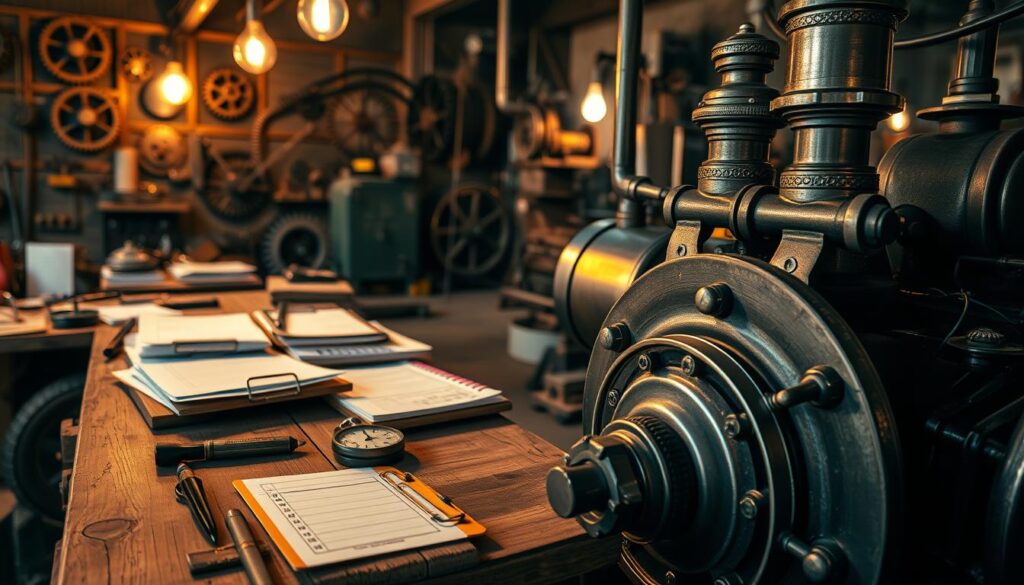
Think of it as a steam-powered confession booth. By tracking a few simple measurements, you’ll hear the engine tell you how hard it’s working, how efficiently it’s burning fuel, and what happens when you ask more of it.
What should you note? Focus on these four key areas. They turn vague wonder into specific, actionable data.
| Observation / Measurement | Method / Tool | What It Tells You |
|---|---|---|
| Time to First Motion | Stopwatch (from heat applied to first flywheel turn) | Engine’s “warm-up” efficiency. A baseline for thermal mass. |
| Steam Production Rate | Listen & count exhaust “puff” frequency vs. burner valve setting | Direct cause-and-effect: more fuel input = more steam output. |
| Rotational Speed (RPM) | Mark on flywheel + stopwatch for 10-20 revolutions | The engine’s happy-place operating speed under no load. |
| Effect of Load | Gently resist flywheel with a pencil eraser; observe exhaust & speed | Proof of Lindy’s principle: more work demanded = more steam consumed. |
Take rotational speed. A mark on the flywheel and a phone stopwatch give you RPM. This is your baseline. Now, simulate load.
Gently press a pencil eraser against the spinning flywheel. What happens? The exhaust “chuff” will likely become more forceful and frequent. The engine is complaining, beautifully. It’s working harder, so it needs more steam.
This is Lindy’s principle in miniature: “The harder it works, the more steam it uses.” Your log captures this drama. You’re not just watching motion; you’re measuring the cost of creating it.
Correlate your burner adjustment with the exhaust note. Crank the fuel up? The puffs become a rapid-fire staccato. This is your steam production rate, audible and clear.
Each entry in your log is a data point that ties back to Section 2’s energy pathway. Heat creates pressure, pressure creates motion, and your run log proves it. Now you’re not just an observer. You’re an analyst.
Quick Concepts: Work, Power, Torque
If our model steam engine were a rock band, work would be the album, power the concert’s raw energy, and torque the bass you feel in your chest. These aren’t abstract physics terms. They are the visceral, measurable outputs of your machine’s performance. Let’s define them without an equation in sight.
Work is what gets done. Full stop. It’s the result of a force moving something over a distance. Think of shoving a heavy textbook across a desk. You did work. In our engine, the piston’s push turns the flywheel against friction. That’s work. The unit is the Joule, but you can just think of it as the “chore” completed.
Power is how fast you knock out that chore. It’s work divided by time. If you and a friend both move the same stack of books, but your friend does it in half the time, they exerted more power. This is where “horse power” enters, a brilliant 18th-century marketing term. Mine owners were told an engine could replace X number of horses. Power became the sales pitch for speed.
Torque is the twisting force. It’s not about speed; it’s about rotational grunt. Feel it when you try to stop the flywheel with your finger. The engine fights back with torque. In car culture, torque is the low-end shove that pins you to your seat from a stop. Horsepower is what screams at the top end on a highway. Our little model steam engine has both.
So, where’s the dial for each? Crank up the burner (input energy), and you increase the engine’s power—the flywheel becomes a buzzing blur. Add a bit of friction to the flywheel (like a gentle finger), and you demand more work and torque from the piston. The engine might slow, but each push is more forceful. You are directly manipulating the machine’s performance profile.
To keep these concepts straight, here’s a quick comparison table:
| Term | Simple Definition | Everyday Analogy | Unit | See it in the Model |
|---|---|---|---|---|
| Work | The result of a force causing movement. | Pushing a stalled car 10 feet. | Joule (J) | One complete revolution of the loaded flywheel. |
| Power | The rate at which work is done. | How quickly you push that car 10 feet. | Watt (W) or Horsepower (hp) | Flywheel RPMs when the burner is on high. |
| Torque | A force that causes rotation. | The “oomph” you apply to a wrench to loosen a bolt. | Newton-meter (Nm) | The resistance you feel when trying to stop the flywheel. |
See? No scary math. Just the language of performance. By playing with your engine’s burner and load, you’re not just making steam—you’re conducting a physics experiment in real-time. Now, who said mechanics had to be boring?
Mini Glossary + Label-the-Diagram Exercise
A glossary is like a cheat sheet for a conversation. A diagram is like a map of a machine’s soul. Let’s open up the mental toolbox and see what you’ve got.
This isn’t about just memorizing stuff. It’s about understanding how things work. If you can name the parts and follow the steam’s path, you get the story.
Mini Glossary: Sage’s Definitions
Forget dry textbook stuff. Here’s the live steam lexicon, explained.
- Boiler: The engine’s stomach. It’s where water gets hot and turns into steam. It’s like a pressure cooker drama.
- Burner: The motivational speaker. It adds the heat that starts the whole process. Without it, there’s no steam.
- Safety Valve: The mechanical equivalent of screaming “I need to vent!” and then doing it. It prevents the boiler from becoming a bomb.
- Cylinder: The theater stage. This is where steam pushes the piston back and forth. All the action happens here.
- Piston: The star actor. Sealed inside the cylinder, it moves because of steam pressure. Its work drives the engine.
- Flywheel: The momentum manager. It smooths out the piston’s movements, making them continuous. It’s like a kinetic celebration.
- Valves (Steam & Exhaust): The traffic cops. They control the steam flow into and out of the cylinder. Timing is everything.
- Vacuum: The unsung hero. As steam condenses, it creates a low-pressure space. This helps pull the piston back. It’s not just push; it’s also pull.
Label-the-Diagram Exercise
Below is a simplified diagram of a classic model steam engine. Your mission is twofold.
First, label the key components. Find the seven parts listed below on the diagram (or in your mind).
1. Boiler
2. Cylinder
3. Piston (inside the cylinder)
4. Flywheel
5. Steam Pipe (the conduit from boiler to cylinder)
6. Exhaust (where spent steam escapes)
7. Safety Valve
Second, trace the narrative. Can you follow the steam’s journey? Start at the boiler, then through the steam pipe and into the cylinder valve. Watch it push the piston and exit through the exhaust port.
This test turns a list of parts into a working system. For those who love detailed anatomical diagrams, this is your gateway drug.
Understanding this flow is key. It’s the same principle behind historic locomotives and modern STEM projects. Did you map the story?
Troubleshooting First Runs (stalls, leaks, low power)
Think of troubleshooting your first engine run as decoding a cryptic message from the Industrial Revolution. The machine speaks in symptoms, not words. Your job is to play detective.
Every hiccup, hiss, and stall is a clue. Adopt a systematic approach. Check the heat source, hunt for leaks, and assess mechanical freedom. This isn’t failure; it’s the core curriculum of practical engineering.
Symptom: The Engine Stalls. This is the classic “first-run freeze.” The flywheel stops dead. Your immediate suspect? Insufficient steam pressure. The energy pathway is broken.
Diagnose like a doctor. Is the burner flame weak or uneven? A feeble fire means not enough heat to create vigorous steam. Is the water level too low? The boiler needs fuel to make its magic.
The more intriguing culprit is valve timing. If the valves don’t open and close in perfect sync with the piston’s stroke, steam gets misdirected. The engine chokes on its own rhythm. It’s like a singer missing their cue.
Symptom: A Hissing Leak. Pressure is the lifeblood of a steam engine. A hiss is the sound of it bleeding out. This enemy is almost always a loose fitting.
Gaskets, pipe joints, and valve stems are common escape routes. The fix is simple but critical: a careful tighten with a wrench—only after the system has cooled completely. Never apply force to hot metal.
Symptom: Low Power or Sluggish Speed. The engine turns, but without conviction. It’s loafing. This points to inefficiency somewhere along the line.
Go back to fundamentals. Is the burner delivering maximum heat? Is the piston moving freely, or is there excessive friction binding it? Sometimes, a piston can be too tight in its cylinder. A drop of light oil on moving parts can work wonders.
Also, check for minor steam leaks you might not hear. They rob pressure silently, sapping power before it can reach the piston.
| Symptom | Likely Cause | Quick Fix |
|---|---|---|
| Engine stalls immediately | Weak burner flame / low water | Increase fuel, check water level |
| Engine runs then stalls | Incorrect valve timing | Adjust valve gear linkage |
| Audible hissing sound | Loose fitting or seal | Tighten connection (when cool) |
| Slow, sluggish rotation | High friction or low steam pressure | Lubricate piston, check burner & for leaks |
| Uneven ‘chugging’ motion | Air in system or sticky valve | Bleed air, ensure valve moves freely |
This troubleshooting table is your cheat sheet. Use it to move from confusion to clarity. The process itself—observation, hypothesis, action—is the real lesson.
Embrace these first-run gremlins. They’re not design flaws; they’re the machine’s way of teaching you its language. Solving them is where you stop being an assembler and start thinking like an engineer.
Reflection Prompts and Cross-Curricular Links
Dionysius Lardner, a 19th-century science writer, said the steam engine made life better by making things cheaper. Was he right? Our little model isn’t just a physics toy. It’s a cultural artifact. Let’s use it to explore some deep, fun ideas.
That chug-chug-chug sound is the heart of our modern world. But what did it cost? I’ll ask some questions. You figure out the answers.
History: Before steam, factories needed rivers for water wheels. How did coal-powered steam change everything? It made factories move to cities near coal fields. This built the industrial cities we know today.
Economics: We measure engine power in “horsepower.” That’s smart marketing. It made new technology seem familiar. What other tech has been sold with old names? The “cloud” for data storage, maybe.
Literature & Film: Listen to the engine’s sound. Now watch Charlie Chaplin’s Modern Times, where he struggles with machines. Read Upton Sinclair’s The Jungle, about a soulless packing plant. The steam engine’s sound became a symbol of anxiety in the machine age.
Environment: We got great progress but lost clear skies. The smogs of London and Pittsburgh were from this “happy” invention. We traded clean air for cheap goods and fast trains. Every new tech has an environmental cost. The steam engine was the first to show us.
| Subject | Key Question | Core Concept | Lasting Implication |
|---|---|---|---|
| History | How did steam power change where people lived and worked? | Urbanization & Centralization | The rise of the industrial city and a new social order. |
| Economics | What does “horsepower” reveal about selling new technology? | Framing & Adoption | Technological progress often requires familiar marketing to overcome public fear. |
| Literature | How is the engine’s rhythm reflected in art of the era? | Mechanical Anxiety | Art critiqued the dehumanizing pace and scale of industrial life. |
| Environment | What was the trade-off between progress and pollution? | The Cost of “Cheap” | Established the paradigm of environmental cost for technological gain, a debate we stil have. |
So, back to Lardner. Did the steam engine make us happier? It definitely gave us more stuff. It connected the world. It built empires and broke old ones. But it also darkened skies and created hard, new work.
Your steam engine reflection isn’t complete without taking a side. Was it good? A necessary evil? The beauty of these cross-curricular links is that there’s no single right answer. Just a richer, messier, and more thought-provoking understanding of our world. That’s the real power behind the pressure.
Teacher Notes: Materials, timing, differentiation
Hey, teacher. You’ve got the theory down and the safety briefing ready. Now, it’s time to make it real in the classroom. Finding a good, small model kit is key. You’ll also need clean water and the right fuel.
For a budget-friendly option, check out a Stirling engine project made from pop cans and rubber bands. It shows the same heat principles without the steam.
When it comes to timing, plan carefully. Spend one to two periods on the core theory (Sections 1-4, 8). Use one period for safety and role briefing (5-6). Then, dedicate one or two periods for the hands-on part, data logging, and fixing issues (7, 10).
Save one period for wrapping it all up. Use the glossary and reflection prompts (9, 11) to help students synthesize what they’ve learned.
Differentiation is your ace in the hole. Challenge advanced students with deeper material. For those needing help, focus on the basics. This guide will help you create a hands-on learning experience. It’s all about making heat, pressure, and motion real.
