Imagine a spinning bronze sphere in 1st-century Alexandria, making steam like a boiling kettle. Hero’s aeolipile was more than a toy—it was the first energy transfer device. It was a big deal in ancient Greece.
Fast-forward 1,600 years, and British coal mines became key for innovation. Thomas Newcomen’s 1712 atmospheric engine was a game-changer. It didn’t just pump water; it opened up new business opportunities.
But how does burning coal turn into moving wheels? It’s all about the science of steam. Heat turns water into steam, which pushes pistons. It’s like magic, turning heat into motion.
Newcomen’s engine wasn’t perfect, but it was a start. It showed how to use heat to motion on a big scale. Savery and Watt later improved on this idea.
These steam engine inventors were true innovators. They created machines that changed history. They turned boiling water into the power for the Industrial Revolution.
James Watt’s Incredible Improvements
Imagine a world where steam engines used coal like it was going out of style. James Watt, a genius from the 18th century, changed that. He made steam engines more efficient, like a rockstar remixing a classic.
The Condenser Breakthrough
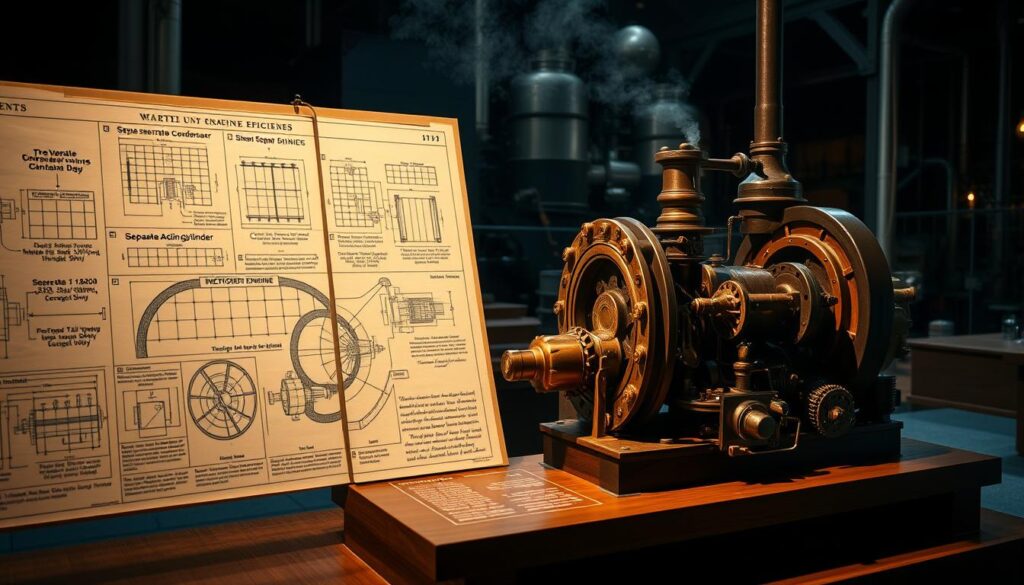
Watt had a big idea while fixing a Newcomen engine. He saw how these machines wasted 80% of their energy reheating metal. Then, he invented the separate condenser, a game-changer.
Think of it like this: old methods used 3 barrels of coal for 1 barrel of power. Watt’s innovation changed that.
- Old method: Burn 3 barrels of coal to make 1 barrel of power
- Watt’s hack: Keep the good stuff (steam expansion) separate from the dirty work (cooling)
“My engine doesn’t consume beer… I mean, coal.”
From Coal Gluttons to Efficiency Kings
Watt’s 1764 patent made steam engines more efficient. This saved fuel and made them profitable. Distilleries and mines could now operate more efficiently.
| Feature | Newcomen Engine | Watt’s Engine |
|---|---|---|
| Coal Consumption | 1 ton per hour | 0.2 tons per hour |
| Energy Efficiency | 20% | 80% |
| Maintenance Costs | £500/year | £100/year |
This was a huge leap forward. Factories could now operate away from coal mines. This started the factory revolution.
George Stephenson: Father of Railways
Imagine a world where your morning commute involved feeding oats to a horse instead of scrolling Twitter. That’s the reality George Stephenson changed when he turned railroads into iron-clad destiny. This wasn’t just engineering – it was social alchemy, changing how humans saw distance, time, and FOMO.
Rocket Man of the Industrial Revolution
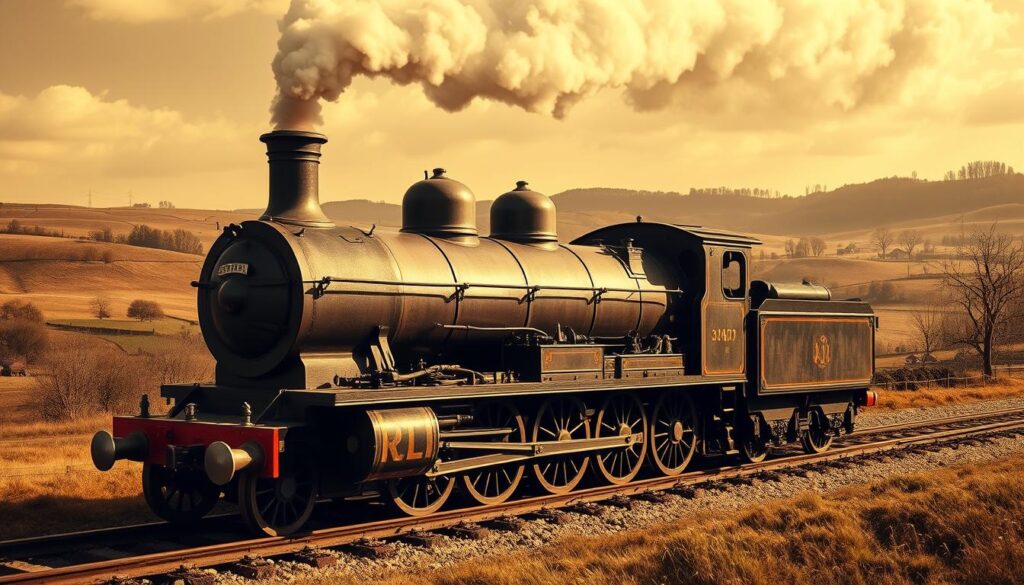
Stephenson’s 1829 Rainhill Trials victory wasn’t just about building the fastest kettle on wheels. His Rocket locomotive was like the iPhone 15 of its day – a 30mph revolution. It made stagecoaches look like flip phones.
Picture this: a steam-powered Ferrari dragging coal carts past galloping horses while spectators’ wigs flew off. Kids today doodle Rocket in margins not just because it’s Thomas the Tank Engine’s moody ancestor. It’s the OG underdog story.
“The public will never be content with 10mph when 30 is possible.”
Tracks, Timetables & Transportation Revolutions
Stephenson didn’t stop at engines. He invented modern transportation’s holy trinity:
- Standardized track gauges (no more “will this wheel fit?” roulette)
- The world’s first railway timetable (FOMO for factory shifts)
- Intercity rail logistics (precursor to your UPS tracking number)
From Hay Bales to Hyperloop
Comparing Rocket to Japan’s bullet trains is like contrasting a Model T with a Tesla Cybertruck. Both moved the needle, but Stephenson’s creation sparked something deeper – our collective obsession with “what’s next.” Modern kids’ love for Polar Express magic and Paddington’s railway adventures? That’s Stephenson’s legacy whispering through pop culture.
Next time you’re impatient because your latte took 3 minutes instead of 2, thank this 19th-century madman who made us all speed addicts. The Liverpool-Manchester Railway wasn’t just tracks and steam – it was humanity’s first hit of velocity-induced dopamine.
Other Pioneers Worldwide
While Britain gets most of the steam-era glory, our “Steam Engine World Cup” shows us other heroes. We look at innovators outside London’s smog, the industrial revolution’s indie bands.
Spain’s Forgotten Steam Genius
Meet Jerónimo de Ayanz y Beaumont, the 1606 Madrid version of Elon Musk. He patented steam-powered mine pumps 74 years before Newcomen’s “groundbreaking” design. His system used piston mechanics that would make Watt blush.
Why isn’t he famous? The Spanish Inquisition’s PR team was too busy to promote his work.
China’s Railway Latecomers
While the West retired steam locomotives in the 1960s, China kept using them until 2003. Mao-era engines were like vinyl records – analog tech in a digital age. Cheap coal and mountains made steam practical long after Japan’s bullet trains.
The last QJ-class locomotives now sit in museums, telling tales of steam power.
| Country | Innovation | Year | Legacy |
|---|---|---|---|
| Spain | Steam mine pumps | 1606 | Forgotten blueprints |
| France | Pressure cooker prototype | 1679 | Papin’s digestor |
| Ottoman Egypt | Steam spit-roast | 1551 | Taqī al-Dīn’s BBQ revolution |
| China | Final steam routes | 2003 | Coal-powered persistence |
From Turkish steam-roasted lamb to French pressure-cooked veggies, these pioneers show steam power’s wide reach. Their stories make us wonder: What if Spain had marketed Ayanz’s pumps like British railways? Would we have “Hispano-Steam” instead of Silicon Valley? History’s vapor trails suggest tech timelines where coal dust settles differently.
Inventor Trading Card Activity
Charizard, meet your new rival – the steam engine. We’re turning history’s inventors into trading card stars. It’s like Yu-Gi-Oh! but with steam power. This project is more than scrapbooking; it’s about using STEM to create amazing inventor profiles.
Build Your Own Steam Hall of Fame
Every trading card needs three key things: stats that slap, art that pops, and special moves. Here’s how to make yours:
- Watt’s Condenser Blast (90 HP): Drains opponent’s thermal efficiency by 50%
- Stephenson’s Rocket Boost (+15 mph terrain bonus)
- De Ayanz Holographic Edition (rarest 1602 Spanish Steam variant)
Pro tip: Add steam trails with washi tape and coffee filters for smokestack clouds. Now, your Trevithick card is not just educational – it’s trade-worthy.
From Sketches to Science Fair Stars
It’s time to study steam engines like Da Vinci studied war machines. Grab your pencils for labeling parts with Ikea precision:
- Draw the piston (the forearm that punches through limitations)
- Label the boiler (the caffeine addict of the system)
- Highlight the flywheel (history’s first energy drink)
Classroom bonus: Host “Steam Showdowns” where kids debate steam engine battles. It’s like Hamilton vs. Burr in industrial history.
Conclusion
The drive for innovation that led to James Watt’s condenser is now seen in Silicon Valley and smartphone charging stations. We’ve moved from George Stephenson’s Rocket to tiny steam engines, like the University of Stuttgart’s 2011 nano-boiler. Innovation didn’t stop with old-fashioned clothes.
Today’s steam engine inventors are not just names in history books. They are kids building beginner model steam engine kits, engineers 3D-printing parts, and teachers teaching thermodynamics with mini turbines. Explaining safety valves to a 10-year-old with a screwdriver is like a drama-filled STEM activity.
Here’s something interesting: 80% of global electricity is made by steam turbines. Your latte’s Wi-Fi is powered by the same principles Fulton and Trevithick used. For those who love to learn by doing, there are blueprints for small engines to download. Museums like London’s Science Museum even let you see Stephenson’s real locomotives up close. The past is not just preserved; it’s alive and working.
