Imagine a Greek inventor’s party trick from 60 AD – Hero of Alexandria’s aeolipile – spinning wildly like a metal TikTok trend gone wrong. Fast-forward 1,700 years, and that same basic principle would launch factories, railroads, and enough industrial smog to make Victorian London look like a charcoal filter test. This isn’t just ancient tech bros messing around – it’s humanity’s first real hack of thermodynamics.
Let’s break it down like Watt breaking down a clogged condenser. Steam power works on a simple premise: heat water until it throws a tantrum, then channel that rage into motion. James Watt’s 1819 essay reveals the real game-changer – his separate condenser turned steam from a novelty act into an 18th-century AI, doubling efficiency while burning less coal than your average steampunk cosplay.
Why should modern minds care? Because every beginner steam engine project today follows the same rules that moved mountains of Welsh coal. The science of steam transportation isn’t some museum relic – it’s the OG renewable energy debate (trees vs. coal, anyone?). Next time your espresso machine hisses, remember: you’re basically staring at the great-great-grandchild of the machine that built empires.
Early Steam Travel: Boats & Trains
Before streaming services, we had steam streaming. It brought big changes in how we moved around. This new tech didn’t just move people; it changed whole economies. It made doubters eat their words.
From Floating Teakettles to Iron Horses
Richard Trevithick’s 1804 locomotive was not a beauty contest winner. Imagine a pressure cooker on wheels – the world’s first steam-powered railway engine looked like a crazy scientist’s grill. But it moved 10 tons of iron at a slow walk, showing steam could beat muscle.
William Symington’s Charlotte Dundas (1803) was Europe’s first steamboat. Critics called it a “floating pub” but it proved them wrong by towing two barges 19 miles without sails. Steam travel was real, not just dreams.
Fulton’s Folly That Actually Worked
Robert Fulton’s Clermont (1807) faced a lot of jokes. Newspapers called it “Fulton’s Folly,” like saying Tesla was just a golf cart with an iPad. But it beat sailing ships by 85% on a 150-mile trip, ending all the laughter.
“The steam locomotive is to the 19th century what Wi-Fi is to coffee shops – suddenly, everything connects.”
George Stephenson’s 1829 Rocket was a game-changer. It was fast and efficient, making earlier steam engines look old. The Salamanca (1812) was the first to make money, scaring coal merchants who faced new competition.
Timeline of Major Inventions
What do dial-up internet, flip phones, and 18th-century steam engines have in common? They all started as early versions of big technologies. Let’s explore how steam engines went from being slow to being fast.
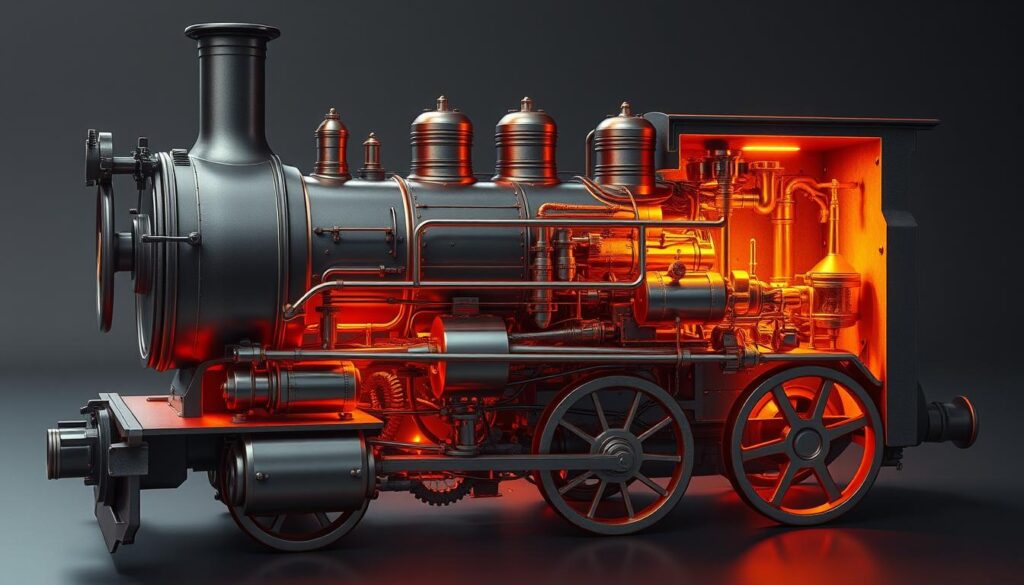
1712-1840: From Atmospheric Engines to Transcontinental Rail
Thomas Newcomen’s 1712 engine was like a Nokia 3310 of its time. It was tough but not very efficient. This coal-eating machine could only do 12 piston strokes per minute, using just 1% of the coal it burned.
To understand this, imagine:
“Burning 1 pound of coal in Newcomen’s engine could lift 1 ton of cargo 1,100 feet—like powering a smartphone with a car battery.”
Then, James Watt came along in 1765. His design was like the iPhone for steam power. It cut coal use by 60%, making steam engines much more efficient.
Watt’s idea of energy transfer made steam engines very useful:
| Inventor | Breakthrough | Efficiency Leap | Cultural Impact |
|---|---|---|---|
| Newcomen (1712) | Atmospheric pressure pump | 0.5% → 1% | Mines stopped flooding |
| Watt (1765) | Separate condenser | 1% → 3% | Factories left riversides |
| Trevithick (1802) | High-pressure steam | 3% → 5% | First steam locomotive |
| Stephenson (1829) | Multi-tube boiler | 5% → 8% | Railways conquered continents |
By 1840, George Stephenson’s Rocket locomotive was moving at 30 mph. This 8%-efficient engine changed how we saw distance. It made it possible for fresh oysters to reach inland cities before they spoiled, and for Sunday newspapers to arrive before Monday.
The key was each innovation’s focus on energy transfer:
- Newcomen: Harnessed atmospheric pressure
- Watt: Recycled steam through condensation
- Corliss: Precision valves controlled steam flow
Yet, these coal engines were very inefficient by today’s standards. It took 100 pounds of coal to generate 1 horsepower-hour. That’s enough energy to microwave 45 frozen pizzas today. But, like early smartphones, these machines helped create our connected world.
Key Inventors and Patents
Before Silicon Valley existed, steam pioneers were already perfecting the art of disruption – and patent lawsuits. Let’s meet the industrial revolution’s answer to Zuckerberg vs. Musk, where courtroom drama often outpaced engineering breakthroughs.
The Steam Engine Hall of Fame
Our cast of characters reads like a Georgian-era Avengers lineup:
- James Watt: The Tony Stark of thermodynamics, minus the charisma. His condenser patent (1769) became the iPhone of its day – everyone wanted it, few could afford it.
- Richard Trevithick: The Elon Musk of 1804, blowing up boilers to prove high-pressure engines worked. His “hold my beer” approach to safety testing is a nightmare for historians.
- Oliver Evans: America’s forgotten innovator, creating portable steam engines decades before Manifest Destiny needed them.
- George Stephenson: The quiet MVP who turned locomotive concepts into the world’s first proper railways.
Watt vs. Trevithick: The Original Patent Trolls
Imagine if Apple patented the smartphone and sued anyone who improved touchscreens. That was Watt’s playbook. His 25-year patent monopoly on steam condenser tech became industrial revolution roadblock #1.
| Innovator | Claim to Fame | Controversy Level |
|---|---|---|
| James Watt | Atmospheric engine upgrades | Patent lawsuits: 15+ |
| Richard Trevithick | High-pressure systems | Boiler explosions: 3 (documented) |
Trevithick’s countermove? Develop engines so powerful they’d literally explode Watt’s legal arguments. The result? A technological arms race where court dates alternated with safety demonstrations gone wrong. Stephenson eventually sidestepped both by focusing on rail infrastructure – the 19th-century equivalent of building app stores instead of phones.
Changes in Everyday Life
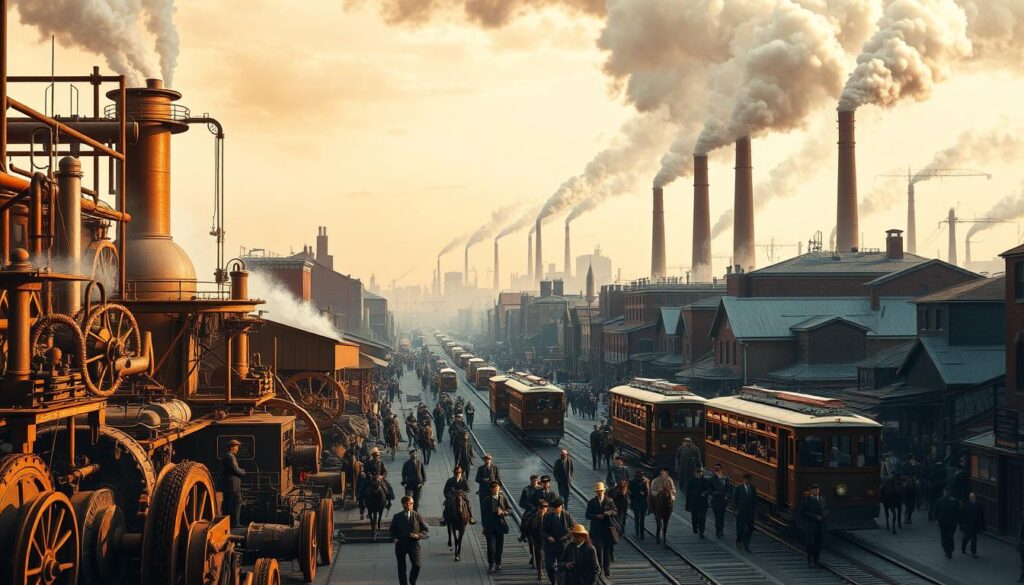
Imagine your great-great-grandma’s shock when her weekly market trip shrank from days to hours. This was all thanks to “metal dragons eating coal.” Steam power didn’t just move goods. It changed how we see time, space, and even how we cook our food.
When Sunday Roast Met Railway Tracks
Before 1825, spices traveled slower than gossip in a small town. By 1850, Britain’s rail network grew faster than a TikTok trend. It had 6,800 miles of track, which is like 98% of all right-swipes on dating apps today (Britannica, 2023). This wasn’t just about speed:
| Aspect | Pre-Steam (1800) | Post-Steam (1850) |
|---|---|---|
| Weekly Work Hours | 80 (sunrise to sunset) | 60 (clock-regulated) |
| Average Travel Speed | 4 mph (horse-drawn) | 30 mph (locomotive) |
| Child Labor % | 18% workforce | 33% workforce |
The dark side? Cotton mills became “childcare centers with paychecks” – 12-hour shifts for 8-year-olds. But here’s the twist even Dickens missed: steam created the modern weekend. Factory whistles demanded synchronized schedules, birthing Saturday afternoons off for workers to… well, recover from factory whistles.
“First train to Brighton felt like flying, ‘cept we left Molly’s shoes on the platform. It was better than walking!”
This energy transformation turned entire regions into single-product zones. Manchester made textiles, Birmingham crafted metals, and your local pub suddenly served “railway pale ale” – the Victorian equivalent of airport margaritas. The social impact? For better and worse, we’re all living in steam’s scheduling app.
Activity: Create a Timeline
Let’s trade history books for hammers and soda cans. We’re not building a popsicle-stick bridge here. We’re creating a tiny steam engine that would impress James Watt. Are you ready to explore thermodynamics through time?
Build Your Own Miniature Powerhouse
Find three items in your recycling bin: an aluminum can, a straw, and candle wax. You’ve got everything you need for a pop-pop boat that shows steam power in action. Here’s how to make it:
- Cut the can into a symmetrical shape (use safety scissors)
- Make a coiled copper tube “engine” with floral wire
- Seal the joints with heat-resistant glue while humming “I Think I Can” from The Little Engine That Could
The Golden Age of Steam Trains ebook explains why this works. “Water heated in the copper coil creates pulsating thrust through phase change.” This makes your boat move. Use labeling exercises to identify parts like pressure chambers and exhaust ports.
Safety First: No Steam Burns Allowed
Before you start:
- Wear oven mitts rated for 450°F – your skin isn’t Teflon
- Use distilled water to prevent mineral buildup explosions
- Position candles downwind unless you want Darwin Award nominations
Pro tip: Add food coloring to your water reservoir. When steam starts pumping, you’ll get rainbow plumes. This will make TikTok science influencers jealous. For advanced builders, our ebook has 1890s blueprints of beginner model steam engines. It’s like Victorian Ikea instructions, but with more brass.
Conclusion: Steam’s Digital Afterlife
The Hogwarts Express chugging through Platform 9¾ isn’t just fantasy – it’s proof steam engines in media keep 19th-century innovation alive in our TikTok era. Tesla’s Cybertruck reveal featured a steam punk aesthetic, while nuclear reactors rely on pressurized water systems Thomas Newcomen would recognize. Our cloud storage? A direct descendant of coal-powered mechanical computation.
Modern STEM education programs now use these analog marvels to teach coding logic. The U.S. Bureau of Labor Statistics projects 10.8% growth in STEM jobs by 2032 – careers rooted in the same thermodynamic principles James Watt patented in 1784. Aspiring engineers can download blueprints from the MIT OpenCourseWare library to build miniature Stirling engines, connecting classroom theory to industrial history.
Here’s the plot twist: your Netflix binge depends on steam. Data centers use vapor-cooled servers echoing Richard Trevithick’s high-pressure engines. Nuclear plants generate 20% of America’s electricity through – you guessed it – steam turbines. Even eco-conscious startups like Malta Inc. are resurrecting thermal storage systems using molten salt instead of coal.
The ebook tucked below this article (subtle, right?) lets you prototype hybrid steam-electric systems. It’s not nostalgia – it’s training for energy challenges where old and new technologies collide. Next time you stream a show, remember: those pixels flow through infrastructure that follows Sadi Carnot’s 200-year-old efficiency equations. The pistons changed, but the physics stayed clutch.
