

Most “competition landscapes” are as exciting as a tax form. But, the world of educational challenges has changed a lot. Now, it’s more like a battle of innovation.
In Spain, the MenteSTEAM challenge has teams solving big environmental problems. They aim to win a spot in the 2026 European STEAMbrace Contest. In Kansas City, middle schoolers are working on reducing food waste through the EcoSpark Waste Reduction Challenge. Their ideas could impress any city planner.
This isn’t just about winning trophies. It’s a fight for the future of innovation. The field is filled with robotics, science fairs, and engineering challenges. Each has its own rules and expectations.
Choosing the right challenge is important. It’s like picking a Netflix series. The wrong choice can be a long, boring ride. In this article, we’ll look at major challenges like MenteSTEAM and EcoSpark. We’ll also uncover what judges really look for—often it’s not what the brochure says.
Team Formation: Building Effective Student Engineering Teams
The secret sauce to winning in student engineering contests is team formation. It’s not just about picking the smartest kids. You need a team that can tackle challenges from all sides. Think of it as building your own Avengers team, where everyone has a special skill.
Effective collaboration is key, as seen in the MenteSTEAM challenge. Students must work together, dividing tasks and presenting solutions. This teamwork is what makes a project succeed or fail. You need a leader who sees the big picture, a detail person, a prototyper, and a presenter who can win over judges.
Finding the right team members can be tough. Look for students who are good at their subjects and enjoy working together. The EcoSpark challenge shows teams guided by experts. Remember, a strong team is only as good as its weakest member, so pick carefully!
Getting the right mix of skills and personalities can make your team unstoppable. With the right team, you’ll not only compete but also excel in student engineering contests.
Project Selection: Choosing Steam-Related Projects with Competition Potencial
Choosing a project is like picking the perfect avocado. It needs patience and a keen eye for quality. In the world of science fair projects, you’re looking for something that solves a real problem and is cool. It’s like dating in the digital age—swipe left on the boring and swipe right on the interesting.
The EcoSpark Challenge is a great example. Students work on projects like reducing food waste or improving recycling. A simple cafeteria tray becomes a place for creativity. MenteSTEAM focuses on climate change and energy. These projects turn local problems into global discussions, showing that the best ideas come from personal frustrations.
Finding the right balance between being possible and bold is key. Can you really build your idea? Will it surprise a seasoned engineer? Here are some tips to help:
- Identify Community Issues: Look around you. What problems are people facing? Solutions that resonate locally often have a broader appeal.
- Stress-Test Your Idea: Review competition rubrics to ensure your project meets the criteria. A brilliant concept that doesn’t align with the judging standards is merely a hobby.
- Engage with Mentors: Seek feedback from teachers or professionals in the field. Their insights can refine your project and enhance its impact.
The goal is to pick a project that excites you and impresses judges. The best science fair projects are creative and practical. They leave a lasting impression on the audience.
Design Process: Engineering Method from Problem Definition to Solution Testing
The design process is like a thrilling adventure. Each step is a chance to innovate and try again. It often starts with a problem that feels like a pesky fly buzzing around your head.
The EcoSpark workshop introduced students to design thinking. This method encourages them to face challenges head-on.
Students learn to see problems as real-life annoyances. This shift in perspective is key. When you define the problem clearly, it becomes the foundation for everything that follows.
Once the problem is defined, it’s time to unleash creativity. This is where ideation kicks in, and students can let their imaginations run wild. It’s like brainstorming with a twist—like a mad scientist cooking up a storm in a lab.
The goal here is to generate as many ideas as possible, no matter how outlandish they may seem.
Next comes prototyping, where the magic happens. Students use materials like duct tape and cardboard to bring their ideas to life. It’s a messy process, often filled with trial and error.
But that’s the beauty of it! Each prototype is a learning opportunity, revealing what works and what doesn’t.
Testing is the final phase, where the rubber meets the road. Here, students put their prototypes through the wringer. They might encounter failures, but that’s not the end of the world.
Instead, it’s a chance to iterate and improve. The key is to embrace the chaos and keep pushing forward.
MenteSTEAM encourages this blend of art and engineering. It reminds us that a solution isn’t just functional; it’s a story waiting to be told. The design process is not a linear path; it’s a jazz improvisation that requires flexibility and creativity.
So, whether you’re tackling engineering design challenges or crafting the next big innovation, remember: it’s all about the journey, not just the destination.
Documentation Standards: Engineering Notebooks and Technical Presentations
Your engineering notebook is more than a record; it’s your team’s story. It captures every brainstorming session, misstep, and exciting moment. Judges will deeply examine it. If it looks like a random list, your great idea might get missed.
Documentation is not just about following rules; it’s your defense and story. A well-kept notebook can make all the difference. It’s like leaving breadcrumbs for judges, each one telling your story. Include sketches, calculations, and thoughts to show your journey.
Technical presentations are where you share your story with many people. It’s important to have a clear structure. Start with the problem, then show your solution, and end with the impact.
Handwriting is often better than typing for credibility. It adds a personal touch that judges appreciate. Don’t forget the appendix; it can be the strongest evidence. Include it to support your claims.
In summary, detailed documentation and engaging presentations are key for STEM competition preparation. They show your hard work and passion. Ready to explore more affordable science experiments? Check out affordable STEAM science experiments you can do at home for inspiration!
| Documentation Element | Importance | Best Practices |
|---|---|---|
| Engineering Notebook | Captures the journey | Be detailed and honest |
| Technical Presentation | Communicates your story | Structure like a TED talk |
| Appendix | Supports your claims | Include relevant data |
Prototype Development: Building and Testing Competition-Ready Models
In the world of engineering design challenges, prototyping is key. It’s where ideas come to life. Students in MenteSTEAM and EcoSpark are making real solutions.
Imagine a team working together, using cardboard and glue guns. They’re not making art; they’re solving real problems. For EcoSpark, it’s a food-waste compactor. For MenteSTEAM, it’s a water-filtration system. The prototype must pass the “poke test” from judges.
Choosing the right materials is important. Think about using recycled items. Your design should look good and work well. It should also stand up to real-world tests.
Making a prototype look good is an art. Every mistake shows your team’s strength. Testing your model many times is essential. It helps you get closer to a top-notch model.
So, get your team ready and start prototyping. For tips on choosing projects, check out this resource. Your journey to creating impactful prototypes begins now!
Budget Management: Maximizing Resources Within Competition Constraints
In the world of student engineering contests, managing your budget is key to success. Money is important, but in these contests, it’s about making the most of what you have. Teams often spend too much on fancy sensors and forget about their presentation boards.
Budget management is the backbone of any successful project. It’s what separates a resourceful team from one that doesn’t make it.
The EcoSpark challenge shows how to manage a budget well. It was supported by grants from the Missouri Department of Natural Resources and MARC SWMD. Students used these resources wisely, showing how partnerships can help achieve more with less.
Here are some tips to make the most of your budget:
- Leverage Local Businesses: Don’t be shy to ask for help. Many local businesses support educational projects.
- Barter Resources: Work with other clubs to trade materials or equipment.
- Create a Realistic Bill of Materials: Stick to what you really need. Avoid making wish lists.
- Present Frugality as a Feature: Judges like teams that can do more with less. Show off your resourcefulness.
Also, watch out for common mistakes. Teams often forget to budget for things like printing. Don’t let this happen to you. Plan ahead to avoid last-minute scrambles.

In conclusion, learning to manage your budget can take your project from good to great. With smart planning, you can impress in the world of student engineering contests.
Presentation Skills: Communicating Technical Concepts to Judges
What’s the point of a groundbreaking project if you can’t show its brilliance to judges? In robotics competitions, how well you present can make all the difference. Students in the EcoSpark challenge get to share their innovative ideas with experts. With help from IDEA Space and Rick Caplan, they learn to make their pitches engaging.
You might have built something amazing, but if you can’t share it well, judges might lose interest. Presentation skills are what level the playing field in robotics competitions. A good pitch can make even a simple project stand out, while a complex one might not impress if presented poorly.
I’ve seen shy students turn into confident speakers on pitch day. They learn that it’s not about using fancy words; it’s about making complex ideas seem obvious. Here’s what makes a presentation win:
- The Hook: Start with the problem, not your name. Grab attention right away.
- The Demo: Show your project in action. It should work, even when it doesn’t!
- The Q&A Dance: Turn tough questions into chances to show off your knowledge.
Now, let’s talk about being confident without being too bold. It’s important to be assertive but not arrogant. Add some humor, but don’t make your pitch a comedy show. Judges want to be impressed and entertained. Give them a memorable experience!
Time Management: Meeting Deadlines and Milestone Targets
Time management is key to a successful science fair project. It’s like racing against time, where every second matters. Teams often fail not because they lack creativity, but because they ignore deadlines.
The EcoSpark challenge shows how to manage time well. It has a clear plan: a kickoff, a month to refine, and a final pitch on February 26. This plan helps teams stay focused and on track.
To do well, plan your project carefully. Set big but achievable goals. Avoid getting stuck on small details for too long. You don’t want to be in a rush to finish your poster in just 24 hours!
Also, don’t forget to plan for unexpected problems. Things like a jammed 3D printer or a sick team member can happen. Think of time management as a design challenge, with surprises and a bit of worry.
| Milestone | Target Date | Completion Status |
|---|---|---|
| Kickoff Workshop | January 1 | Completed |
| Prototype Development | January 15 | In Progress |
| Final Pitch Preparation | February 20 | Pending |
| Final Pitch Day | February 26 | Upcoming |
Mentor Engagement: Working with Professional Engineers and Teachers
Think of a mentor as your personal GPS, guiding you through the ups and downs of STEM competition preparation. A good mentor doesn’t drive the car but helps you avoid obstacles. Imagine a professional engineer helping you see a project in a new light, like mentioning thermal expansion.
The MenteSTEAM model shows how teachers are innovation leaders. They offer classroom support and materials for students to face challenges. EcoSpark’s Rick Caplan and the IDEA Space team bring design thinking expertise to the table.
Mentors aren’t mind-readers. To engage them well, ask questions that show respect for their time. This way, you get the most out of their wisdom.
Knowing how to interact with mentors is key. Set clear expectations from the start. And remember, getting different advice from experts is normal. It’s all part of the learning journey!
Lastly, mentorship is beautiful. The best relationships are when students teach their mentors something new. This is the heart of the STEAM circle of life.
Competition Day Preparation: What to Expect and How to Excel
Competition day is a big deal. It’s where nerves and creativity meet. Teams are excited and a bit nervous. Being ready is key to success.
Start with the basics: a checklist. It should include everything from power strips to snacks. A good snack bag can keep your team sharp.
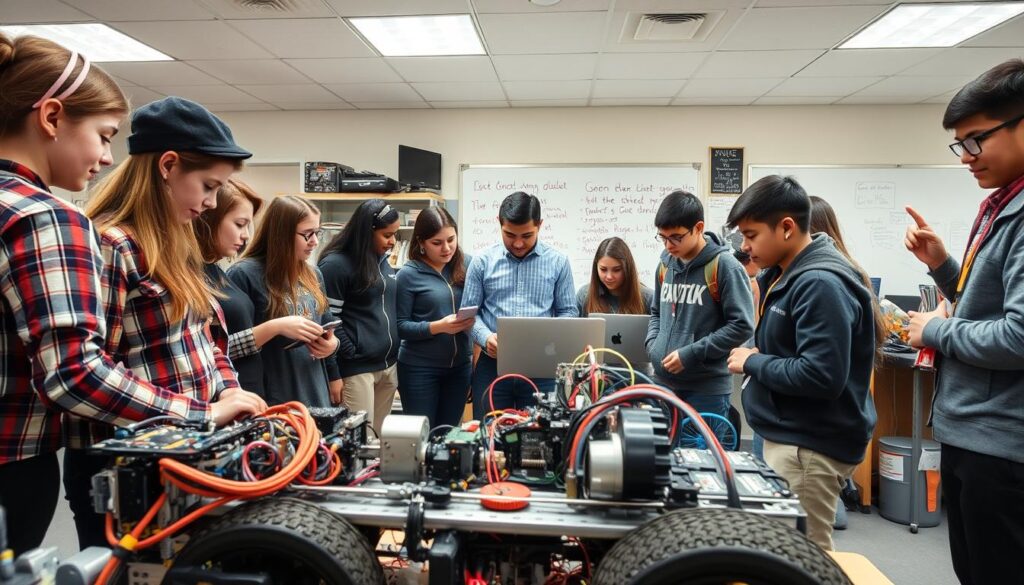
Then, focus on mental preparation. Imagine judges visiting your booth. Practice your presentation and teamwork. It’s not just about your project, but how you work together.
Live demos are critical. They can go well or not. Be ready for technical issues. A good backup plan can turn a bad situation into a positive one.
Networking is also important. Talk to other teams with real interest. Ask them about their projects. You’ll learn and make friends.
Remember, it’s not just about tech skills. Pay attention to the competition, but do it quietly. Watching others can help you learn without looking like a spy.
Whether it’s a local event or a big contest, treat it like a mission. With the right prep, you’ll do great and have fun.
Win or Learn: Post-Competition Analysis and Improvement Strategies
The trophy is shiny, but the real treasure lies in what comes after the competition. Reflecting on your experience is key. Judge feedback is like analyzing a great film—every detail matters.
You want to identify those engineering design challenges that tripped you up and learn from them.
Catalog the moments when your team shined or faltered. This is where growth happens. Create a repository of your project. It should serve as a launchpad for future endeavors, not a forgotten relic collecting dust.
The most successful teams often stumble first. They learn to iterate and adapt, making each setback a stepping stone toward success.
Consider engaging with your peers and mentors to share insights. Building a culture of continuous improvement is essential. Ask yourself, “What just happened, and how can I make it weirder next time?” This mindset fosters innovation and resilience.
For more guidance on strengthening STEM education and addressing engineering design challenges, explore resources like the STEM Education Strategic Plan. Embrace the journey, and remember, every experience is a lesson waiting to be learned.
