I used to think steam pressure was just angry water. But it’s much more complex and fascinating. It’s like finding out your quiet neighbor is a jazz musician with three PhDs.
This power drove the Industrial Revolution. Yet, most of us don’t really get it. It’s about 3 x 10^19 gas molecules per cubic centimeter. They collide a lot, creating a strong force.
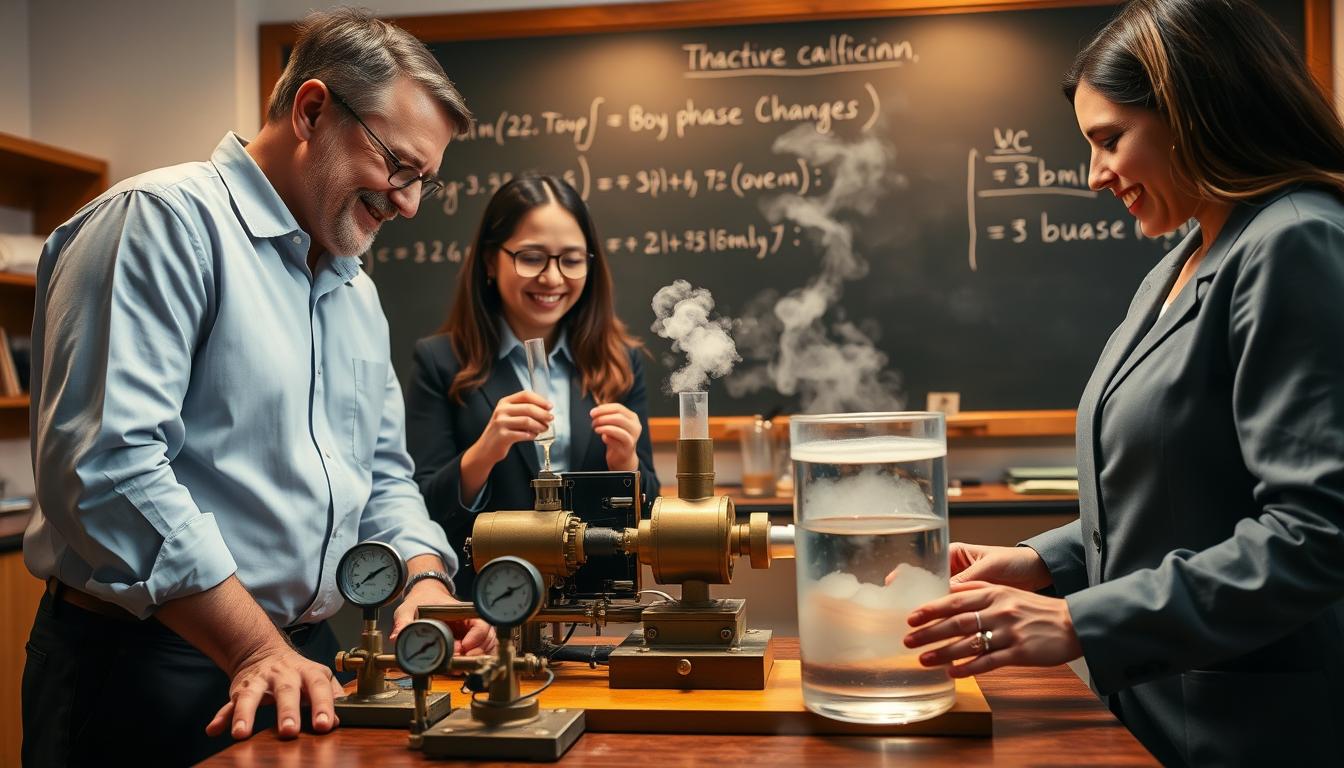
With safe hands-on learning and phase change demonstration, you’ll see Boyle’s Law in action. No need to decipher ancient texts. It’s like learning about the force that moves pistons and powers turbines.
The aim is to understand the molecular behavior in a boiler drum. You’ll get it as easily as you imagine your morning coffee brewing.
Units and tools: psi, kPa, bar, gauges, transducers, calibration basics
Ever wondered why your car tire shows 32 psi while European manuals use bar? Welcome to the world of pressure measurement units. Americans stick to pounds per square inch, just like we do with Fahrenheit and miles. But the rest of the world uses kilopascals and bar, showing they’ve adopted the metric system.
Understanding these units is key. It turns raw data into useful information.
Let’s look at the conversion landscape. 1 atmosphere equals 760 Torr, which is 101,325 Pascals, or 101.325 kilopascals, or 1.01325 bar. That’s about 14.7 psi in American terms. It’s like the Tower of Babel.
| Unit | Abbreviation | Equivalent to 1 atm | Common Use |
|---|---|---|---|
| Pounds per square inch | psi | 14.696 | US automotive, industrial |
| Kilopascal | kPa | 101.325 | International standard, scientific |
| Bar | bar | 1.01325 | European industrial, meteorology |
| Torr | Torr | 760 | Vacuum systems, medical |
The difference between gauge vs absolute pressure is key. Gauge pressure shows how much your system is above atmospheric pressure. Absolute pressure shows the total pressure, including the atmosphere.
Think of it like this: gauge pressure is your salary above the poverty line. Absolute pressure is your total income. Both are important, but they tell different stories.
Now, let’s talk about the tools we use. The tools that measure pressure are either direct or indirect. Pressure transducers and gauges are not just tools. They’re translators that turn molecular chaos into numbers we can read.
Direct reading instruments measure the force gas molecules exert on a surface:
- Bourdon gauges: Those elegant mechanical devices with curved tubes that straighten under pressure—steampunk aesthetics meet Victorian engineering
- Capacitance diaphragm gauges: Modern precision instruments that make Bourdon gauges look like sundials, measuring tiny deflections in a flexible membrane
- Digital pressure transducers: Electronic sensors that convert mechanical stress into electrical signals with remarkable accuracy
Indirect instruments measure something related to pressure. They measure how well gas conducts heat, then figure out the actual pressure. Thermocouple and Pirani gauges are examples of this clever approach.
Here’s the truth: calibration methods are essential. An uncalibrated gauge gives you fiction instead of fact. It’s only right twice a day, like a stopped clock.
Proper calibration needs traceable standards, controlled environments, and regular checks. Most places calibrate once a year. But critical systems need checks every few months.
Professional calibration methods compare your gauge to a certified standard. It’s not just about checking the number. It’s about verifying accuracy, checking for hysteresis, and documenting uncertainty.
Master these basics—pressure measurement units, instrument types, and calibration—and you’ll go from passive observer to informed interpreter. The numbers on your gauges are more than just digits. They’re a language, and you’ve learned to read it fluently.
Boyle’s law: syringe demo, constant temperature compression, graphing P vs 1/V
In 1662, Robert Boyle gave us a simple yet powerful gas law. You can show it with a syringe and some effort. Boyles law says that at a constant temperature, pressure and volume are inversely related. It’s like a seesaw, where one goes up, the other goes down.
The equation is simple: P × V = k, with k constant at a fixed temperature. But what happens at the molecular level?
Gas molecules aren’t packed tightly like subway commuters.
They’re more like dancers in an empty club, with lots of space between them. The volume they occupy is tiny compared to the container. This is why gas compression works.
When you reduce volume, you force molecules into a smaller space. This increases their density. With more molecules in less space, they hit the container walls more often. This results in higher pressure.
The theory assumes elastic collisions with no energy loss. It’s like perfectly bouncy rubber balls, not wet snowballs that lose energy.
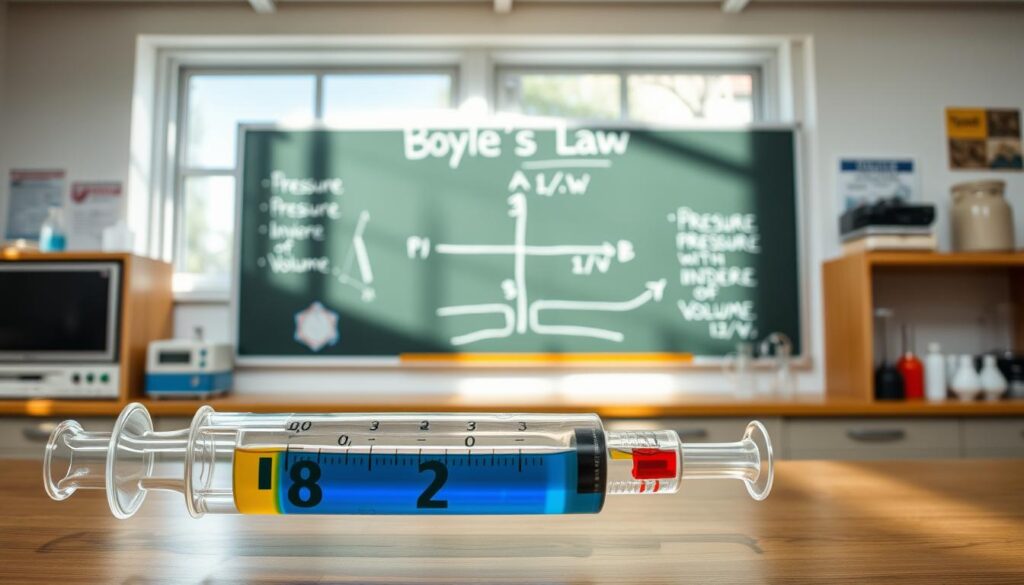
The syringe demo makes abstract equations real. You can feel the pressure pushing back against your thumb.
Setting up your syringe demonstration:
- Pull the plunger to a specific volume marking, such as 20 mL
- Seal the syringe tip with your finger or a cap—no air escapes
- Push the plunger inward to compress the trapped air to 10 mL
- Feel the resistance increase as volume decreases—that’s molecular democracy in action
- Note that temperature should remain constant; rapid compression generates heat
The pressure-volume relationship is felt through your fingertips. Fewer seats mean more crowding, leading to higher pressure.
For real scientific rigor, graph your results. But here’s the clever part: plot pressure versus volume directly, and you get a hyperbola. It’s mathematically correct but not visually appealing.
Graphing procedure for linear results:
- Record pressure at multiple volume settings in your syringe
- Calculate the reciprocal of volume (1/V) for each data point
- Plot pressure on the y-axis and 1/V on the x-axis
- Connect the dots—you should see a beautiful straight line
- The slope of this line equals your constant k
The straight line shows that theory and reality sometimes agree. It’s a rare moment when the universe and your algebra get along.
| Volume (mL) | Pressure (kPa) | 1/V (mL⁻¹) | P × V (kPa·mL) |
|---|---|---|---|
| 20 | 101 | 0.050 | 2020 |
| 15 | 135 | 0.067 | 2025 |
| 10 | 203 | 0.100 | 2030 |
| 5 | 405 | 0.200 | 2025 |
Notice how the P × V product stays consistent? That’s your constant k showing off.
The isothermal process is key. Add heat, and you leave Boyle’s world for Charles’s, where temperature matters.
So, do compressions slowly. Fast compression heats up the gas, breaking the constant-temperature rule.
Boiler design uses this law for steam applications. It’s about volume, temperature control, and pressure relief. Engineers need to know this well.
When steam expands, volume goes up and pressure goes down. This is gas compression in reverse. It’s why steam engines powered the Industrial Revolution.
Demos make invisible concepts visible. You’re reading molecular behavior like Braille. It’s education at its best—when physics becomes real.
Boiling and vapor pressure: altitude effect and closed vs open systems
Ever wonder why backcountry campers in Colorado complain about undercooked rice while their Miami counterparts never face that problem? The answer isn’t camping skill or stove quality. It’s altitude effects on boiling point, and understanding this phenomenon reveals how vapor pressure actually governs phase changes.
Water doesn’t boil at 100°C because some thermodynamic deity decreed it. That temperature only holds at standard atmospheric pressure—14.7 psi at sea level. The boiling point represents the exact moment when vapor pressure equals the surrounding atmospheric pressure.
Think of it as molecular escape velocity. Molecules at the liquid surface constantly attempt to break free into the gas phase. Temperature determines how many succeed.
At higher temperatures, more molecules possess sufficient kinetic energy to overcome intermolecular forces. When enough molecules escape simultaneously throughout the liquid volume—not just at the surface—you get boiling. That’s the critical distinction between evaporation and boiling.
Now here’s where altitude effects get interesting. Climb to Denver’s mile-high elevation and atmospheric pressure drops to about 12 psi. Water’s vapor pressure reaches equilibrium with this lower pressure at roughly 95°C.
Your pasta water is boiling—just at a temperature that doesn’t cook starches efficiently. Physics doesn’t care about your dinner plans.
| System Type | Pressure Behavior | Boiling Point Response | Practical Application |
|---|---|---|---|
| Open System | Atmospheric pressure determines ceiling | Varies with altitude and weather | Standard cooking pot, open kettle |
| Closed System | Pressure builds until relief valve activates | Increases with temperature rise | Pressure cooker, autoclave, boiler |
| Sealed Rigid Container | Pressure rises without limit | Continues increasing dangerously | Improper storage—potentially explosive |
Closed system pressure operates under entirely different rules. Seal water in a rigid container and heat it, and those energetic vapor molecules have nowhere to escape. Pressure builds relentlessly.
This is precisely why pressure cookers work. By trapping steam, internal pressure climbs to 15 psi above atmospheric, raising the boiling point to about 121°C. Higher temperature means faster chemical reactions, which translates to reduced cooking time.
The same principle makes industrial boilers extraordinarily efficient energy carriers—and extraordinarily dangerous when safety systems fail. Closed system pressure without proper relief mechanisms doesn’t just risk equipment damage; it risks catastrophic rupture.
The phase transition itself deserves attention. When water converts to steam, it absorbs tremendous energy—the latent heat of vaporization—without any temperature increase. You can measure 100°C liquid water and 100°C steam with identical thermometers, yet the steam contains vastly more energy per gram.
This thermodynamic quirk makes steam such an effective industrial working fluid. It carries energy efficiently, releases it during condensation, and the cycle repeats.
Understanding altitude effects on phase changes matters beyond cooking frustrations:
- Chemical processes requiring specific temperatures must account for local atmospheric pressure
- Sterilization protocols in medical autoclaves depend on achieving sufficient temperature through closed system pressure
- Boiler design must accommodate operating altitude to maintain proper steam generation
- Distillation and evaporation equipment performs differently in Denver versus New Orleans
The vapor pressure curve for water—plotting pressure against temperature—isn’t just academic abstraction. It’s a practical tool for predicting system behavior. The Clausius-Clapeyron equation quantifies this relationship, allowing engineers to calculate exactly how much boiling point shift occurs with pressure changes.
Here’s the safety implication that keeps boiler operators awake: uncontrolled pressure in a closed system doesn’t gradually increase risk. It creates conditions for explosive failure. When liquid water suddenly converts to steam—occupying roughly 1,600 times more volume—the energy release can level buildings.
This isn’t hypothetical. Industrial accidents involving steam boiler failures demonstrate what happens when closed system pressure exceeds design limits without proper safety mechanisms engaging.
The difference between understanding these concepts theoretically and grasping them viscerally separates textbook knowledge from genuine comprehension. Vapor pressure isn’t some abstract number in a reference table. It’s the measurable force of molecular chaos attempting to achieve equilibrium with surrounding conditions.
Safety valves: how they work, set points, and bicycle pump test analog
Every pressure vessel needs a fail-safe, and that’s where safety valves come in. They are the last line of defense against overpressure disasters. These mechanical sentinels sit atop boilers, pressure cookers, and industrial vessels, waiting to act when needed.
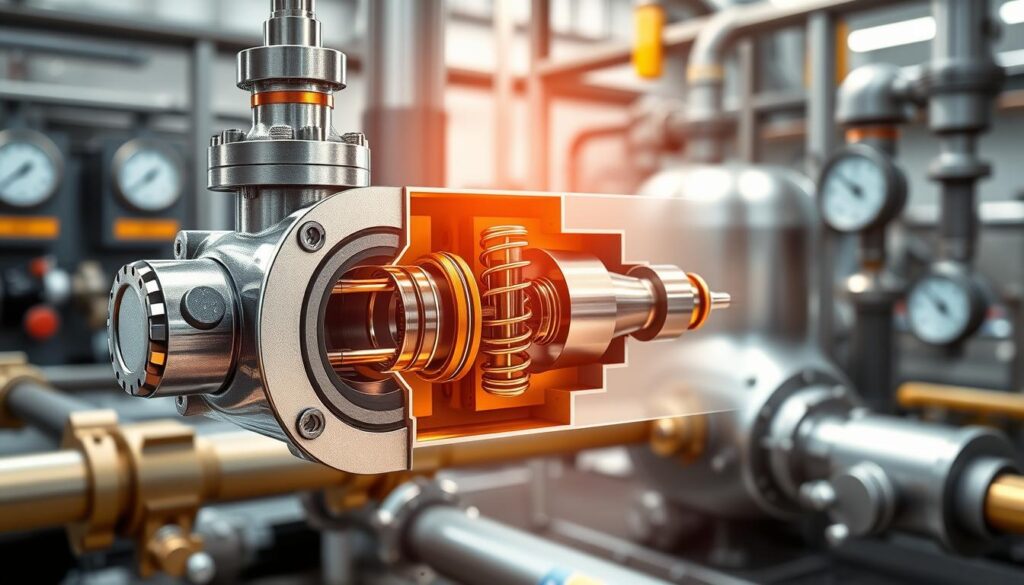
The beauty of safety valves lies in their simplicity. A spring holds a disc firmly against a seat, creating a seal that contains pressure. When fluid pressure pushes upward with enough force to overcome the spring tension, the disc lifts and vents the excess pressure through a discharge opening.
This is not a gradual leak or a friendly warning. The valve opens decisively, releases pressure until equilibrium returns, then slams shut again. It’s automated pressure relief driven by pure physics, no electronics or human intervention required.
Understanding pressure as force per unit area makes the mechanism crystal clear. Imagine a 100-pound spring holding a disc with one square inch of surface area. When pressure reaches 100 psi, you’ve got 100 pounds pushing up against 100 pounds pushing down—a perfect standoff.
Add just one more psi, and that balance tips. The disc lifts, pressure escapes, and the cycle resets. This threshold is the set point, and getting it right matters more than your Wi-Fi password.
Set points aren’t pulled from thin air or set by whatever feels comfortable. Engineers calculate them based on vessel design pressure, material strength ratings, and safety margins that would impress an anxious parent. A boiler rated for 150 psi might have its safety valve set at 165 psi—high enough to avoid nuisance venting during normal pressure spikes, but low enough to prevent the vessel from exceeding its maximum allowable working pressure.
Set point calibration requires precision tools and trained technicians. You’re adjusting spring compression to achieve exact opening pressure, then testing repeatedly to verify consistent performance. A valve set too high offers false security, like a smoke detector with dead batteries. A valve set too low becomes the boy who cried wolf, venting unnecessarily and wasting energy while training operators to ignore alarms.
The bicycle pump demonstration brings this abstract concept into tangible reality. Set up a pump connected to a sealed container fitted with a simple spring-loaded release valve. As you pump, students watch the pressure gauge climb steadily. When pressure hits the predetermined threshold, the valve pops open with a satisfying hiss, venting air until pressure drops below the set point.
The valve snaps shut, and the cycle can repeat. This hands-on analog perfectly mirrors industrial safety valve operation, minus the steam burns and liability concerns. Students observe the mechanical response to pressure differential, the precision of the set point, and the automatic nature of overpressure protection.
Testing and maintenance separate functional safety systems from expensive decorations. Regular inspection reveals corrosion, wear, or debris that could prevent proper seating. Lift testing—manually opening the valve or using test connections—verifies that the valve can open when needed.
Actual pressure relief testing requires specialized equipment to measure opening pressure accurately. You don’t guess whether a parachute will open; you don’t guess whether a safety valve is calibrated correctly either.
| Valve Type | Operating Mechanism | Typical Set Point Range | Response Time | Best Application |
|---|---|---|---|---|
| Spring-Loaded Direct | Spring tension vs. fluid pressure | 15-3000 psi | Milliseconds | General purpose, simple systems |
| Pilot-Operated | Small pilot valve controls main valve | 50-3000 psi | 0.5-2 seconds | High pressure, tight control needed |
| Balanced Bellows | Bellows compensates for backpressure | 15-1500 psi | Milliseconds | Variable backpressure conditions |
| Rupture Disc | Metal membrane bursts at set pressure | Custom designed | Instantaneous | One-time emergency relief, corrosive media |
Different valve types suit different applications, but the principle remains constant: reliable overpressure protection through mechanical response to pressure thresholds. Spring-loaded valves offer simplicity and reliability for most applications. Pilot-operated valves provide tighter control in high-pressure systems where even small pressure variations matter.
Balanced bellows designs compensate for backpressure in the discharge system, maintaining accurate set points when downstream conditions vary. Rupture discs serve as one-shot protection, bursting at precise pressure to provide instant full-area relief—perfect for emergency scenarios or corrosive fluids that would damage traditional valves.
The consequences of neglecting set point calibration and testing range from inefficient operation to catastrophic failure. A stuck valve transforms a safety device into a bomb timer. Regular calibration schedules aren’t bureaucratic busy work—they’re the difference between controlled operation and explaining to investigators why basic engineering principles were treated as optional suggestions.
Understanding safety valve operation transforms abstract pressure limits into concrete protective mechanisms. That spring-loaded disc isn’t just another fitting on a pipe. It’s a mechanical contract promising that when pressure exceeds safe limits, physics will intervene before human reaction time becomes relevant. In a world where invisible forces can tear metal apart, having a reliable, calibrated, tested safety valve isn’t paranoia—it’s the minimum entry fee for responsible pressure system operation.
Classroom stations: syringe manometer, kettle demo, rotation plan
Watching twenty students rush to one boiling kettle is common. Station-based learning solves this problem. It turns chaos into a well-organized learning experience.
Laboratory stations let students touch and see steam pressure concepts firsthand. They don’t just hear about gas behavior; they see it. This hands-on approach shows how pressure changes based on your view and position.
At station one, students use a syringe manometer setup. It’s a dream for those who learn by doing. By pushing the plunger, they see pressure change. It’s like magic, proving Boyle’s Law in a real way.
Students get instant feedback. As they compress the syringe, the pressure goes up. This shows them how molecules behave in a clear way.
Station two is about the kettle demonstration. It’s simple but very effective. Students watch as water turns to steam at 100°C. This shows how heat turns liquid into vapor.
Students with a visual learning style love this station. They see steam rising and bubbles forming. It shows how heat and pressure are connected.
The demonstration rotation plan keeps things organized. Students move in groups, learning without getting in the way. This way, everyone gets to see and do different things.
Students move from station to station in a set order. This keeps things running smoothly. In just forty-five minutes, they learn a lot, not just a little.
| Station | Primary Concept | Learning Style | Key Observable |
|---|---|---|---|
| Syringe Manometer | Boyle’s Law (P-V relationship) | Kinesthetic | Pressure gauge response to compression |
| Kettle Demo | Phase change and vapor pressure | Visual | Liquid-to-gas transition at 100°C |
| Data Analysis | Graphing pressure relationships | Analytical | Linear best-fit lines and trends |
Clear instructions are key to success. Each station has written instructions that are easy to see. This way, students know what to do without asking too many questions.
Safety is important at each station. Students wear eye protection with the syringe. They stay back from the kettle to avoid getting burned. Hot surfaces get clear warning labels to keep students safe.
This method makes learning efficient. Students learn about steam pressure in different ways. The rotation plan makes sure everyone sees everything, helping them understand better.
When done right, learning becomes real. Students see that pressure is more than just a number. They’ve watched molecules change and felt the difference in volume. Theory and reality have become one.
Data table design: plotting best fit line, error bars, and sources
Numbers in a notebook don’t automatically mean anything. They need structure and analysis. Data tables give measurements their shape and meaning.
To start, plan your table before you begin. You’ll need columns for each variable. Volume goes first, followed by pressure in different units.
Using different units is key. Dimensional analysis is like a physics test. It shows you understand relationships, not just numbers.
| Volume (mL) | Pressure (psi) | Pressure (kPa) | 1/V (mL⁻¹) | PV Product |
|---|---|---|---|---|
| 20.0 | 14.7 | 101.3 | 0.050 | 2026 |
| 15.0 | 19.6 | 135.1 | 0.067 | 2027 |
| 10.0 | 29.4 | 202.6 | 0.100 | 2026 |
| 8.0 | 36.8 | 253.7 | 0.125 | 2030 |
Adding a column for 1/V makes your graph easier to analyze. The PV product column checks if Boyle’s Law is true. If not, you learn something new.
Plotting pressure against 1/V tests if things are inversely related. The best-fit line shows what’s happening. But, it’s never perfect.
Real experimental data doesn’t follow the perfect line. The line’s slope tells you about your system. Any deviation means you’ve hit a snag.
Error bars are important. They show how sure you are about your measurements. Each point has a range of possible values.
Pressure gauges have limits. Your speed and technique also affect your results. Temperature changes during the test also matter.
Knowing where errors come from makes you a better analyst. Here are the main sources of error in pressure-volume tests:
- Syringe friction: The plunger doesn’t move smoothly. This affects your results.
- Temperature changes: The gas gets hotter during compression. This raises the pressure.
- Gauge precision limits: Analog gauges need you to guess between marks. This introduces uncertainty.
- Human reaction time: You can’t always press the button at the exact right moment.
- Air leaks: Even small gaps change your system.
Changing pressure units needs care. You need to know how to convert them. One atmosphere is 101,325 Pascals, 14.7 psi, or 1.013 bar.
Getting the units wrong messes up your graphical analysis. Dimensional analysis helps you avoid mistakes.
The best-fit line through your data is like finding a signal in the noise. It’s about recognizing patterns in numbers. This skill is useful everywhere.
Error analysis is about facing the uncertainty of measurement. It’s not about pretending to be perfect. The gaps in your data tell you more than a perfect line could.
When students understand and show error, they become thinkers. They learn that conclusions must match the evidence. This is what matters.
Real engine links: boiler drum, water level, pressure cycles
That simple kettle demo you did holds the key to understanding some of history’s biggest industrial disasters. The leap from classroom to real-world machinery isn’t just about different subjects. It’s about scaling up. Your experiments were more than just schoolwork; they were models of machines that powered the Industrial Revolution and keep our modern world running.
A boiler drum is like your kettle’s big brother. It handles huge heat, turns water to steam, and holds pressures that could turn your classroom into a danger zone. Knowing how boiler operation works means understanding the same phase-change physics that happens on a massive scale, affecting megawatts and lives.
Keeping the water level right isn’t just about cleaning up. It’s a matter of life and death.
When steam touches heating surfaces instead of water, things get very hot, very fast. Metals can fail, leading to explosions. Steam generation needs constant watch because the difference between safe operation and disaster is just inches. The safety rules you’ll see in real places? They’re based on lessons learned the hard way.
Pressure cycling in big systems is like your syringe experiments but with much bigger stakes. As steam does work—like spinning turbines or heating buildings—pressure drops. Control systems then add more heat. Water turns to vapor faster. Pressure goes up again. This cycle keeps going, showing the system’s health.
Why is this so important? Because those pressure readings tell you how the system is doing. Any odd pressure cycling patterns mean something’s wrong, like equipment failing or control issues. The principles you studied—like pressure and volume relationships—apply directly to real-world operations.
The vapor pressure you learned about in your kettle demo applies to boiler operation too. More heat means faster vaporization, higher pressure, until safety valves kick in or steam use matches production. That balance you saw when your kettle boiled steadily? Industrial systems aim for the same, but with much bigger flow rates.
| Aspect | Classroom Demo | Industrial Boiler | Core Principle |
|---|---|---|---|
| Pressure Range | 0-15 psi (syringe) | 150-3,000 psi | Contained vapor pressure builds with heat |
| Water Volume | 1-2 liters (kettle) | 5,000-50,000 gallons | Phase change requires energy input |
| Cycle Time | 2-5 minutes | Continuous operation | Pressure cycling responds to demand |
| Safety Device | Whistle or vent | Multiple redundant valves | Pressure relief prevents failure |
| Monitoring | Visual observation | Digital sensors, alarms, automation | Constant vigilance ensures safe operation |
Connecting these dots shows how your demos are more than just experiments. They’re the start of understanding real thermal systems. The molecular behavior you talked about—like density changes and energy absorption during phase transitions—works the same whether you’re working with a syringe or a power plant.
This isn’t about just memorizing facts. It’s about seeing that classroom physics and real-world systems speak the same language. When you compressed that syringe and watched the pressure rise, you were doing the same thing that control systems do thousands of times a day in facilities all over the world.
Your kettle’s steam whistle? That’s a manual safety valve.
The pressure gauge on your demo equipment? It’s the same tool used on every boiler drum, just with different settings. Understanding this shows that theoretical knowledge has real-world uses. Your experiments weren’t just prep for learning later; they were hands-on training with industrial principles, just without the real-world consequences.
Careers and certifications: boiler operator, technician, safety inspector
Ever wonder who keeps hospital steam systems safe? It’s certified professionals who turn classroom lessons into real-world skills. The boiler operator license is key to these jobs, where knowing pressure is critical to avoid disasters.
Boiler operators manage and run pressure vessels in many places. Their work is vital, as mistakes can harm patients and systems. They keep steam systems running smoothly, ensuring safety and care.
To get certified, you learn in class and practice hands-on. You’ll learn about thermodynamics, safety, water treatment, and emergency responses. This knowledge is essential for the job.
Boiler technicians focus on maintenance and repairs. They have deeper mechanical skills than operators. Technicians fix problems, replace parts, and do preventive work to keep systems running.
Safety inspectors check if systems follow rules and are safe. They have the power to stop systems that don’t meet standards. For them, safety is always first.
All these jobs need the same basic skills. Knowing the difference between gauge vs absolute pressure is key. Getting this wrong can be dangerous.
Professionals must understand various gauges and their limits. They need to know how to read them correctly. This skill is critical for safety.
| Career Path | Primary Responsibilities | Certification Requirements | Salary Range (USD) |
|---|---|---|---|
| Boiler Operator | System operation, monitoring, basic maintenance, safety checks | State license exam, documented training hours, practical assessment | $45,000 – $75,000 |
| Boiler Technician | Repairs, diagnostics, component replacement, system upgrades | Technical certification, apprenticeship completion, specialized training | $55,000 – $85,000 |
| Safety Inspector | Code compliance verification, system audits, enforcement authority | Advanced certification, field experience, regulatory knowledge | $60,000 – $95,000 |
Professional certification needs vary by location and system size. Larger systems require more credentials. You must pass written and practical tests to show your skills.
The certification process includes:
- Classroom lessons on thermodynamics, combustion, and safety compliance standards
- Hands-on training hours on real boiler systems
- Written exams on codes and emergency procedures
- Practical tests on startup, shutdown, and troubleshooting
- Continuing education to keep your certification
Knowing gauge vs absolute pressure is essential. Misreading this can lead to dangerous mistakes. It’s critical for setting safety devices correctly.
The demand for these careers is steady. Pressure systems evolve, but the need for skilled professionals remains. They must understand both old and new technologies.
For those who want to apply physics in real life, these careers are great. You’ll work on systems that keep buildings warm and processes running. Professional certification turns your knowledge into a valuable asset.
These jobs are serious and important. When you inspect a system or adjust a valve, you ensure safety. Training is key, and safety compliance rules are strict. They filter out those who don’t take safety seriously.
These careers offer real impact, unlike many office jobs. The boiler operator license shows you understand pressure and its risks. This knowledge is valuable and makes a difference.
Printable checklist: PPE, setup, cleanup
Pilots use pre-flight checklists to avoid mistakes. The same is true for steam pressure demos. These checklists help avoid accidents that YouTube often shows.
First, make sure you have the right personal protective equipment. Safety glasses protect from debris. Thermal gloves prevent burns from steam. And, always wear closed-toe shoes to avoid injuries from dropped equipment.
When setting up, check your gauges and syringes for damage. Make sure the manometer fluid levels are correct. Also, double-check your electrical connections. Mark off safe areas around pressurized parts. Students need clear boundaries, not just warnings.
While running the demo, keep an eye on the pressure. Look out for leaks or anything that seems off. It’s easy to think everything is okay right before something goes wrong.
Cleaning up is just as important as setting up. Let safety valves and pressurized systems cool down before you start taking things apart. Let heated equipment cool down to room temperature. Store your gauges properly to keep them calibrated. And, follow the rules for disposing of materials.
This careful approach helps avoid accidents. By following detailed steps, you turn likely problems into manageable risks. Print out these checklists for every station. This way, students learn to follow safety rules on their own. This skill is very useful in real-world settings where safety is always a priority.
Think of it as a safety net against accidents that could happen.
