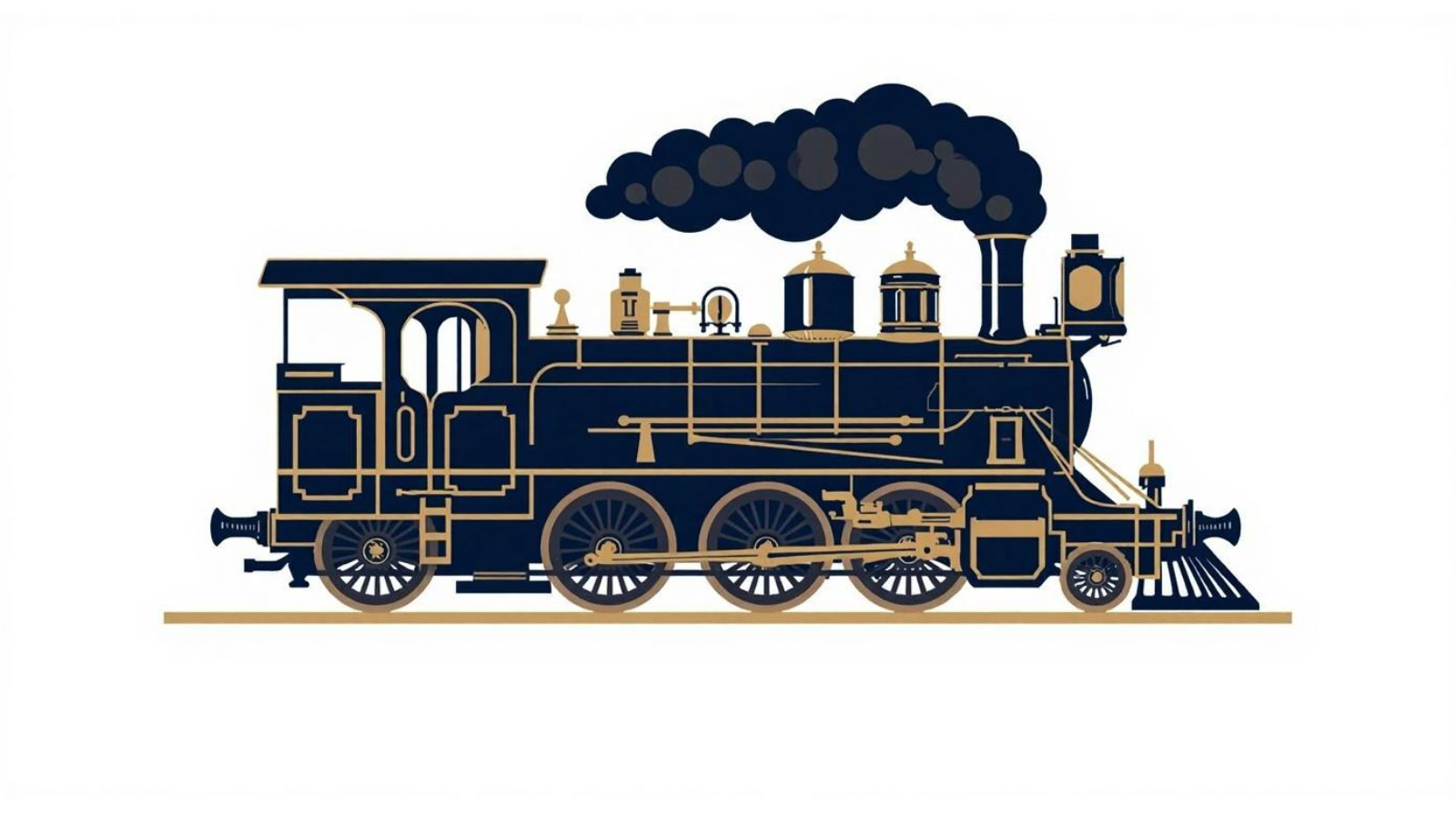
Bedtime stories, theme park rides, and 19th-century innovation all share a common thread. They all rely on the science of steam. This force has powered both childhood dreams and industrial breakthroughs. My nephew debates whether Percy or Thomas is the better tank engine, while physicists geek out over James Watt’s separate condenser.
The chuff-chuff sound of how steam engines work remains unchanged. Those hissing valves aren’t just for show. They’re the original dance of energy transfer, turning heat into motion. It’s why STEM books like Where Do Steam Trains Sleep At Night? are bestsellers.
Steam technology turns water’s boiling into a force for change. Imagine the Hogwarts Express, powered by memes instead of coal. It shows the genius of thermodynamics: you can’t cheat physics, whether moving wizards or widgets.
This 200-year-old innovation continues to spark our imagination. Every whistle blow carries the echoes of human ingenuity. It’s a mix of industrial revolution and childhood wonder, all powered by water’s transformation from liquid to gas.
Famous Train Stories for Children
What do sentient locomotives and 19th-century engineering rivalries have in common? More drama than your average TikTok feed. Let’s explore how famous steam locomotives became pop culture’s unlikely superstars. They turned piston rods into personality traits and boiler pressure into bedtime stories.
All Aboard the Silver Screen
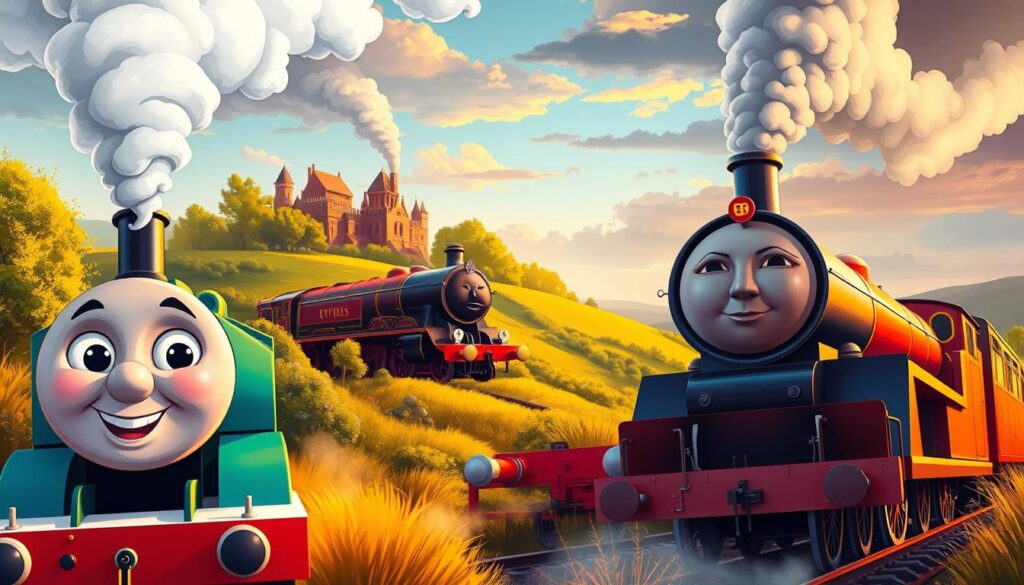
Hollywood loves trains, but it’s not just about the trains. It’s about power struggles. Take Thomas & Friends, where Victorian-era engines gossip like Real Housewives. Diesel 10’s claw-handed villainy? That’s basically Brunel vs. Stephenson’s steam engine inventors feud with extra CGI.
Real history alert: The “engine wars” saw broad-gauge radicals battle standard-gauge traditionalists – railroad drama before drama had railroads.
From “The Polar Express” to “Snowpiercer”
Kids’ train tales serve hidden physics lessons wrapped in adventure. The Polar Express serves hot cocoa; Snowpiercer serves Newton’s first law: “An object in motion stays in motion… unless Chris Evans punches through 17 frozen train cars.” Both stories hinge on impossible engines – one magical, one apocalyptic – proving thermodynamics makes great plot glue.
- Chuggington: Preschool geopolitics with talking trains
- Dinosaur Train: Jurassic Park meets Amtrak schedules
- Real-world parallel: George Stephenson’s Rocket vs. Brunel’s atmospheric railway
“Every revolution needs an engine – whether it’s driving social change or just trying not to derail on Cahuenga Pass.”
These stories work because they turn popular trains for kids into relatable characters. A steam locomotive’s whistle becomes a voice, its wheels a moral compass. Next time your kid quotes Sir Topham Hatt, remember: they’re absorbing 200 years of engineering history through rainbow-colored storytelling.
Top Books and Movies Featuring Steam Engines
Steam engines are more than just machines; they’re cultural locomotives in our imagination. They power stories that mix nostalgia with clever problem-solving. Let’s explore the most iconic tales from media.
Literature’s Chugging Chronicles
Books about trains have a special place in our hearts. The Railway Series is like a royal family in the world of trains. These trains teach us about solving conflicts, just like Gordon learns from his pride.
“I think I can—I think I can—I think I can explain Bernoulli’s principle.”
The Little Engine That Could is more than a children’s story. It’s a tale of determination and STEM. The Boxcar Children shows how to turn old railcars into cool spaces, beating IKEA at DIY.
STEM Between the Lines
Kenneth Oppel’s The Boundless mixes mystery with science. It’s like Murder on the Orient Express meets Bill Nye. The story teaches about pressure valves and has a Sasquatch in the baggage car.
Dan Brown’s Inferno has a train scene that’s scientifically wrong. It’s like watching Einstein try to build with Legos. Remember, using Bernoulli’s principle to derail a train might not be the best idea.
- Hidden genius: The Boundless teaches physics through circus adventures
- Red flags: Dan Brown’s train physics are better suited for fantasy
- Timeless MVP: Thomas & Friends teach us about solving problems
Media Project: Make a Mini Storybook or Movie Poster
Why should Hollywood have all the fun? This is your chance to unleash your inner George Stephenson and George Lucas. Our project turns boiler blueprints into creative masterpieces. Whether you’re drawing steam engines for a graphic novel or creating posters for a steampunk movie, you can do it.
Build Your Own Iron Horse
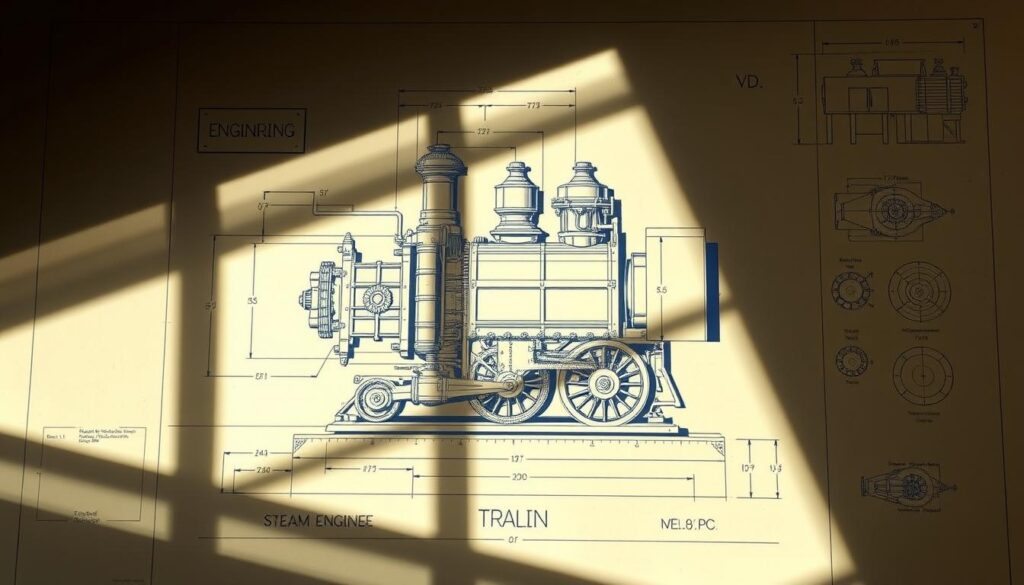
Let’s start with a challenge. Imagine a Star Wars speeder bike from 1880s Manchester. Use real boiler schematics (free online) and think: “Where would Jabba the Hutt install a pressure gauge?” It’s more than arts and crafts; it’s telling a mechanical story.
Attention TikTokers: Your #CoalTok ASMR video needs to follow 1876 Pennsylvania Railroad specs. Just saying.
Label Like a Victorian Engineer
Now, let’s get hands-on with our beginner model steam engine template. You’ll need to identify:
- Smokebox vs. ashpan (hint: one’s not a hipster coffee brand)
- Blast pipe placement (the original ‘exhaust system’)
- Firetube alignment (where physics meets art)
Pro tip: Visit Strasburg Rail Road to see how real engineers labeled components. Their 19th-century workshop notes are like modern IKEA instructions.
Turn your blueprint into meme-worthy content. Can your followers spot the intentionally wrong rivet pattern? First person to DM the error gets a virtual lump of coal. It’s educational trolling at its finest.
Conclusion
James Watt’s 1776 steam engine patent didn’t come with an instruction manual for bedtime stories. Yet, here we are, watching Thomas & Friends’ “The Great Race” turn George Stephenson’s Rocket into animated Olympic glory. These tales make differential calculus look cooler than any CGI explosion.
History’s original STEM projects weren’t built in a day. Those clanking 19th-century prototypes required sweat and slide rules. Modern kids exploring steam locomotive history through storybooks or DIY experiments inherit more than nostalgia.
They’re grabbing the same problem-solving torch that lit the Industrial Revolution. Just swap coal dust for coffee cans.
Next time you spot a toy train circling the tracks, remember it’s hauling 200 years of engineering grit. Want to test that theory? Build your own coffee-can steam engine (parental supervision advised).
If Watt could transform tea kettles into world-changing machines, surely we can manage a kitchen-table version. Bonus points if yours survives trial runs better than Stephenson’s first boiler designs.
The tracks between past and present stay busy. Whether you’re binge-watching Railway Series episodes or sketching movie posters for imaginary locomotives, you’re keeping history’s firebox stoked. Just don’t forget – every great invention starts with someone crazy enough to ask “What if we made it steam-powered?” Now go prove Watt right.
