
Let’s face it. The old image of tradespeople, covered in grease, is outdated. It’s like thinking about dial-up modems.
Meet Sean Delaney, an 18-year-old from South Yorkshire. He didn’t follow the usual college route. Instead, he started a three-year apprenticeship at the University of Sheffield’s Advanced Manufacturing Research Centre (AMRC), supported by IMTS.
Sean’s journey is a lesson in vocational training for today’s world. It’s a mix of learning in class and working on the job. And the best part? He got paid from day one.
This approach breaks the mold of old-school learning. It combines classroom work with real-world experience. You’re not just a student; you’re a professional in training.
So, is this the best way to start a career? Is it the ultimate career hack for those who love to learn?
We see the modern engineering apprenticeship as a first-choice path. It’s where traditional skills meet modern technology.
Apprenticeship Program Types
Think of engineering apprenticeships as a diverse world. Here, old trade skills meet new tech. The idea of just one path is outdated.
Today, you have many choices. It’s not just about getting a job. It’s about picking the path of your career. Let’s look at the options.
First, there are the traditional programs. These focus on skills passed down through generations. Think of manual machining, welding, or electrical work. It’s about mastering skills through practice.
On the other side, there are tech accelerators. These programs are all about the latest tech. They teach you about programming robots, 3D printing, and automation. It’s more about the code than the metal.
Then, there’s the mix of both. These programs, like many Level 3 Advanced Apprenticeship paths, combine old and new. They teach you to use both a micrometer and a data dashboard. This mix prepares you for both technical and human skills.
So, which path is right for you? Do you want the deep skills of a traditional program or the fast skills of tech? The table below helps you decide.
| Program Type | Core Focus | Skill Outcome | Ideal For |
|---|---|---|---|
| Traditional Guild-Style | Deep mastery of a specific trade (e.g., machining, welding) | Bespoke suit of timeless, portable skills | Those who value craft, precision, and becoming an irreplaceable expert |
| Modern Tech Accelerator | Programming, automation, additive manufacturing | Fast-fashion skillset tied to current tech stacks | Tech enthusiasts who thrive on rapid change and software-driven solutions |
| Fusion/Hybrid Program | Blending hands-on trade skills with digital tools & data analysis | Future-proof toolkit combining physical and digital prowess | Problem-solvers who want to bridge the gap between the shop floor and the control room |
The right program matches your goals. Want to do both building and programming? The fusion path is for you. Start by exploring registered apprenticeship programs to see the options. Your future job is waiting for you to choose.
Traditional vs Modern Approaches
The true power of a modern engineering apprenticeship is in combining old and new skills. We often see a false choice between traditional tools and modern software. This is a mistake.
Traditional crafts rely on feeling and intuition. A carpenter might sense a problem in the wood, or a mason might know good mortar by touch. Modern tools, like 3D modeling, offer precision. They can turn ideas into real prototypes or make leveling work easier.
Is one better than the other? No, the best approach is to use both. The future is about combining human skills with technology. This creates a powerful mix of old and new.
Think about making custom furniture. A skilled craftsman’s eye for detail is unmatched. But add 3D modeling software, and the process gets even better. The craftsman can design and test digitally before starting to build. This leads to fewer mistakes and more precise work.
Site surveys are another example. A drone can quickly map a site, giving a detailed view. But a seasoned engineer is needed to understand the data. The drone provides the map, and the engineer finds the important details.
This mix of old and new is where quality and efficiency meet. Tools like Powered Now help manage projects, freeing up the craftsman to focus on the work. The craftsman’s eye ensures quality, while technology makes sure it’s precise.
| Traditional Craft | Modern Tool | The Integrated Advantage |
|---|---|---|
| Measurement by Eye & Rule | Digital Caliper & Laser Level | Human interpretation backed by flawless digital precision. |
| Hand-Drawn Sketches & Prototypes | 3D Modeling & Simulation Software | Creative vision made tangible, testable, and optimized before physical work begins. |
| Intuitive Job Scheduling | Project Management Software (e.g., Powered Now) | Experience-driven oversight with crystal-clear logistical tracking and client communication. |
| Physical Site Walks & Surveys | Drone Photogrammetry & Scanning | Comprehensive macro-data informed and validated by boots-on-the-ground micro-experience. |
This isn’t about choosing one over the other. It’s about moving forward. The best apprenticeship programs teach both traditional and modern skills. They help you respect the wood and the algorithm.
Let’s stop debating old versus new. The goal is to become a master builder for today’s world. Your hands and your software should work together as a team.
Application Process
Getting into an engineering apprenticeship is like taking apart and putting back together a complex machine. It’s not just about sending out a resume and waiting. It’s more like trying out for a special team. They need to trust you with their work.
Sean Delaney’s story shows that luck isn’t everything. His “chance meeting” was actually a result of his hard work. Today, programs like the AMRC use online portals. These portals are your first challenge. You need to understand what they’re looking for.

Don’t just list your grades. The interview is where you show your skills. They want to see how you handle pressure. Can you explain a tough problem clearly?
Source 3 says that skills like communication are key. How you talk about a failed project can be more important than the project itself.
To succeed, you need to mix curiosity with analytical skills. Show them your projects and how you think. A blog or a Lego build can be very telling. It’s like a mix of a portfolio and a story.
| Component | What They’re Really Looking For | Your Best Move |
|---|---|---|
| Partnership Portal (e.g., AMRC) | Initiative and research skills. Can you navigate their ecosystem? | Tailor every answer to the partner’s published projects and tech. Show you’ve done the homework. |
| Behavioral Interview | Problem-solving process and communication under stress. | Use the STAR method (Situation, Task, Action, Result) but focus on the “Action” thinking. Be honest about failures. |
| Skills Portfolio | The blend of hands-on curiosity and analytical follow-through. | Include 2-3 diverse pieces: a CAD design, a repair log, a data analysis from a hobby. Contextualize each with a short narrative. |
| Networking & Proactive Outreach | Genuine interest and professional demeanor beyond the form. | Engage with company tech talks on LinkedIn. Ask insightful questions. A brief, informed email to a program coordinator can set you apart. |
The best application tells a story. It’s about a builder, a thinker, and a learner. It shows applied intellect. Your task is to create that story before you start. The right apprenticeship program wants a future partner, not just a fill-in. Act like one from the start.
Skills Development Timeline
Think of your skills as software that needs updates. But the core operating system stays with you forever. This is the heart of engineering apprenticeships today. The old way promised a direct path from beginner to expert. Now, it’s a continuous cycle.
The typical apprenticeship lasts three to four years. Sean Delaney’s 36-month journey is a good example. He balanced on-the-job training, formal study, and real-world work. It looks simple on paper, but the truth is different.
Technical skills become outdated quickly. What you learn in Year One might be outdated by Year Three. This is why you need to work on two levels from the start.
Track One is the visible part: learning CNC machines, circuit design, or building codes. It’s the “what” you do. This track has clear goals, certifications, and a path to follow.
Track Two is the hidden, yet vital part. It’s about building essential skills that last. Most programs overlook this. But you can’t ignore it. These skills are the foundation:
- Listening & Speaking: For explaining complex issues to non-technical people.
- Creativity: For finding solutions when standard methods fail.
- Problem-Solving: Applying skills to people and processes, not just math.
- Teamwork & Leadership: For leading projects, not just being part of them.
Why focus so much on Track Two? Because technical skills change fast. But skills like leading a team, explaining budgets, or finding creative solutions are timeless. These are your permanent skills.
The timeline is not a lie, but it’s not the whole story. A true engineering apprenticeship timeline is like a Gantt chart for building a strong mind. It shows the ongoing balance between doing the job and learning to think, lead, and adapt. This is the only plan that never goes out of date.
Employer Partnerships
Think of a top-tier engineering apprenticeship as a long, paid interview with big companies. It’s where you learn by doing real work. This is thanks to partnerships with big names.
For you, it’s like getting a sneak peek into career alternatives you might not have known about. For the company, it’s a way to find future talent. Let’s look at what makes these partnerships work.
IMTS/AMT and the Advanced Manufacturing Research Centre (AMRC) have a strong partnership. They work with giants like Boeing, Airbus, and Rolls-Royce. This partnership is more than just a logo on a brochure. It’s a direct path to good jobs.
Your projects solve real problems for these companies. Your mentors are their engineers. Your network is their professional circle. This access is a big advantage.
So, how do you know if a partnership is real or just for show? Look for substance, not just logos. A real partner helps design the curriculum and opens doors for interviews.
| Partnership Feature | Surface-Level Partnership | Strategic Talent Pipeline |
|---|---|---|
| Apprentice Access | Company tours, guest lectures. | Embedded project work with mentor teams. |
| Curriculum Input | Generic advisory board membership. | Direct input on skills gaps and tech trends. |
| Hiring Pathway | Standard job posting access. | Priority interview slots or direct placement. |
| Network Building | Annual networking event. | Continuous integration with engineering staff. |
| Investment Type | Financial donation. | Combined financial, human, and intellectual capital. |
The table shows the difference. You want the right column. In a real partnership, you’re seen as a prospective employee from the start. This mindset is key.
For employers, it’s a smart move in the talent market. They’re not just hiring a graduate; they’re shaping one. They get the skills they need for the future.
When looking at Engineering Apprenticeships, check the partner list. Ask if these companies actually hire from there. A good program is backed by serious industry players. It teaches you the skills needed for your future job.
These partnerships open doors to career alternatives that job boards can’t offer. You’re not just learning a trade. You’re being prepared for a specific job in a real-world setting. Your professional network grows naturally, not through forced connections.
In the end, a strong partnership turns apprenticeships into a smooth transition into your future job. It’s not just about completing a program. It’s about starting your career with people you already know. That’s not just education; it’s a launchpad.
Earning While Learning
The ‘earn while you learn’ idea is more than just a saying. It’s a new way to think about starting your career. Instead of taking on a big loan for college, Engineering Apprenticeships offer a job right away. This isn’t just a part-time gig. It’s your main job.
You’re not choosing between school and work. You’re doing both at the same time. You get to learn by doing, not just by reading books. Your skills grow as you work, making you a valuable asset.
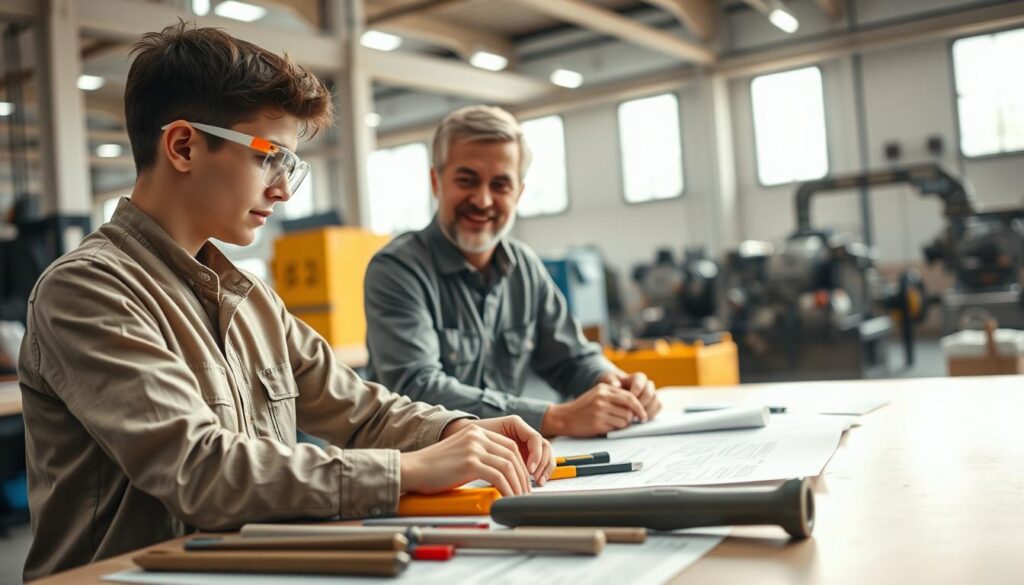
So, how much do apprentices make? It depends on the job and where you are. But, you can earn enough to live on, or even a full salary. For example, at places like the AMRC, apprentices like Sean Delaney start with a real job. They’re not just getting coffee. They’re working on real projects.
The difference is huge. It’s not just a little better. It’s a big change.
| Aspect | The Traditional Graduate (Year 1-4) | The Engineering Apprentice (Year 1-4) |
|---|---|---|
| Primary Financial Status | Net negative. Accumulating debt. | Net positive. Earning a salary. |
| Professional Identity | Student. Limited real-world application. | Employee. Building documented, hands-on experience. |
| Network Value | Peers and professors. | Industry professionals, mentors, and a company roster. |
| Long-Term ROI Launch | Begins after graduation, often with entry-level role. | Begins immediately, accelerating towards skilled professional status. |
This approach really pays off in the long run. Starting your career three or four years early is a big advantage. It’s not just about the money you save. It’s about the head start you get in your career.
This is a smart move in the world of career alternatives. It turns education into a way to make money from the start. You graduate with savings, experience, and a job you know how to do. That’s a financial plan worth following.
Career Advancement
If the old model promised a linear path to senior engineer, the new apprenticeship reality offers something closer to career parkour.
The traditional ladder is dead. Today’s engineering apprenticeships don’t hand you a single rung to climb; they hand you the entire scaffolding. You’re not just learning to weld or code—you’re learning to adapt, to re-learn, to solve problems nobody knew existed yesterday.
This creates what I call “career antifragility.” You’re not just resilient to change; you benefit from it.
Let’s map the territory. Career advancement post-apprenticeship isn’t a single highway. It’s an entire interstate system with on-ramps, off-ramps, and occasional toll booths.
We can break it down into three distinct pathways, each more interesting than the last.
The Vertical Climb (The Obvious One)
This is what most people picture. You start as an apprentice, become a junior engineer, then a project lead, and eventually you’re managing entire teams or departments.
But here’s the modern twist. With essential skills baked into your apprenticeship—communication, systems thinking, collaboration—you’re not just climbing. You’re climbing smarter.
You can pivot into roles like Manufacturing Engineer or CNC Machinist without starting from zero. The foundational skills are transferable, making you a promotion-proof asset.
The Horizontal Shift (The Creative One)
This is where the “lattice” beats the “ladder.” Your skills in mechanical engineering, for instance, might let you pivot into robotics, aerospace, or even tech-adjacent fields like technical sales or quality assurance.
The argument from the data is clear: essential skills enable adaptation and re-learning. This isn’t just theory. It’s your ticket to industries that didn’t exist when you started your apprenticeship.
You’re not stuck in manufacturing. You can shift laterally into adjacent tech fields, consulting, or specialized niches that value your hands-on problem-solving approach.
The Diagonal Leap (The Entrepreneurial One)
This is the most exciting path. It combines vertical promotion with horizontal skills to create entirely new trajectories.
Maybe you climb to a senior engineering role (vertical), then leverage your technical skills to move into project management (horizontal), and eventually launch your own engineering consultancy (diagonal).
The foundational blend of hard technical skills and soft essential skills creates what I call “unparalleled mobility.” You’re not just employable; you’re adaptable, capable of creating roles that didn’t exist before.
The data doesn’t lie. This combination leads directly to higher earnings and significantly greater job satisfaction. It sets you up not just for your first job, but for an entire career that can weather economic storms and technological shifts.
Let me show you what this looks like in practice:
| Pathway Type | Sample Roles | Key Skills Leveraged | Typical Timeframe |
|---|---|---|---|
| Vertical | Senior Manufacturing Engineer | Technical mastery, project leadership | 5-8 years |
| Horizontal | Technical Sales Engineer | Communication, systems thinking | 3-5 years |
| Diagonal | Engineering Consultant | Adaptation, problem-solving, entrepreneurship | 7-10 years |
| Hybrid | Project Manager (Technical) | Technical + management skills | 4-6 years |
The table above illustrates the key point: modern engineering apprenticeships don’t create one-trick ponies. They create problem-solving polymaths who can navigate this lattice structure.
This is what I mean by “career antifragility.” You’re not just surviving the next technological shift; you’re thriving on it. You’re not climbing a single ladder; you’re navigating a dynamic three-dimensional grid.
And the evidence supports this. The skills that make you adaptable—communication, collaboration, critical thinking—are precisely the ones that enable continuous re-learning.
This leads directly to higher lifetime earnings. But more importantly, it leads to something rarer: true job satisfaction. You’re not stuck in a role that becomes obsolete. You’re constantly evolving, constantly relevant.
So when someone asks about career advancement after an apprenticeship, don’t just show them a ladder. Show them the entire playground. Because that’s what you’ve been given: the tools to play anywhere.
Success Stories
Forget the generic testimonials. The real proof of trade skills training is in the daily logbooks of apprentices like Sean Delaney. Let’s look at his logbook and see beyond the usual stories. This is a real-time case study in combining old and new.
Sean isn’t just learning to use a wrench. He’s learning both manual precision and digital skills. He’s mastering the feel of a lathe and the sight for a perfect weld. At the same time, he’s getting good at digital twins and CNC programming.
Sean’s story is just one example. The Advanced Manufacturing Research Centre (AMRC) has trained over 1,300 apprentices. Their success stories show that combining new tech with traditional skills is key.
This fusion means a technician can diagnose problems by ear and confirm solutions with data. It means a fabricator can read 3D models as easily as 2D blueprints. The secret is to have depth in one area to boost the other.
The table below shows the skill domains where combining old and new skills boosts career success for Engineering Apprenticeships graduates.
| Traditional Skill Domain | Modern Tech Integration | Resultant Competitive Edge |
|---|---|---|
| Manual Machining & Fabrication | CNC Programming & Additive Manufacturing | Ability to both operate and program advanced machinery, reducing prototyping time. |
| Mechanical Assembly & Fitting | Digital Twin Simulation & IoT Sensor Data | Can pre-empt failures and optimize assembly processes using predictive data. |
| Blueprint Reading & Spatial Reasoning | 3D CAD Modeling & Augmented Reality (AR) Overlays | Visualizes and communicates complex assemblies intuitively to cross-functional teams. |
| Quality Inspection (Visual/Manual) | Metrology Software & Automated Optical Inspection | Shifts role from inspector to data analyst, focusing on trend analysis and process improvement. |
So, what do 1,300+ journeys teach us? Analysis is more valuable than inspiration. The apprentices who do well treat their education like a double major. They respect traditional trade skills and build digital literacy.
This isn’t about picking between old and new. The future belongs to those who know how to use both. The best Engineering Apprenticeships combine both, making graduates into technologists.
Getting Started Guide
So, you’ve read the map. Now, are you ready to walk the hybrid path of modern Engineering Apprenticeships?
Your first tactical move is an internal audit. Forget just checking boxes. Ask yourself if you’re wired for a model that values problem-solving as much as a perfect weld. This vocational training demands both.
Step two is reverse-engineering. Don’t just “want to be an engineer.” Pinpoint the material, the industry, the machine. Aspire to work on turbine blades? Find the programs that feed into Siemens Energy or GE Aerospace. Your goal dictates your search.
Next, decode the application with the cold eye of an analyst. Revisit section four. Your personal statement isn’t a diary entry; it’s a manifesto showing the essential skills you already possess. Treat every question as a puzzle piece.
This is your field manual. Synthesize the research, the self-assessment, and the partnership seeking into one actionable checklist. The shift from consumer to protagonist starts here.
Your own saga in skilled trades begins not with a leap, but with this single, analytical step forward. The blueprint is complete. Now, go build something.
