Think about your morning coffee. You pour hot water over coffee grounds, getting energy and flavor. The steam that rises is like the Rankine cycle for our world.
The Rankine cycle is key to our power. It’s found in coal plants and nuclear reactors. It’s like a rollercoaster for energy, reaching high heat then dropping to do work.
There’s a catch. You need top-grade heat to get work output. In physics, there’s no free lunch. It’s all about balancing enthalpy and effort.
The steam engine was a game-changer in the 18th century. It changed economies and maps. We’re enjoying the benefits of that innovation today.
Let’s explore the journey of energy. From the boiler to the turbine to the condenser. We’ll see the “Height of Heat” where energy is at its peak before it’s used.
What Is a Cycle? From water to steam and back
A thermodynamic cycle is not like a hamster wheel. It’s more like a Broadway show. The stage is set, and our H2O molecules change and exit, only to get ready for the next show. The Rankine cycle is like a classic musical that powers our world.
It’s like a superhero origin story for water. Liquid water enters the boiler, where it becomes superheated steam. This is the first act of the Rankine cycle, where heat energy changes its state.
The Rankine cycle is a closed loop, like a classic rock album. The steam spins a turbine and then goes to the condenser. Here, it cools down and turns back into liquid water.
The condensed water is too weak to go back to the boiler alone. The pump helps by pressurizing it. This gets it ready for the cycle to start again.
While a hamster on a wheel just runs, the Rankine cycle is a four-act play. It’s boil, expand, condense, pressurize. It’s a process that extracts work from heat by moving a fluid through its phases. It’s reliable, powerful, and the base of modern energy.
Components in Plain English: Boiler, Turbine/Piston, Condenser, Pump
Let’s explore the Rankine cycle’s inner workings. Each part has its own role. It’s like a band where each member is vital.
Boiler
The boiler is like the lead singer of our thermodynamic band. It needs constant fuel and attention. It turns cool water into hot, high-pressure steam.
It adds heat energy to water. This process is all about energy transfer. The boiler takes heat from combustion or nuclear reactions.
Modern systems have made big changes. I saw a system where the boiler, gasifier, and generator are all in one. The boiler is the heart of the system.
Turbine/Piston
The turbine or piston is like the drummer. It turns the boiler’s energy into useful motion. Steam expands through blades or against a piston.
This expansion loses energy but turns it into work. The turbine/piston is key to making the Rankine cycle work. It turns heat into motion.
It’s like a drummer making music everyone can feel. The turbine connects to generators or pumps. This connection is like a band playing together.
Condenser
The condenser is like the bassist. It’s not as flashy but keeps things stable. It cools down the steam after it’s used.
The condenser turns the steam back into liquid water. It releases heat to the environment. This process is important for the cycle.
It makes the system more efficient. Liquid water takes up less space than steam. This helps pull more steam through the turbine. The condenser is essential for the cycle’s success.
Pump
The pump is like the roadie. It moves the cooled water back to the boiler. It needs electrical energy to do this.
The pump increases the water’s pressure. This is the least efficient part of the cycle. But without it, the cycle stops.
In our analogy, the pump is like the crew member setting up the stage. They’re not in the spotlight but essential. This completes the Rankine cycle.
These four components work together endlessly. Each one is vital but different. Remove any, and the cycle stops. The Rankine cycle is a beautiful example of teamwork.
Visualizing Energy: “Height of Heat” metaphor for enthalpy
If energy were a skyscraper, enthalpy would be the penthouse suite at the top. In thermodynamics, enthalpy is the total heat content of a system. But, that definition is as exciting as a flat soda. Let’s give it some fizz.
Think of enthalpy as the “Height of Heat.” It’s the energy stored in steam, ready to burst into action. This energy is like a bouncy ball waiting to jump into the pool of work.
Imagine heat as a fluid, and enthalpy as the height of that fluid in a tank. The higher the fluid, the more energy it has to rush down and turn a waterwheel. In the Rankine cycle, we take water and crank up its enthalpy sky-high in the boiler.
The Mosh Pit vs. The Orderly Queue
Picture two social scenes inside a power plant. Inside the boiler, you’ve got a high-enthalpy state: a chaotic, high-energy mosh pit. Water molecules are superheated steam, bouncing off the walls of the pipes, full of chaotic, useful energy.
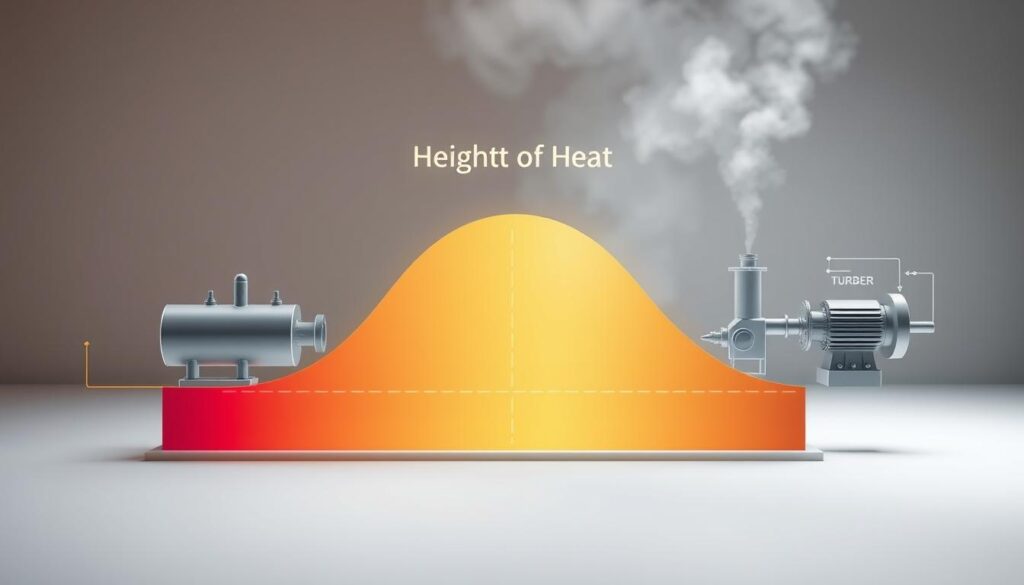
After the steam has stormed through the turbine and done its work, it gets to the condenser. Here, the scene is a stark contrast. The enthalpy is low. The steam has been spent. It’s no longer a raging mosh pit; it’s a calm, orderly queue of water molecules, waiting their turn to go back to the boiler.
Why the Height Metaphor Works
This “Height of Heat” metaphor works because it’s intuitive. You don’t need to visualize abstract “joules per kilogram.” Just picture a bouncy castle at the top of a slide. The kids at the top (high-pressure, high-temperature steam) have tons of energy.
The slide is the turbine, and the work is done as they zip down, turning the turbine blades on their way to the calm, cool pool at the bottom (the condenser). The greater the height (the higher the enthalpy), the more energy for a thrilling, work-producing ride.
This is the core of the Rankine cycle. We don’t just add heat; we add enthalpy. We pump water to a high pressure, then add a massive amount of heat (increasing its enthalpy dramatically) to create superheated steam. This high-enthalpy fluid is the fuel for our entire process.
From Metaphor to Math (Don’t Panic)
In thermodynamic terms, enthalpy (H) is defined as H = U + PV. Don’t let the symbols scare you. Think of it this way: U is the internal energy (the mosh pit’s raw, chaotic energy). P is pressure, and V is volume.
The PV term is like the “oomph” or the “push” the steam has due to its pressure and volume. Enthalpy combines the internal energy with this “push” energy. In a boiler, we’re jacking up both the internal energy (heat) and the pressure, sending the enthalpy through the roof.
This is why high-pressure steam is so powerful. It’s not just hot; it’s a highly compressed, high-enthalpy fluid that’s desperate to expand. When you let it loose in a turbine, that stored enthalpy is converted into the kinetic energy of spinning blades.
The drop in enthalpy across the turbine is what we capture as useful work. It’s the thermodynamic equivalent of a bungee jump—the higher the starting point (higher enthalpy), the bigger the thrill (and the more electricity we generate).
So, the next time you see steam rising, don’t just see vapor. See the enthalpy—the invisible, measurable height from which heat can fall to do our bidding. It’s not magic; it’s just thermodynamics with a good head for heights.
Where Work Happens: Expanding steam and force on a piston
High-pressure steam is like a coiled spring, ready to burst with energy. This is the exciting part of thermodynamics where heat turns into motion. It’s like the moment we get to enjoy the meal we’ve been preparing.
The coiled spring analogy is more than just a figure of speech. High-pressure steam holds a lot of energy. When it’s released, it expands and pushes hard, creating force. This is the work output that engineers aim for.
Imagine a steam locomotive piston. Superheated steam enters the cylinder, creating a force that moves heavy metal. This is the force on a piston at work. It’s a simple yet powerful transfer of energy.
The work output is not just a theory. It’s the steam’s reward for all the heat it received. We put in thermal energy and get mechanical work back. Efficiency is key here, as we want to maximize the return on our investment.
The principle of work output is not old-fashioned. Take the free piston steam hydraulic pump for example. It uses steam to drive a hydraulic pump piston directly. No need for complex mechanisms. This shows how the basic work output principle can lead to new ideas.
Steam expands because it wants to take up more space. By directing this expansion against a piston or turbine, we tap into this natural urge. We’re not creating energy from scratch. We’re just giving heat a specific task: push this, spin that, move something.
This phase is the climax of thermodynamics’ game. All the preparation—the boiling, the pressurizing—leads to this moment. The steam expands, force is applied, and work is done. The cycle pays off.
Classroom Model: Syringe “engine” expansion demo
Forget the power plant for a moment. Let’s make the Rankine cycle small enough to fit on your desk. The best demos are simple. For a clear view of how pressure moves things, you need a big medical syringe and your thumb.
This isn’t just a science fair trick; it’s a real way to see how pressure turns into motion. We’re using a simple syringe to show how all heat engines work. The work output in this demo isn’t turning a generator, but it’s the same principle in a small way.
The Syringe as a Single-Cylinder Engine
Think of the syringe as a single, one-cylinder engine. The barrel is your cylinder, the plunger is your piston, and your thumb is the valve. The air inside is like the steam in a Rankine cycle. The demo has two key phases that mirror the real thermodynamic cycle.
First, the compression stroke. Pull the plunger all the way back, drawing in a full “cylinder” of air. This is like the pump in a Rankine cycle drawing in water. Now, cover the tip with your thumb and try to push the plunger in. You’ll feel the resistance—the air inside is being compressed, and its pressure and temperature rise. This is the “compression” phase, and you’re doing work on the air inside, storing energy.
Now, the real magic. While keeping your thumb sealed tightly over the tip, release the plunger. If you’ve created a good seal, the plunger will lurch forward with surprising force. That’s your work output event. The high-pressure air you created by compressing it now does work on the plunger, converting the stored energy into kinetic energy. It’s a tiny, powerful “POP!” of physics in your hand.
How does this compare to a real steam engine? The table below shows how our simple syringe matches the components of a Rankine cycle.
| Syringe Component | Steam Engine Equivalent | Function in the Cycle |
|---|---|---|
| Plunger | Piston | The moving part that converts pressure into linear motion. |
| Barrel | Cylinder | The chamber where pressure is converted into motion. |
| Air Inside | Working Fluid (Steam) | The medium that gets compressed and expanded. |
| Your Thumb (sealing the tip) | Valve System | Controls the flow and pressure of the working fluid. |
| Plunger Shooting Forward | Power Stroke / Turbine Spin | The moment of work output, converting pressure into kinetic energy. |
Here’s a step-by-step guide to the demonstration. Follow it to see the work output principle in action:
- Step 1: Pull the plunger of a clean, dry syringe all the way back to the maximum volume mark. You’ve just performed the intake stroke.
- Step 2: Place your thumb firmly over the tip of the syringe, creating an airtight seal. This is your “closed system.”
- Step 3: Gently push the plunger in a few millimeters and release. You’ll feel resistance. You are now compressing the trapped air, storing energy.
- Step 4: With your thumb sealing the tip, push the plunger in a bit more, then let go. The energy is released, and the plunger shoots forward—that’s your work output.
This simple act of the plunger shooting forward is the core of the Rankine cycle. The energy stored in the compressed air is released, and the motion is the work output. It’s a clear, simple way to see how we can use trapped fluid to do work—the heart of thermodynamics, right in your hand.
Estimating Ideal vs. Real Efficiency (friction, heat loss)
In the world of thermodynamics, the Rankine cycle is a perfect dance of energy. Every bit of heat is turned into useful work output. But, reality is far from perfect.
Our ideal model has no friction and no heat loss. It’s a beautiful dream. But, real engines face two big enemies: friction and heat loss.
The Unwelcome Guests of Thermodynamics
Friction is like the drag in your engine. It turns energy into heat before it can do any work. Heat loss is like a thief, stealing energy from the engine.
Imagine a sports team that’s talented but can’t follow the plan. That’s what happens in engineering. The ideal plan is perfect, but the real game is full of challenges.
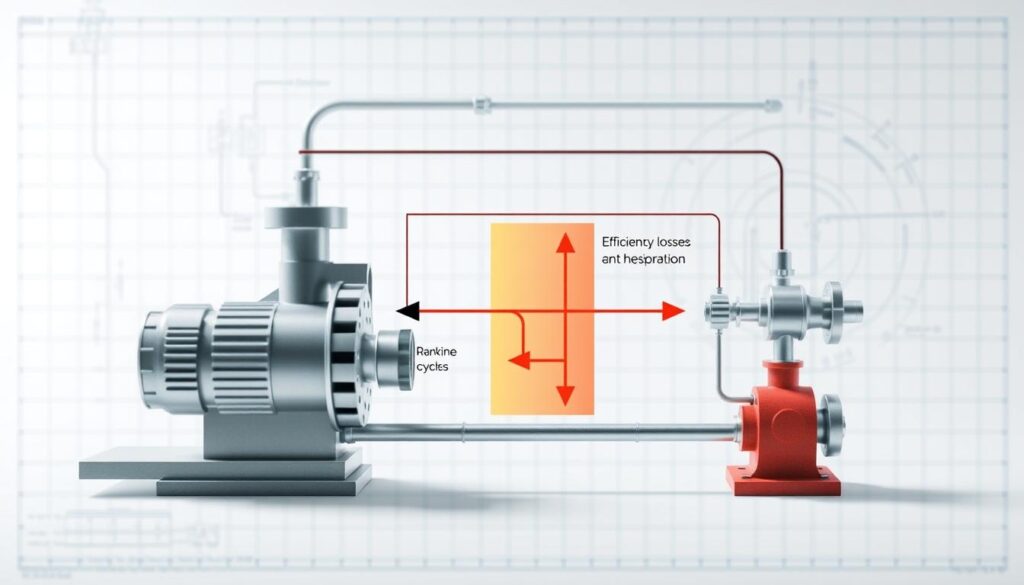
We talk about ideal versus real efficiency. The ideal efficiency is the best possible, set by physics. Real efficiency is what you get after losing energy to friction and heat.
Modern steam engines are doing great if they hit 20% real efficiency. That means 80% of the energy is lost. But, that 20% can be enough.
Take a solar turbine. If it can turn 5% of sunlight into work, it’s worth it. Success in the real world is often about being good enough, not perfect.
Estimating real efficiency is about being smart. You find the big losses and work to reduce them. It’s a battle for every bit of performance.
The Rankine cycle is our perfect plan. But, fighting friction and heat loss makes it real. It’s a constant challenge in an imperfect world.
Reading Basic Steam Tables (A Friendly Walkthrough)
Looking at a steam table for the first time can be overwhelming. It’s like staring at a complex spreadsheet. But, think of it as a financial report for your boiler. It shows the energy balance, like a bank statement.
In this world, enthalpy is the currency. It’s the total heat energy in a unit of steam. The steam table is like a ledger that tracks this energy.
Let’s explore a single entry. Say you’re looking at 212°F (100°C). The table will show you the pressure and the enthalpy for that temperature.
Here’s what you’ll see:
| Temperature (°F) | Pressure (psi) | Enthalpy (Btu/lb) | The “Bank Statement” Translation |
|---|---|---|---|
| 212 | 14.7 | 1150 | Your current “energy balance” at this temperature. |
| 250 | 29.8 | 1164 | Higher pressure and temperature, slightly more energy in the “bank.” |
| 300 | 67.0 | 1192 | More heat and pressure equals more stored energy. |
| 350 | 134.5 | 1217 | High pressure, high temperature, high “account balance.” |
The enthalpy number shows the thermal energy per pound of steam. A condenser is like a wealth manager for this energy. It converts high-value steam energy into hot water for later use.
So, reading a steam table is like checking your thermal energy system’s financial report. The enthalpy column shows your energy capital. It’s not just a table; it’s your steam’s balance sheet.
Cycle Sketching Activity: Sketch, Label, and Conquer the Rankine Cycle
Grab a pencil. This isn’t a test, it’s a co-creation. We’re going to build a Rankine cycle from scratch. It’s not about artistic perfection; it’s about clarity.
By drawing it, you’re not just seeing the cycle, you’re building it in your mind. Think of it as the ultimate connect-the-dots for aspiring thermal engineers.
We’ll map the journey of a single, ambitious water molecule. Our story has four key scenes, and you are the director. Clear your mental desk. You’ll need a blank sheet of paper and a pencil (or stylus, for the digitally inclined).
Your Directorial Debut: A Four-Act Play on Paper
Let’s break down our four “scenes” or components. We’ll build this step-by-step.
Act I: The Boiler – The Grand Heist of Energy
Start in the middle of your page. Draw a simple rectangle. This is your boiler. Label it. Now, draw a bold, heavy arrow pointing *into* the boiler from the left. Label this arrow “Heat In (Qin)”.
This is where the fuel’s energy, the lifeblood of the cycle, is first injected. It’s the moment the quiet, liquid water gets its superpowers.
Act II: The Turbine – The Grand Performance
From the boiler, draw a line or arrow to the right, leading to a simple, bladed fan or a cylinder. This is your turbine. Label it. The arrow from the boiler to the turbine is your high-pressure, high-energy steam.
Draw a bold arrow coming *out* of the turbine and label it “Work Out (Wout)”. This is the moment of truth, where thermal energy becomes useful, rotational energy.
Act III: The Condenser – The Necessary Reset
From the turbine, draw a line to a new box or circle on the right. This is your condenser. This is the critical step many forget: the condenser is not an afterthought.
It’s the system’s reset button. Draw a bold arrow pointing *away* from the condenser. Label this arrow “Heat Out (Qout)”. This is the heat rejected to the environment, the price we pay to the universe for order.
Act IV: The Pump – The Unsung Hero
Lastly, draw a line from the condenser back to the boiler. In the middle of that line, draw a small circle or a pump symbol. This is the pump. Draw a small arrow going *into* the pump and label it “Work In (Win)”.
This is the work we have to put back into the system to push the condensed water back to the high pressure of the boiler, completing the loop. It’s the quiet, essential effort that keeps the drama going.
Now, step back. You’ve just drawn the energy flow. The beauty is in the arrows: Heat in, work out, heat out, work in. It’s a closed loop of energy transformation.
| Component | Primary Function | Energy Symbol | Your Arrow & Label |
|---|---|---|---|
| Boiler | Adds heat energy, creates high-pressure steam | Qin (Heat In) | Arrow IN, labeled “Heat In (Qin)” |
| Turbine | Converts steam energy to mechanical work | Wout | Arrow OUT, labeled “Work Out (Wout)” |
| Condenser | Rejects waste heat, condenses steam | Qout | Arrow OUT, labeled “Heat Out (Qout)” |
| Pump | Pumps liquid back to high pressure | Win | Arrow IN, labeled “Work In (Win)” |
Why This Sketch Beats a Textbook Diagram
You didn’t just copy a picture. You built a mental model. You’ve decoded the logic. The condenser isn’t just a box; it’s the system’s pressure-release valve.
The pump isn’t an afterthought; it’s the humble, unsung hero that completes the loop.
So, hold up your sketch. You haven’t just drawn a diagram; you’ve mapped the logic of an engine. You’ve translated heat, work, and flow into a story you can see. That’s the real power of the Rankine cycle—it’s not a mystery, it’s a map. And you just drew it.
Careers & History: Stationary engines to locomotives
Imagine the Industrial Revolution in your mind. You see soot-covered factories and giant pistons moving. The sound of a steam engine powers it all. This was more than a power source; it was the heart of industry.
But the story of the steam engine is not just about the past. It’s about how it has evolved, from stationary engines to mobile concepts today. The Rankine cycle, once old, is now being used again in our search for sustainable power.
The journey from stationary engines to modern applications is a lesson in engineering. The first work output came from these stationary engines. They powered factories and pumped water from mines. The condenser was key, making the engines more efficient by pulling more power from the steam.
The dream was always to make this power mobile. The 1920s saw the rise of steam cars. Brands like Doble and Stanley made cars that were quiet, powerful, and smooth. They were the best mobile steam technology at the time, but gasoline became more convenient.
Now, we’re seeing steam power make a comeback. It’s not in old, coal-fired engines, but in new, innovative ways. The Rankine cycle is being used in:
- Open-Source Innovation: Projects like the open-source 3kW steam engine make small-scale, combined heat and power (CHP) possible for off-grid homes.
- Biomass Power: New condenser and boiler designs are being used with biomass, turning waste into heat and electricity.
- Solar Steam: Concentrated solar thermal plants use the sun’s heat to create steam and drive turbines.
- Hydraulic Hybrids: Concepts like the “free-piston steam hydraulic pump” use steam to pressurize fluid, storing energy for mobile and stationary power.
To understand this evolution, it helps to see the journey in a snapshot:
| Era | Primary Driver | Condenser Role | Primary Work Output | Modern Analogy |
|---|---|---|---|---|
| Early Industrial (1800s) | Coal | Basic Jet Condenser | Factory Machinery, Pumps | The Factory Heart |
| Locomotive Era (Late 1800s) | Coal/Water | Improved Surface Condenser | Locomotive Traction | The Continental Railroad |
| Early Automotive (1920s) | Kerosene/Gasoline | Compact Air-Cooled | Passenger Vehicle Propulsion | Stanley Steamer |
| Modern Revival | Biomass, Solar, Waste Heat | Advanced Heat Exchangers | Distributed CHP, Hybrid Systems | Open-Source 3kW Engine |
| Future Concept | Concentrated Solar, Geothermal | Advanced Binary Cycle | Grid-Scale Storage, Desalination | Steam Hydraulic Hybrids |
The real story isn’t about the past. It’s about the future. The modern open-source 3kW steam engine project is a proof-of-concept for distributed, resilient power. It asks: what if your home’s heat and electricity came from a clean-burning, biomass-powered micro-CHP unit in your basement?
The condenser technology, once a simple water tank, is now a high-efficiency, compact heat exchanger. The work output is no longer just turning a flywheel; it’s about providing local, resilient energy.
This isn’t a steampunk fantasy. It’s a recognition that the Rankine cycle is a timeless principle. It powered the first industrial revolution by moving pistons. Today, it’s being reimagined to store solar heat, to turn agricultural waste into power, and to create hydraulic pressure for the next generation of vehicles. The steam engine never died; it was just waiting for our technology, and our imagination, to catch up with its full power.
Exit Ticket: Diagram + 3 misconceptions corrected
Your final exam is simple. Sketch the Rankine loop. Label the boiler, turbine, condenser, and pump. Draw arrows for heat in, work out, and heat rejected. If you can do that, you’ve grasped the fundamental architecture. Now let’s clear the fog from three persistent myths.
Myth 1: Steam engines are obsolete. This is like calling the wheel outdated. Modern combined-cycle plants from Siemens and GE use advanced Rankine cycles as their bottoming loop, achieving staggering efficiency. The basic physics refuses retirement.
Myth 2: Efficiency is the only metric that matters. Obsessing over peak efficiency misses the point of feasibility. A solar thermal plant with a modest 5% net gain can be revolutionary if it’s reliable and built. The real work output must power something, not just win a theoretical contest.
Myth 3: This is only for giant power plants. The cycle scales. It propelled locomotives and now fits in micro-CHP units for homes. Wherever you need to convert heat to motion, from a massive turbine to a small piston, the principles apply. The humble condenser completing the loop is as critical in a toy model as in a gigawatt facility.
You now see the circle. The water travels, the energy transforms. This isn’t just textbook thermodynamics. It’s the hidden rhythm of industrial civilization. Go find where this cycle turns in the world around you. Your tour is complete.
