Ever looked at a physics equation and wondered what it really means? You’re not alone. Learning math often becomes too abstract, when it should be real.
This problem isn’t just about school. It stifles creativity. What if you could start over and understand it better?
Meet the steam engine. It’s not old news; it’s a bridge between theory and reality. Pressure, once just a symbol, becomes the hero of a real story.
We’re going hands-on, like a builder. Forget just knowing PSI numbers. Let’s dive into history and see how it all works. We’ll use the steam engine as our learning tool.
Our aim is to make these concepts come alive. No more seeing them as just numbers. Let’s see them as the powerful forces that changed history. This guide will help you understand it all.
Pressure Vocabulary: Absolute vs Gauge, PSI vs kPa
To build or operate a steam engine safely, you must learn its language. It’s like learning a new local dialect. In pressure, there are two main dialects: gauge pressure and absolute pressure. Knowing the difference is key to understanding pressure’s raw truth versus our social way of talking about it.
Gauge pressure is what you see on your boiler or tire gauge. It’s about pressure relative to our atmosphere. When your engine’s gauge shows 0 psi, it’s not in a perfect vacuum. It’s just at balance with our atmosphere’s 14.7 psi.
Absolute pressure shows the true force. It measures from a perfect vacuum. Unlike gauge pressure, it ignores our atmosphere. To find absolute pressure, add the gauge pressure to the atmospheric pressure. So, if your boiler gauge is at 15 psi, the absolute pressure is 29.7 psi.
PSI is the standard in the U.S., while the world uses kilopascals (kPa). The conversion is simple: 1 psi is about 6.895 kPa. It’s more than a conversion; it’s a cultural shift.
The table below shows the main differences:
| Feature | Absolute Pressure | Gauge Pressure |
|---|---|---|
| Reference Point | Perfect vacuum (absolute zero pressure) | Local atmospheric pressure |
| Zero Point | True zero (perfect vacuum) | Atmospheric pressure (approx. 14.7 psi or 101.3 kPa at sea level) |
| Typical Use | Scientific calculations, thermodynamics, weather (barometric pressure) | Engineering, industry, tire pressure, boiler gauges |
| Example | Absolute pressure = Gauge Pressure + Atmospheric Pressure | What you read on a standard pressure gauge |
When your steam engine’s safety valve is set for 50 psi, that’s gauge pressure. But to grasp the true force on your boiler’s walls, think in absolute terms. This knowledge is not just for academics; it’s essential for safe and smart engineering.
How Boilers Create Pressure (Phase Change Overview)
James Watt had a big moment when he figured out water’s secret. This secret is called a phase change. It’s why boilers can make pressure. It’s like water turning from calm to powerful vapor.
Here’s how it works. You heat water, and its molecules start moving fast. At 212°F (100°C) at sea level, they hit a point where they change completely.
This change is called latent heat. It’s the energy needed to change state without changing temperature. Watt saw that steam’s power came from this hidden energy.
Imagine this change happening in a sealed metal box, like your boiler. The steam molecules move fast, hitting each other and the walls. This is what we call pressure.
| State of Water | Molecular Behavior | Energy Type | Result in Confined Space |
|---|---|---|---|
| Liquid (Pre-boil) | Vibrating in place, sliding past neighbors | Sensible Heat (temperature rise) | Minimal pressure increase |
| Phase Change (Boiling) | Breaking bonds, absorbing latent heat | Latent Heat (state change) | Rapid vapor production |
| Vapor (Steam) | High-speed, independent movement | Kinetic Energy | Significant pressure via collisions |
| Superheated Steam | Extreme velocity, no droplets | Additional Sensible Heat | Even higher pressure |
The table shows how pressure works. It’s not just about temperature. It’s about steam density. More heat means more steam, which means more pressure.
Boiler design is key. It must handle the steam’s energy. Knowing these boiler basics makes the boiler predictable.
The big challenge is controlling the steam. You want enough pressure for work, but not too much. That’s where safety valves and gauges come in.
So, fire heats water, and latent heat makes steam. Confined steam creates pressure. Understanding this is key to steam power.
Safe Operating Ranges for Small Demonstration Engines
Think of your steam engine’s pressure limit as a velvet rope. Cross it, and physics will step in. History shows us that ignoring this limit can be tragic.
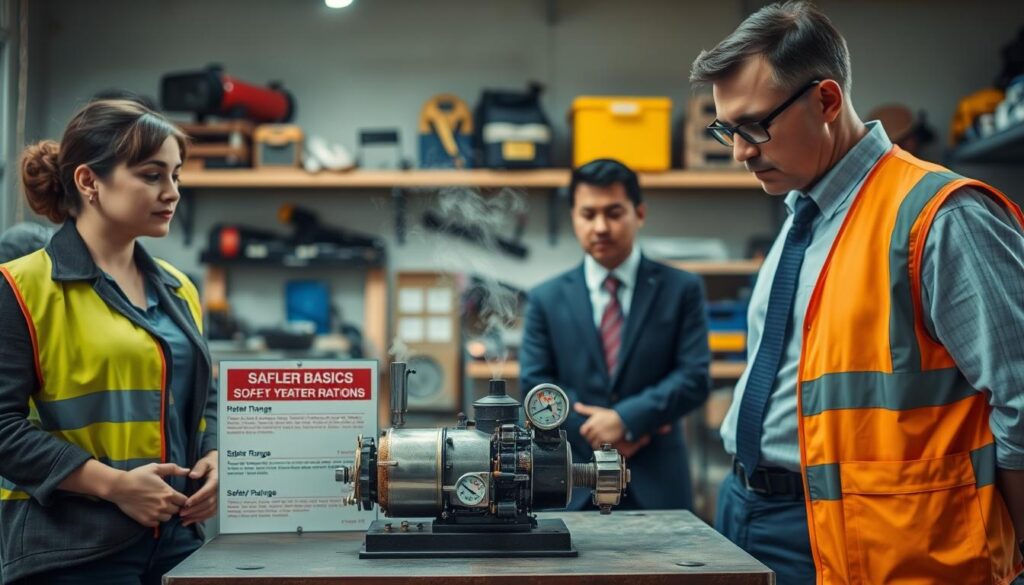
Your engine works in a safe range, usually 10 to 30 PSI. It’s not a big machine but a delicate one. Going over this range can cause big problems.
Boiler basics are key to safety. The engine’s design balances strength and practicality. Remember, pressure goes up fast as water turns to steam.
Every engine has safety features. The safety valve stops things before they get too hot. The fusible plug is a last resort to prevent damage.
Knowing your engine’s limits is important. It depends on its design and materials. This knowledge can prevent disasters in your workshop.
Staying within limits shows smart thinking. It’s about using power wisely. Your boiler basics knowledge helps you know when to stop.
Always check your pressure with a good gauge. Make sure your safety valve works. Keep a safe distance while it’s running. These steps show you care about your work.
Safe operation makes your story exciting, not scary. It’s where curiosity meets caution. By mastering boiler basics, your demos will inspire, not frighten.
Measuring Pressure: Bourdon gauge vs U‑tube manometer
Two tools are ready to show you your boiler’s secrets. One clicks mechanically, the other whispers with fluid. Choosing one isn’t just about getting a number. It’s about picking your teacher.
Pressure measurement has a clever history. We can’t see force, so we measure its effects. You choose a tool that shapes your understanding of the system.
The Bourdon Gauge: Mechanical Ingenuity
The Bourdon gauge is a common sight. It’s found on everything from tire pumps to industrial boilers. Its secret is a clever, flattened tube shaped like a C or spiral.
When pressure is applied, the tube straightens. This movement is amplified through gears and linkages. You get a quick reading of your gauge pressure on a dial.
This tool is direct, durable, and great for workshops. It gives you a single number. But, it’s a mechanical reading. Springs can wear out, and gears can break. It shows you the pressure but not why it changes.
The U-Tube Manometer: Physics in Glass
The manometer is for those who love the purest form. It’s a U-shaped tube filled with liquid, connected to your pressure source and the atmosphere. It shows you the pressure through the height difference of the liquid columns.
The U-tube manometer connects you to Torricelli’s 1643 barometer. This historic device measured atmospheric pressure. Reading the fluid height lets you feel the pressure changes with temperature and volume.
Choosing Your Instrument: A Practical Guide
So, which tool is right for your engine? Here’s a guide:
- For quick monitoring & safety: The Bourdon gauge is best. It’s easy to read and always on your boiler.
- For calibration & learning: The manometer is key. It checks your gauge’s accuracy and teaches you about pressure.
- For low-pressure systems: A water manometer is very sensitive. It shows even small pressure changes clearly.
- For durability: The Bourdon gauge withstands bumps and vibrations. But, a glass manometer needs care.
Use both tools for the best results. The Bourdon gauge is your constant companion during runs. The manometer is for experiments and calibration.
This pair covers everything. One gives you a practical reading. The other teaches you about pressure. Together, they make measurement a conversation with physics.
Mini‑Lab: Predict how pressure changes with heat input
Imagine knowing the pressure in your boiler before you even turn it on. It’s not magic; it’s engineering. Let’s dive into a thought experiment.
Imagine a sealed, water-filled container on a burner. You add heat. The first thought is “pressure will rise.” But the how and why are what really matter.
The Anatomy of a Prediction
At first, nothing much happens. The heat you add warms the water. The pressure gauge might move a bit, but it’s not the big moment.
But then, something changes. At the boiling point, water turns into steam. This is when things get interesting. In a fixed space, each new steam molecule adds to the crowd.
More molecules mean more collisions against the walls. This leads to more force and higher pressure. It’s like a molecular dance.
The relationship between pressure and time isn’t simple. It’s a curve. Can you draw a graph of pressure over time? Start with a gentle slope as the water heats up. Then, as it turns to steam, the line shoots up.
This exercise links temperature, phase change, and the ideal gas law. It’s engineering ahead of time. You’re not just reading a gauge; you’re predicting its reading. This is the difference between following a recipe and truly understanding.
Data Table & Sample Calculations
Data tables might seem like dry accounting, but they’re actually the Rosetta Stone of your steam engine’s story. They translate steam hisses and piston strokes into a language engineers understand: numbers. Let’s move from qualitative wonder to quantitative rigor.
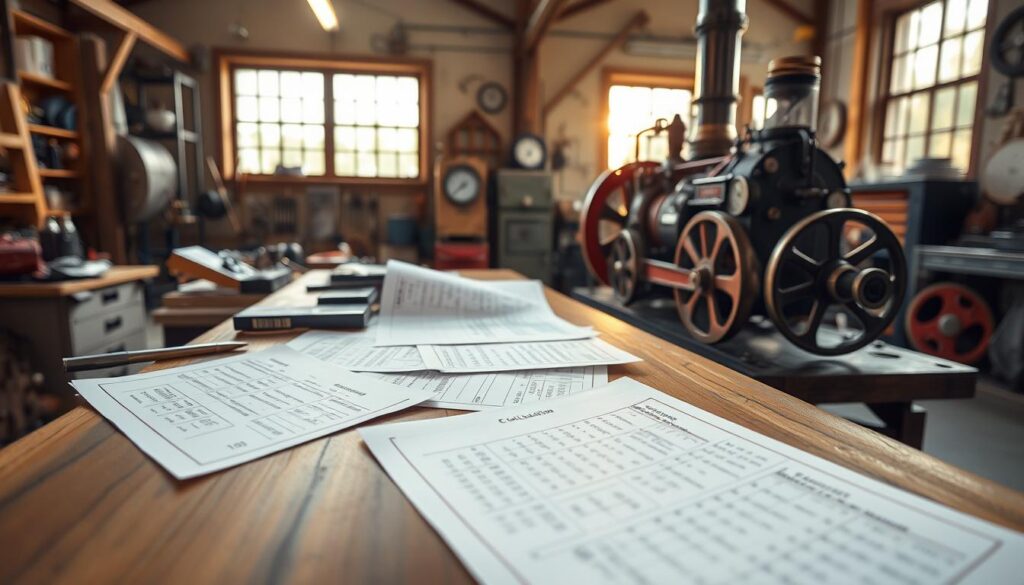
Imagine you conducted our mini-lab experiment. You heated water, watched the gauge, and recorded values every minute. Your raw observations transform into the narrative below.
| Time (minutes) | Temperature (°C) | Gauge Pressure (PSI) | Observations |
|---|---|---|---|
| 0 | 22 | 0 | Cold start, atmospheric pressure |
| 2 | 65 | 2.5 | First visible steam, slight needle movement |
| 4 | 98 | 8.7 | Water boiling, pressure building steadily |
| 6 | 112 | 15.3 | Steam production vigorous, safety valve hissing |
| 8 | 120 | 20.1 | Steady state reached, pressure stable |
This table tells a clear story. Temperature and pressure are dance partners—when one rises, the other follows. The initial lag shows energy going into phase change. The final plateau reveals your system’s equilibrium point.
Now for the fun part: making those numbers work. Pressure without application is just a statistic. Let’s calculate the actual force generated.
From PSI to Pounds-Force: A Worked Example
Take the final pressure from our table: 20.1 PSI (gauge). First, convert to absolute pressure. Add atmospheric pressure (~14.7 PSI).
Absolute Pressure = Gauge Pressure + Atmospheric Pressure
20.1 PSI + 14.7 PSI = 34.8 PSI (absolute)
Your engine’s cylinder has a piston. Let’s say its diameter is 1 inch. The area it presents to steam pressure is:
Area = π × (radius)²
Radius = diameter ÷ 2 = 0.5 inches
Area ≈ 3.1416 × (0.5)² ≈ 0.785 square inches
Force is pressure pushing on that area:
Force = Pressure × Area
34.8 lbf/in² × 0.785 in² ≈ 27.3 pounds-force
That’s the push on your piston. It seems modest—about the weight of a large suitcase. But scale changes everything.
The Scaling Principle: Why Locomotives Moved Mountains
Apply the same math to a historic locomotive. A 12-inch piston at 150 PSI gauge:
- Area ≈ 113.1 square inches
- Absolute pressure ≈ 164.7 PSI
- Force ≈ 18,600 pounds-force
Suddenly, we’re talking about nine tons of push per cylinder. That’s the magic of scaling pressure and area. Your demo engine whispers the same physical law that made trains roar.
The Cornish engineers worshiped this math. They called it “duty”—work done per bushel of coal. It was their economic gospel. Your data table is a tiny chapel in that same church of quantification.
These calculations bridge centuries. They connect your kitchen-table experiment to the Industrial Revolution’s ledger books. Numbers make the connection undeniable.
Common Mistakes: The Ghosts in Your Machine
History’s steam pioneers didn’t get it right on the first try. Their notebooks were filled with corrections about air pockets and faulty readings. For you, the modern builder, these aren’t failures. They’re a direct line to understanding precision.
Let’s diagnose two classic gremlins. They’ll rob your engine of power and make your data a work of fiction.
The Phantom Thief: Air in the Lines
Steam is stubborn. It wants to push. Air, on the other hand, is a spongy accomplice. A pocket of trapped air compresses under pressure, acting like a weak spring.
This steals the immediate, crisp shove your piston needs. Your engine runs lethargic, a ghost of its true power. The fix is simple but vital. Before your final seal, let steam purge the system. Watch for a steady, clean jet from your bleed valve.
The Beautiful Lie: Unzeroed Instruments
Your gauge pressure reading is only as honest as your instrument’s starting point. This is the heart of accurate measurement.
A Bourdon gauge’s zero can drift. If you don’t calibrate it to atmospheric pressure before you start, your “20 PSI” might be 18 or 22. In a small, delicate system, that error is huge.
The U-tube manometer has its own quirks. Forgetting the fluid’s density is like using the wrong unit of measure. Water and mercury give wildly different readings for the same pressure.
And if the two sides aren’t level at the start, your baseline is off. You’re building your calculation on a tilted foundation.
The table below turns these lessons into a quick-reference guide. Think of it as your cheat sheet against the most common ghosts.
| Mistake | Primary Instrument | The Symptom | The Science Behind It | The Simple Fix |
|---|---|---|---|---|
| Air in Lines | All Systems | Sluggish, weak piston action; inconsistent power. | Air is compressible, damping the direct force transfer of incompressible steam/water. | Purge system via a bleed valve until only steady condensate or steam exits. |
| Unzeroed Gauge | Bourdon Gauge | Consistent offset in all gauge pressure readings (e.g., always reads 2 PSI high). | Mechanical spring tension or pointer position has drifted from true atmospheric baseline. | Before operation, loosen the case screw and adjust pointer to “0” with the system open to atmosphere. |
| Unlevel Manometer | U-Tube Manometer | Incorrect pressure calculation even with correct fluid column height difference. | The starting “zero” height difference (Δh) is not actually zero, adding a constant error. | Ensure both fluid columns are at exactly the same level before applying pressure to one side. |
| Wrong Fluid Density | U-Tube Manometer | Dramatically over or under-estimating pressure using the standard formula. | Pressure = ρgh. Using water’s density (ρ) for a mercury-filled tube gives a answer ~13.6 times too small. | Always note the manometer fluid type and use its correct density (ρ) in your calculations. |
Master these checks, and you move from builder to diagnostician. Your engine won’t just run. It will sing.
Real‑World Links: Pressure in locomotives and safety valves
From your workbench to the 40-ton Industrial Revolution machines, steam pressure was key. While you work on small models, 19th-century engineers used boiler basics to power railroads. They applied the same boiler basics to move mountains of freight and people.
In the 1820s, George Stephenson and others built high-pressure trains. The “Rocket” and others amazed with 50-80 PSI boilers. They scaled up boiler basics to move tons of iron and steam.
The pressure in locomotives was intense. It was a contained explosion waiting to happen. The safety valve was the hero, ensuring public safety.
The Unseen Guardian: How Safety Valves Redefined Engineering Ethics
The safety valve was more than a part; it was a promise. It showed that machines and people have limits. This is the “ethical engineering” you’re learning.
When you check your model’s pressure gauge, you connect to history. The principles are the same: control the steam and measure the force. The safety valve, a simple device, was key to keeping things safe.
Your project is more than a model; it’s a lesson in history. You’re learning the boiler basics that powered nations. Every PSI tells a story of progress and safety.
Extension: Pressure vs Torque observations
We’ve measured pressure and calculated force, but the real magic is torque. Pressure in the boiler is just a start. Torque is what actually twists the flywheel and does the work. This is where Watt’s genius for efficiency comes alive.
In a model engine, high-pressure steam rushes into the cylinder, giving the piston a hard push. That’s peak torque. But Watt’s clever trick is to cut off the steam early. The trapped steam keeps expanding, pushing the piston further, but with less pressure.
The force, the torque, starts strong and fades to a gentle nudge. Watch a model engine run. You’ll see the initial kick followed by a slower, coasting motion. This is the expansive principle in action, turning steam into a powerful, loping rhythm.
Without a heavy flywheel, the motion would be jerky and useless. The flywheel stores momentum from the powerful stroke. It carries the piston through the weak part of the cycle.
This is the poetry of the machine. Pressure is a scientific fact on a gauge. Torque is the twisting truth of it. Seeing this dance is to witness the elegant, brutal logic of steam.
