Energy is like office gossip—it spreads fast. In a steam engine, heat is the energy that moves. It uses three main ways to travel.
Imagine a stovetop. The heat from the burner doesn’t just appear in your soup. It moves through conduction, a process where heat goes from one solid to another. This is how the fire’s heat spreads through the metal walls.
Convection is different. It’s like a story unfolding in a boiler. Hot water rises, cools, and sinks in a cycle. This movement is key to the engine’s work. You can learn more about it in this deep dive into heat transfer mechanisms.
These processes are surprisingly delicate. A thin layer of air can block heat flow much better than a thick copper wall. This is the heart of a heat engine. It’s how steam engines work, moving heat from hot to cold to do work.
Latent Heat and Why Steam Packs a Punch
If you’ve ever burned your hand on a steaming kettle, you’ve felt the latent heat of vaporization. It’s not just hot; it’s a full-blown, energy-packed phase change. This isn’t just about making things hot; it’s about a fundamental change of state.
It’s the difference between a warm cup of tea and the scalding blast from a steam vent. This hidden energy is the unsung hero of the Industrial Revolution and the quiet powerhouse in your power plant.
Think of latent heat as the universe’s way of charging a battery. You pump a massive amount of thermal energy into water to make it boil, but the temperature stops climbing at 100°C (at sea level, any way). Where does all that extra energy go? It’s not making the water hotter.
Instead, it’s performing the Herculean task of breaking the molecular bonds holding the liquid together, forcing a phase change from liquid to vapor. The water is basically packing its bags with a colossal amount of energy, like a suitcase you can’t overstuff no matter how hard you try.
This isn’t a small amount of energy. The enthalpy of vaporization for water is about 2,260 kilojoules per kilogram. To put that in perspective, it takes more energy to boil a kilogram of water into steam than it does to heat that same water from freezing to boiling.
This is why a steam burn is so much worse than a hot-water burn. The steam isn’t just hot; it’s unloading all that stored latent heat the moment it condenses back into water on your skin, releasing that hidden energy in a violent, concentrated burst.
In a steam engine, this is the core of its might. The boiler’s job isn’t just to make steam; it’s to act as a latent heat battery. It stores energy in the form of high-pressure, high-energy steam. This is the “punch.”
When that steam rushes into the cylinder and hits a cooler surface, it doesn’t just cool down—it condenses. This phase change from gas to liquid releases that enormous latent heat of condensation directly into the metal of the piston or turbine, creating a powerful pressure drop that is the primary force driving the engine.
The efficiency of this heat transfer is everything. Research highlights a critical factor: condensation. There are two main ways steam gives up its latent heat. The first, filmwise condensation, creates a smooth, insulating film of water on the surface, which acts like a thermal blanket and slows heat transfer.
The second, dropwise condensation, is the star performer. Here, water forms discrete, high-surface-area droplets that roll away quickly, exposing fresh metal to more steam. This dropwise condensation can increase heat transfer coefficients by an order of magnitude compared to the filmwise method. It’s the difference between a steady drip and a torrential downpour of heat transfer.
So, why does steam pack such a punch? It’s not the temperature of the steam. It’s the latent heat—the stored, silent energy of a phase change. The Industrial Revolution wasn’t powered by hot air; it was powered by the latent heat of vaporization, the moment water became more than just hot, and steam became more than just a cloud.
Boiling Point vs. Pressure: The Steam Engine’s Secret Weapon
Ever tried to make a decent cup of tea at the top of a mountain? It’s a disappointing, lukewarm affair. The culprit isn’t your tea bag; it’s the boiling point of water, which changes with atmospheric pressure. At high altitude, water boils at a lower temperature, never getting hot enough to properly steep your Earl Grey. In the world of steam power, engineers cleverly reverse this principle to create immense power.
The science is simple. The boiling point of a liquid is the temperature at which its vapor pressure equals the surrounding atmospheric pressure. Lower the surrounding pressure (like on a mountain top), and the liquid can boil at a lower temperature. If you increase the pressure, you can raise the boiling point. This isn’t just a fun fact for backpackers; it’s the fundamental hack that made the Industrial Revolution possible.
In a steam engine, this principle is weaponized. By sealing water in a strong boiler and heating it, engineers create a high-pressure environment. This drastically raises the water’s boiling point, allowing it to absorb and store far more heat energy before turning to steam. The result? The steam produced is much hotter and contains vastly more thermal energy than steam at normal atmospheric pressure. This high-energy, high-pressure steam is what gives a steam locomotive the power to pull a thousand tons of steel.
To visualize this pressure-cooker effect, consider how the boiling point of water changes with pressure. The table below illustrates this non-linear relationship.
| Pressure (Atmospheres, atm) | Approx. Boiling Point of Water (°C) | Practical Example |
|---|---|---|
| 0.5 atm (High Altitude) | ~81°C (179.6°F) | Water boils before a proper cup of tea can be made. |
| 1.0 atm (Sea Level) | 100°C (212°F) | The standard we all know and love. |
| 2.0 atm | ~120°C (248°F) | Typical pressure in a home pressure cooker. |
| 5.0 atm | ~152°C (306°F) | Typical steam pressure in a 19th-century locomotive boiler. |
| 10.0 atm | ~180°C (356°F) | High-pressure steam in industrial applications. |
This simple table reveals the steam engine’s genius. By containing the chaos and cranking the pressure, engineers could create steam with a temperature far exceeding 100°C. This “superheated” steam holds exponentially more energy to do work. So, the next time you see a pressure cooker, remember: it’s not just for beans. It’s a miniature model of the thermodynamic hack that powered the modern world, all by mastering the simple, negotiable boiling point.
Where Heat Flows in an Engine: Firebox → Boiler → Cylinder → Exhaust
A steam engine is like a heat tour through four areas. Each area has its own role in the Rankine cycle. This cycle is like a play with four acts.
The story is simple. Heat goes from a hot place to a cold place. It goes through four main parts.
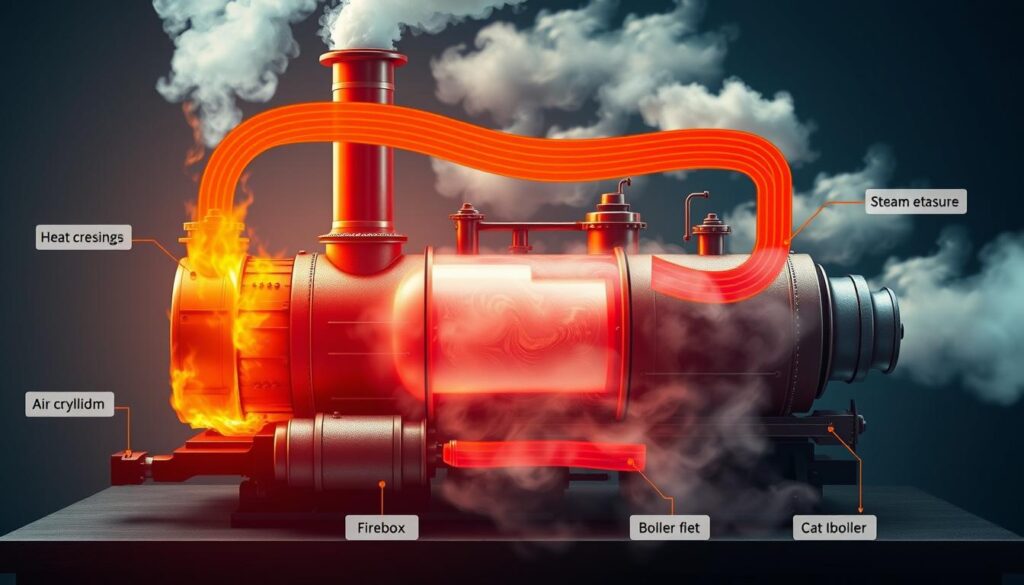
The journey starts in the firebox. This is where fuel burns, creating a lot of heat. The heat then moves to the next stage through convection and radiation.
In the boiler, water waits for heat. The heat makes the water boil and turn into steam. This is the engine’s power.
The steam then goes to the cylinder. Here, it expands and does work. The first law of thermodynamics shows how this works: QH – QL = Wnet,out.
But, the story isn’t complete without the condenser. This is where the steam cools down and turns back into water. A pump then sends it back to the boiler.
The engine’s efficiency is its final score. It’s how much work it does compared to the heat it uses. But, it’s always less than perfect, thanks to Carnot’s limit.
| Component | Role in the Cycle | Thermodynamic Function | The Analogy |
|---|---|---|---|
| Firebox | Hot Source (Heat Addition) | Provides high-temperature thermal energy (QH) via combustion. | Venture Capitalist |
| Boiler | Evaporator | Transfers heat to water, causing phase change to high-pressure steam. Dominated by latent heat and convection currents. | Startup Incubator |
| Cylinder/Turbine | Work Output | Converts thermal energy of steam into mechanical work (Wnet,out). | Public Offerings (IPO) |
| Condenser | Cold Sink (Heat Rejection) | Removes waste heat (QL), condensing steam back to liquid for reuse. | Administrative Overhead |
When you see a steam engine, think of the heat’s journey. It goes from being invested to doing work, then retires. It’s a cycle that shows the engine’s soul.
Hands‑On: Map heat paths with IR thermometer or wax crayons
Enough theory. Let’s get our hands dirty and actually see heat in motion. We’re not just reading diagrams; we’re making the invisible, visible. Forget the abstract equations for a moment—we’re going to be thermal detectives, mapping the secret highways and byways of heat flow. Think of it as forensic science for thermodynamics.
Your first, and most satisfying, tool is the humble infrared thermometer. That gadget you used to check foreheads a few years back? It’s your new best friend. Point it at different parts of a simple system—a boiling kettle on a stove, the side of a coffee mug, or a computer’s heat sink. You’ll see a thermal gradient in real-time: a hot spot, a cooler path, and the conductive journey in between. You’re not just measuring temperature; you’re mapping a story of energy transfer.
The Wax Crayon Chromatography Trick
No IR gun? No problem. You can conduct a stunningly simple, colorful experiment with a pack of children’s wax crayons. Here’s the alchemy:
- Take a metal plate or baking sheet (aluminum works great).
- Draw thick, bold stripes of different colored crayons along one edge.
- Apply gentle, even heat to the opposite edge with a hairdryer or by placing the plate on a warm (not hot) stovetop.
You’ll witness a slow-motion race. The heat conducts through the metal, and the waxes—each with a slightly different melting point—will melt in sequence. You’re not just watching heat; you’re watching it travel. The colorful, spreading melt zones create a literal heat map. Where the wax stays solid, you’ve found a thermal insulator in the metal’s structure or a point of poor conduction. Where it races ahead, you’ve found a thermal highway.
This isn’t a parlor trick. It’s a direct, visceral demonstration of the principles in Source 1, which discusses how temperature gradients form across materials with different conductive properties. The wax doesn’t lie. A slow-melting line indicates a thermal barrier or a change in material. A fast-melting front shows a path of low thermal resistance. You are, in effect, painting with physics.
Interpreting Your Thermal Map
So you’ve got your thermal image or your psychedelic wax masterpiece. What now? This is where analysis meets intuition.
The table below shows how to translate what you see into the language of thermal dynamics:
| What You See | What It Means (The Physics) | Real-World Implication |
|---|---|---|
| Sharp, distinct temperature bands | High thermal gradient; material is a poor conductor or there’s an air gap. | Indicates where you need better insulation or a thermal bridge. |
| Slow, even color change on wax | Uniform, predictable conduction through a consistent material. | Material is a good, uniform conductor (like a copper plate). |
| Sudden color change or “cold spot” | Likely a joint, a different material, or an air pocket disrupting heat flow. | Points to a design flaw or a possible point of failure (like a cold bridge in a window). |
| Wax melts in a direct, fast line | Excellent conductive path; heat is moving with minimal resistance. | Indicates an efficient thermal pathway, like a heat sink on a CPU. |
This isn’t just academic. Understanding these pathways is the difference between an engine that seizes and one that purrs, or a house that’s drafty versus one that’s cozy. You’re not just looking at heat; you’re seeing information. You’re seeing where energy is lost, where it flows, and where it gets stuck. It’s thermodynamics, stripped of its intimidating equations and presented in a rainbow of melting wax. So grab that crayon or that IR gun. The heat is trying to tell you a story. Are you listening?
Build a Simple “Copper Coil” Heat Exchanger Demo
The heat exchanger is key in thermodynamics, managing energy flow quietly. It doesn’t get the credit it deserves. You can learn about it with just copper tubing and curiosity.
This demo shows how two fluids at different temperatures exchange energy. Copper tubing is used because it’s a great conductor. Coil the tubing and put it in water. One side is hot, the other is cold.
But, in real life, thermal resistance makes things tough. A heat exchanger faces more than just metal and water. It also deals with air and mineral deposits on the pipe.
Building your own heat exchanger makes the science real. Here’s how to see it in action:
- Copper Tubing: The conductive highway for heat.
- Two Water Sources: A container of hot (not boiling) water and a source of cold tap water.
- Clear Tubing & Buckets: To direct and collect the water flow.
Coil the copper, immerse it in cold water, and run hot water through it. Your hands will feel the heat. The coil will warm the bath, while the cold bath cools it down.
This shows the magic of the heat exchanger. The rate at which the cold water warms up shows the rate of heat transfer. Try changing the hot water flow rate. See how it affects the cold bath’s temperature.
This simple coil teaches us a lot. It shows the first law of thermodynamics and the barriers to perfect efficiency. It’s a hands-on lesson in the ongoing battle between ideal physics and real-world challenges.
Graphing Temperature vs Time (Cooling and Heating Curves)
Forget cryptic equations for a moment. The most eloquent proof of latent heat‘s power is found not in a formula, but in a simple, plotted curve.
Imagine heating a beaker of ice water. You record the temperature every 30 seconds. Your naive expectation? A smooth, upward-sloping line. The reality is far more interesting.
The curve climbs as the ice warms, then—boom—it hits 0°C and goes flat. You’re pumping in heat, but the thermometer is stuck. This plateau isn’t a malfunction. It’s the energy doing deep, structural work: breaking the rigid bonds of the ice crystal lattice. This is the latent heat of fusion, holding the temperature hostage until every last bit of solid becomes liquid.
The climb resumes until 100°C. Then, another defiant flatline. Again, maximum heat input, zero temperature rise. Now, energy is fighting the molecular attraction of liquid water, turning it to vapor. This is the latent heat of vaporization, the real heavyweight.
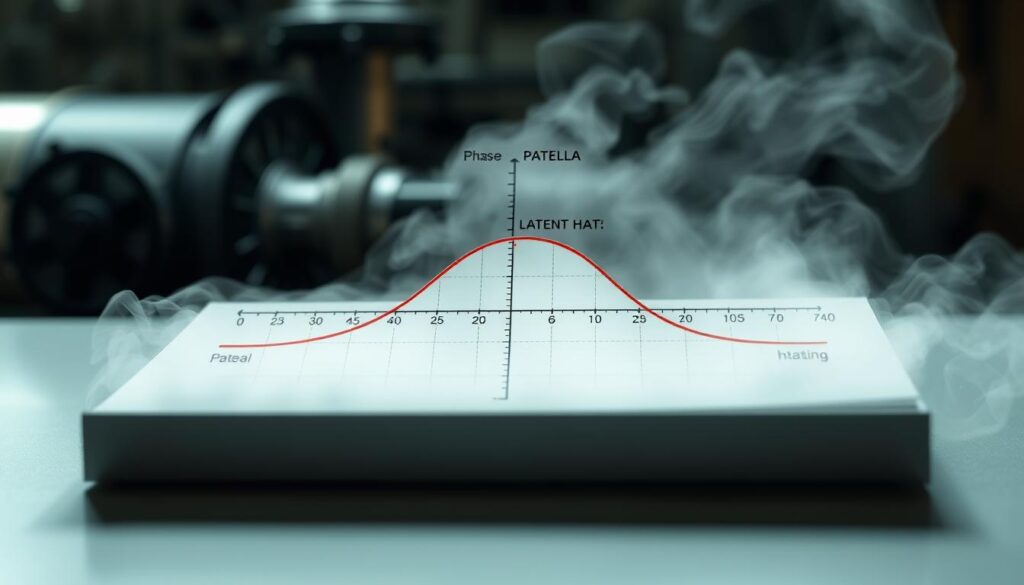
See that horizontal line? That’s where the magic—and the work—happens. It’s energy’s coffee break, where it’s busy changing the state of matter instead of raising the temperature.
Cooling condensing steam tells the same story in reverse. The temperature falls to 100°C and plateaus as vapor surrenders its hidden energy to become water. That released latent heat is what a steam engine’s condenser must manage.
This graphical signature is the fingerprint of phase change. In the elegant T-s diagram of a Rankine cycle, these plateaus become the critical horizontal segments. They visually map where the boiler is investing energy into creating steam and where the condenser is cashing that energy back out.
Reading these curves is like learning the body language of thermodynamics. The slopes show sensible heating. The flatlines shout latent heat at work. It’s the ultimate visual cheat sheet for understanding where energy is stored and released in any system, from your kitchen kettle to a thousand-horsepower locomotive.
So next time you see a temperature graph with a plateau, don’t think “error.” Think transformation. That’s the silent, powerful language of latent heat, written in the ink of time and temperature.
Efficiency Leaks: Insulation, soot, and scale
Think of a steam engine’s efficiency like a bucket with holes. The Second Law of Thermodynamics guarantees a big, fundamental leak we can’t fix. But then we drill a bunch of extra holes ourselves. In the real world, three mundane villains—poor insulation, soot, and scale—are the saboteurs at work, siphoning off precious thermal energy before it can be turned into useful work.
Imagine your beautifully designed heat exchanger—the boiler tubes, the firebox walls, the steam passages. Now, imagine them under a slow, insidious attack.
Let’s audit the three primary leaks in our thermal budget, the profit margins of the steam age.
The Insulation Failure: The Great Escape
Heat is a lazy traveler. It will take the path of least resistance. Uninsulated or poorly insulated boiler surfaces, steam pipes, and cylinders are like an open door for heat. This isn’t just lost energy; it’s wasted fuel and money. Good insulation isn’t a luxury; it’s a seal on your thermal vault.
Soot: The Velvet Insulator
That black, sooty film coating the firebox tubes? It’s not just dirty; it’s a disaster for efficiency. Soot is a fantastic insulator. A layer as thin as a credit card can dramatically reduce the heat transfer from the hot combustion gases to the boiler water. It’s like trying to warm your hands through a thick, fluffy blanket. You’re burning fuel, but the heat can’t get through the soot to do its job. This is a convection-to-conduction failure right at the critical interface.
Scale: The Silent Strangler
If soot is the problem on the fire side, scale is its evil twin on the water side. As water boils away, it leaves behind mineral deposits—lime, calcium, and other minerals—that cement themselves to the inside of your heat exchanger tubes. This scale is a terrible conductor. Just a few millimeters of this crust can be a more effective thermal barrier than a brick wall. To push the same amount of heat through this crust, the system needs higher steam pressure and a higher boiling point, which slashes overall efficiency. This is the “thermal resistance” engineers fight against.
The table below breaks down these “efficiency leaks” and their impact:
| Leak Source | Where It Strikes | How It Steals Efficiency | Practical Consequence |
|---|---|---|---|
| Poor Insulation | Boiler surfaces, steam lines, cylinders | Direct conductive and convective heat loss to the environment. | Higher fuel cost for same output; wasted fuel. |
| Soot Buildup | Fire-side of boiler tubes/plates | Acts as an insulating blanket, crippling heat transfer from flame to water. | Reduced steam production, higher fuel use, and increased emissions. |
| Mineral Scale | Water-side of boiler tubes and heat exchanger surfaces | Creates a thermal barrier, forcing higher pressures/temps for same output. | Higher fuel costs, risk of tube failure from overheating. |
So, while the Carnot limit defines the absolute ceiling, these real-world leaks determine how far below that ceiling you operate. A perfectly designed engine with a soot-coated, scaled-up boiler might only achieve a fraction of its boiling point. The battle for efficiency isn’t just won with better blueprints; it’s won with a wire brush, a water softener, and a good layer of modern insulation. The war against thermal waste is fought not in the drawing office, but in the soot and grime of maintenance.
Safety Checklist for Heat Experiments
The history of thermodynamics is filled with breakthroughs and sometimes, accidents. Let’s focus on the former. Working with heat is about informed respect. This checklist will protect you.
First, understand the risks. Steam isn’t just hot vapor. It carries latent heat, which can burn you if it touches your skin. A steam burn is like a sneaky attack.
Then, there’s pressure. Water in a sealed container can get too hot and build up pressure. This pressure can be dangerous. Always use a pressure relief valve to avoid accidents.
Hot metal is very good at conducting heat. Your favorite mug might be too hot to handle. Always check surfaces with a thermometer or a cautious tap.
Think about what happens after your experiment. Make sure it doesn’t damage your workbench or wiring. Properly manage your waste heat.
| Risk Factor | The Why (The Science) | The Guard (The Action) |
|---|---|---|
| Pressure Overload | In a sealed system, water’s boiling point rises with pressure. Exceed the vessel’s rating, and you’ve built a miniature boiler bomb. | Always use rated containers (e.g., pressure cookers for demos) with verified pressure relief valves. Never modify or block safety vents. |
| Steam & Hot Fluid Burns | Steam transfers latent heat upon condensation, causing deeper, severe burns faster than dry heat. | Wear long sleeves, gloves, and eye protection. Keep limbs and face away from steam exhaust ports and possible leak paths. |
| Hot Surface Contact | Metals like copper and aluminum conduct heat rapidly from the source to your fingers. | Use insulated gloves or tongs. Designate a “hot zone” with clear boundaries. Let equipment cool fully before handling. |
| Material Fatigue | Scale (mineral deposits) and corrosion weaken metal over time, lowering its failure point. This is the silent killer of old equipment. | Inspect used or homemade gear for rust, pitting, or heavy scaling. When in doubt, retire it. It’s not vintage; it’s volatile. |
| Waste Heat & Fire | Your experiment’s exhaust or heated base needs a safe sink. Directing it onto wood or plastic is an invitation. | Use a metal tray, stone slab, or firebrick as a base. Have a fire extinguisher (Class ABC) nearby and know how to use it. |
Gear up. Think it through. Then marvel safely at the power you’re harnessing. The goal is enlightenment, not evacuation. Now, with the garage intact, let’s test what you’ve learned.
Quiz & Worksheet with answer key
Think you know about heat? Let’s see if you’ve been paying attention. Grab a pencil. No cheating.
Question 1: You’re designing a boiler for a model steam engine. Why is a copper coil in the firebox better than just running the fire around a water tank? Think about conduction and convection.
Question 2: Why does a steam scald at 100°C hurt more than boiling water at the same temperature? What concept explains this?
Question 3: You’re brewing coffee at a mountain cabin. Why does your water boil at 95°C instead of 100°C? What does this have to do with a steam engine’s boiler pressure?
Question 4: Sketch a simple shell-and-tube heat exchanger for a model engine’s condenser. Explain why the steam’s latent heat is key in this phase change.
Answer Key:
1. Copper is great at conduction, moving thermal energy directly into the water. A design relying on hot air is inefficient. The coil maximizes conductive surface area for faster energy transfer.
2. The extra zing is due to latent heat of vaporization. Steam at 100°C has the energy it took to vaporize the water. It dumps this energy into your skin upon condensation.
3. Lower atmospheric pressure at altitude lowers the boiling point. This is why steam engine boilers are pressurized. They raise the boiling point and superheat the steam, packing more energy into the cylinder.
4. The sketch should show hot steam from the engine entering tubes surrounded by a coolant. The magic is in the latent heat release. As steam condenses back to water in the tubes, it releases its latent energy to the coolant. The heat exchanger is all about managing these phase changes.
