
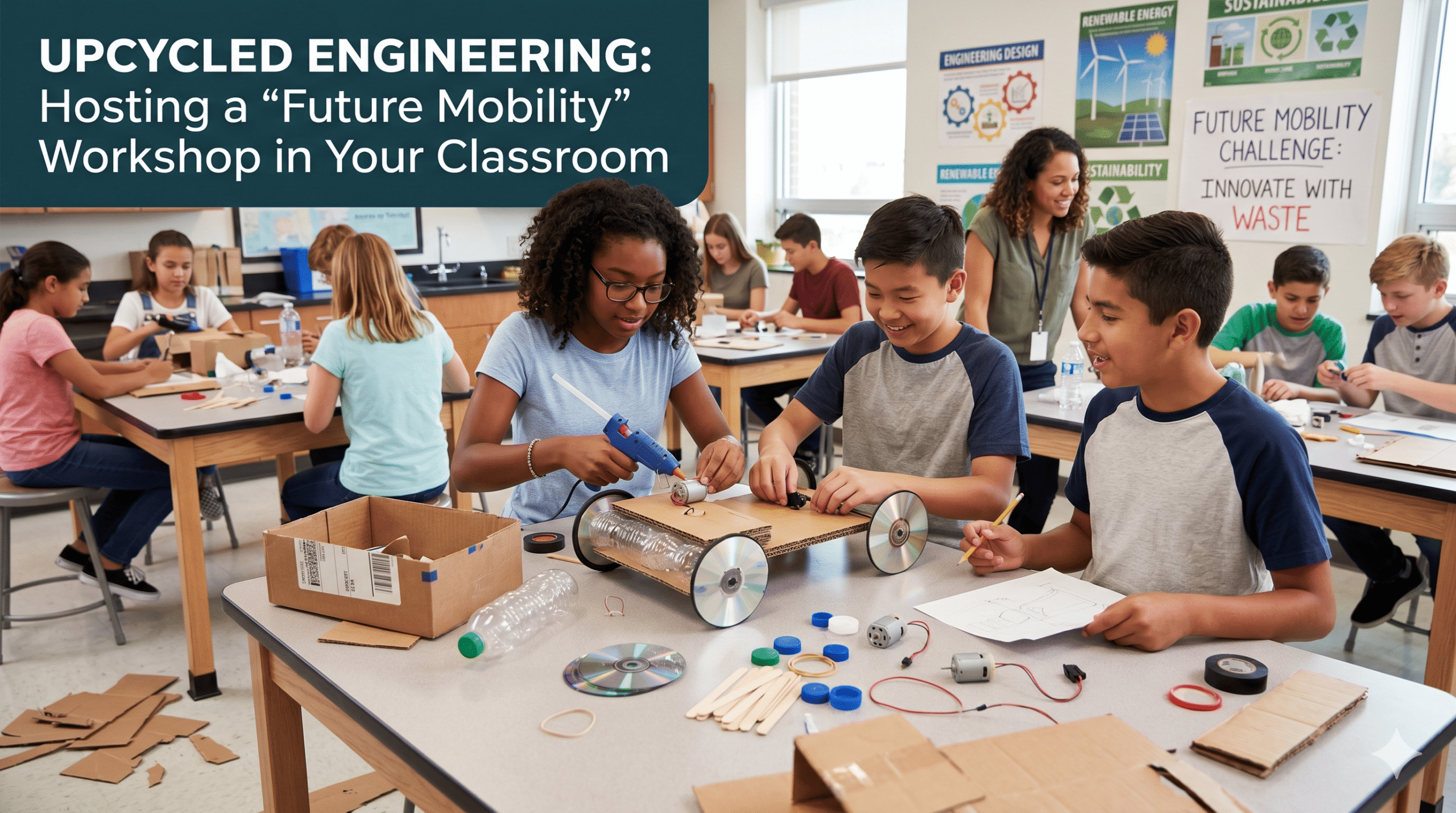
The intersection of environmental consciousness and mechanical design is the frontier of modern education. As educators, our goal is to move beyond simply teaching students how things work, pushing them to consider how things should work in a resource-constrained world. A “Future Mobility” workshop challenges students to think like sustainable engineers. By utilizing upcycled materials—discarded cardboard, plastic bottles, old CDs, and repurposed toy motors—students can explore the fundamentals of kinetic energy, aerodynamics, and structural integrity without the need for expensive kits. This hands-on approach forces creative problem-solving, teaching young innovators that waste is simply a resource that has not yet been reimagined.
Integrating Sustainability Into Mechanical Design
Teaching sustainable mechanical design requires a fundamental shift in how we approach the engineering process. Rather than starting with pristine, purpose-built components, students must analyze the raw properties of recovered materials and adapt their designs accordingly. This constraint breeds deep innovation. When a student is forced to use a bottle cap as a wheel or a bent paperclip as an axle, they are actively engaging in complex material science and friction analysis.
This pedagogical methodology aligns seamlessly with the Next Generation Science Standards by emphasizing engineering design, energy transfer, and the human impact on the environment. Students must calculate the weight-to-power ratio of their upcycled vehicles, understanding that heavier recycled materials require more energy to achieve forward motion. Whether they are utilizing simple rubber band tension, balloon-powered air pressure, or basic electrical circuits, the underlying physics remains rigorous. The workshop setting transforms theoretical physics into a tangible challenge where students can physically see the cost of friction and the distinct benefits of an aerodynamic profile.
Comprehensive Lesson Plan and Execution
Structuring the workshop effectively ensures that the inherent chaos of building translates into measurable, standards-aligned learning outcomes. The following framework outlines a highly structured, fast-paced environment that keeps students engaged from the initial concept generation to the final test drive.
| Phase | Duration | Focus Area | Educator Action |
| 1. Engage and Introduce | 15 Minutes | Concept & Constraints | Present the “Future Mobility” challenge. Display the available upcycled materials and define the specific success criteria (e.g., distance traveled, straight-line stability). |
| 2. Ideate and Draft | 20 Minutes | Blueprinting | Require students to sketch their vehicle designs before touching physical materials. Emphasize the importance of planning axles, chassis stability, and the power source. |
| 3. Prototyping Build | 45 Minutes | Hands-On Engineering | Facilitate the building process. Actively guide students through problem-solving issues like misaligned axles, excess weight, or insufficient power transfer. |
| 4. Testing and Iteration | 25 Minutes | Performance Analysis | Run the vehicles on a designated classroom test track. Have students measure distance, record structural failures, and make rapid adjustments to improve performance. |
| 5. Synthesis and Debrief | 15 Minutes | Conceptual Review | Lead a discussion on why certain designs succeeded. Focus on the direct relationship between material choices, friction, and kinetic energy. |
Setting Up Prototyping Stations
To manage the classroom effectively and mimic a true manufacturing environment, educators should organize the room into distinct, role-specific stations. A “Chassis and Body” station can house heavy corrugated cardboard, rigid plastic containers, and safe cutting tools. An “Axle and Wheel” station should contain wooden dowels, bamboo skewers, CDs, bottle caps, and supervised hot glue zones. Finally, a “Power and Propulsion” station provides rubber bands, balloons, and small DC motors.
Segmenting the room forces students to think modularly about their vehicles while maintaining strict safety protocols around tools and adhesives. They must collaborate with peers at different stations, ensuring their propulsion system will actually fit the chassis they are building across the room. Just as we focus on aesthetic engineering when building beautiful steam-powered projects, students must ensure that their distinct, upcycled modules come together to form a cohesive, functional, and visually intentional final product.
Evaluating Upcycled Innovation
Evaluating a project built from reclaimed materials requires a nuanced approach that values the iterative process as much as the final mechanical product. A vehicle that barely moves but demonstrates a highly complex, well-documented engineering attempt should often score higher than a simple, flawless design that took zero risks. By implementing established project-based learning strategies, educators can accurately assess the depth of student understanding rather than just the final aesthetic output.
| Assessment Pillar | Key Criteria | Exemplary Indicators |
| Functional Engineering | Reliability & Kinetic Transfer | The vehicle successfully translates stored energy into forward motion. Axles rotate freely with minimal friction; the chassis supports the propulsion system without buckling. |
| Resource Optimization | Creative Material Use | The student demonstrates ingenuity in repurposing materials. Waste is minimized, and the structural properties of the upcycled items are maximized for the design. |
| Process Documentation | Iterative Reflection | The student provides a clear blueprint, logs test track failures, and documents the specific adjustments made to improve the vehicle’s final physical performance. |
By utilizing this robust evaluation framework, educators validate the authentic struggle of the engineering process. Hosting a Future Mobility workshop proves to students that the tools to build the future are already in their hands, waiting to be engineered into something extraordinary.
